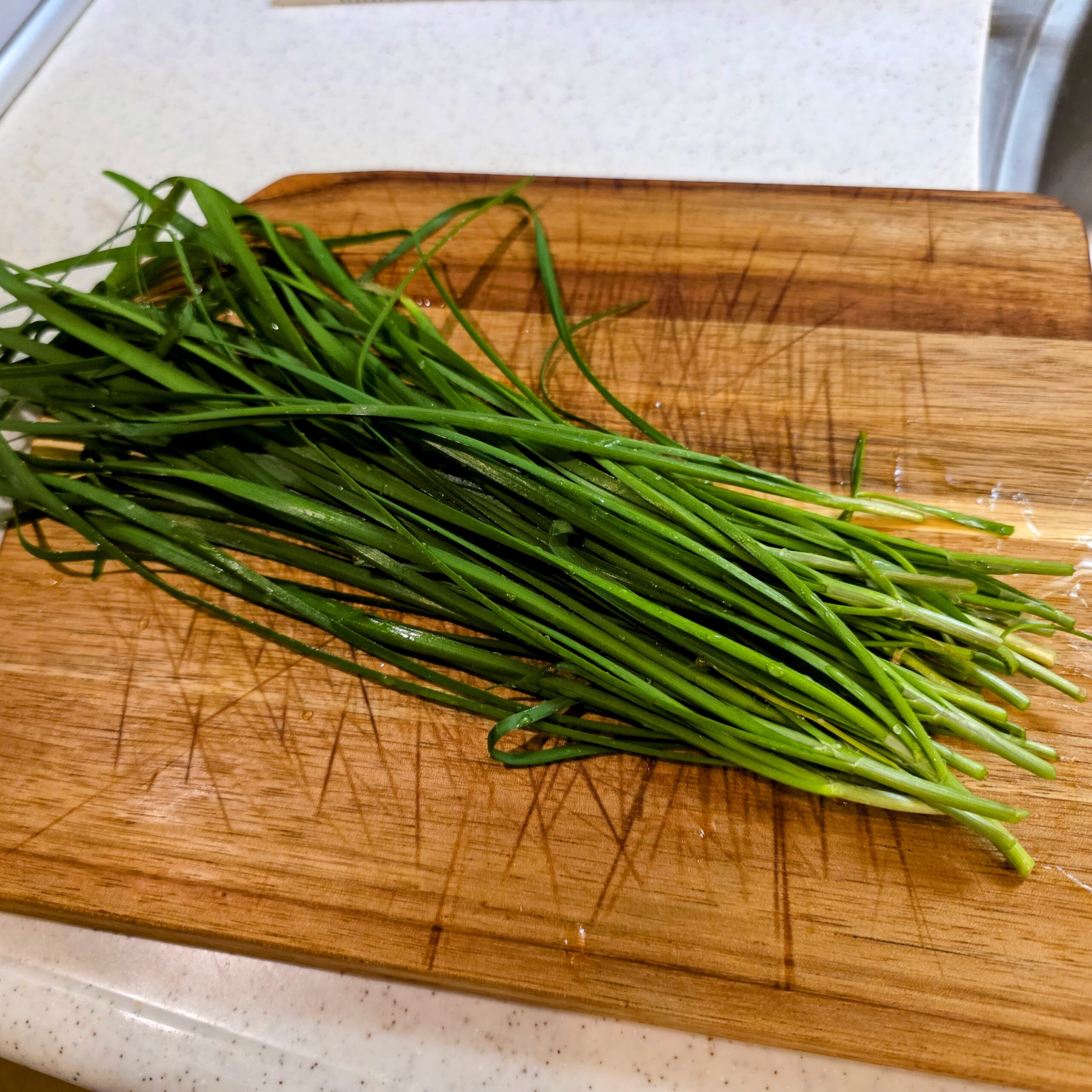
When cutting Chinese chive (Allium tuberosum), the tip, middle, and pale basal portion can seem to smell slightly different. The important point is to separate a kitchen observation from what experiments have actually demonstrated.
The characteristic aroma of Chinese chive is dominated by sulfur-containing volatile compounds. In Allium plants, tissue disruption allows sulfur precursors and enzymes such as alliinase to interact, rapidly generating new aroma compounds. Cutting is therefore not just preparation; it initiates chemistry.
Research supports organ-level differences
A 2024 Horticulturae study analyzed volatile compounds in different organs and developmental stages of two Chinese chive cultivars using HS-SPME/GC-MS. Total volatile content and sulfur-compound profiles differed among leaves, pseudostems, and roots.
This supports the statement that every part of a Chinese chive plant does not have an identical volatile profile. It does not, however, directly prove a specific tip-versus-middle-versus-basal gradient within a single leaf.
Why cutting makes the smell appear
A 2010 Food Chemistry study characterized sulfur volatiles generated from crushed Chinese chive leaves. Tissue damage brings previously separated substrates and enzymes together, creating the familiar sharp aroma. More extensive cutting can therefore alter aroma generation, although precise culinary effects depend on cutting size, time, temperature, and tissue condition.
Heating changes the chemistry again
Many aroma compounds are volatile, and aroma-forming enzymes lose activity with heat. Cooking can therefore reduce some freshly generated compounds while creating or emphasizing other aromas. “Heating removes the smell” is too simple a description.
A kitchen test is an observation, not a controlled experiment
Comparing tip, middle, and basal pieces before and after heating is a useful way to notice plant chemistry. But human smell is subjective, and the pieces differ in water content, thickness, and cut surface area. The scientifically supported conclusion is narrower: Chinese chive organs differ in their volatile profiles, and tissue disruption triggers sulfur-aroma chemistry.
For related context, see A DNA Marker for “Orange-Like” Flavor Could Accelerate HLB-Tolerant Citrus Breeding.
For related context, see Volatiles from Damaged Camellia Leaves Reduced Herbivore Damage in Neighboring Branches.
For related context, see Bonito Stock Plus Intense Red Light Turns Euglena Red—Through Chloroplast Loss and Carotenoid Persistence.
References
- Chen M et al. Distribution Pattern of Volatile Components in Different Organs of Chinese Chives (Allium tuberosum). Horticulturae. 2024;10:1201. https://doi.org/10.3390/horticulturae10111201
- Yabuki Y et al. Characterisation of volatile sulphur-containing compounds generated in crushed leaves of Chinese chive. Food Chemistry. 2010;120:343–348. https://doi.org/10.1016/j.foodchem.2009.11.028
- Yoshimoto N, Saito K. S-Alk(en)ylcysteine sulfoxides in the genus Allium. Phytochemistry. 2019;167:112078. https://doi.org/10.1016/j.phytochem.2019.112078
Comments