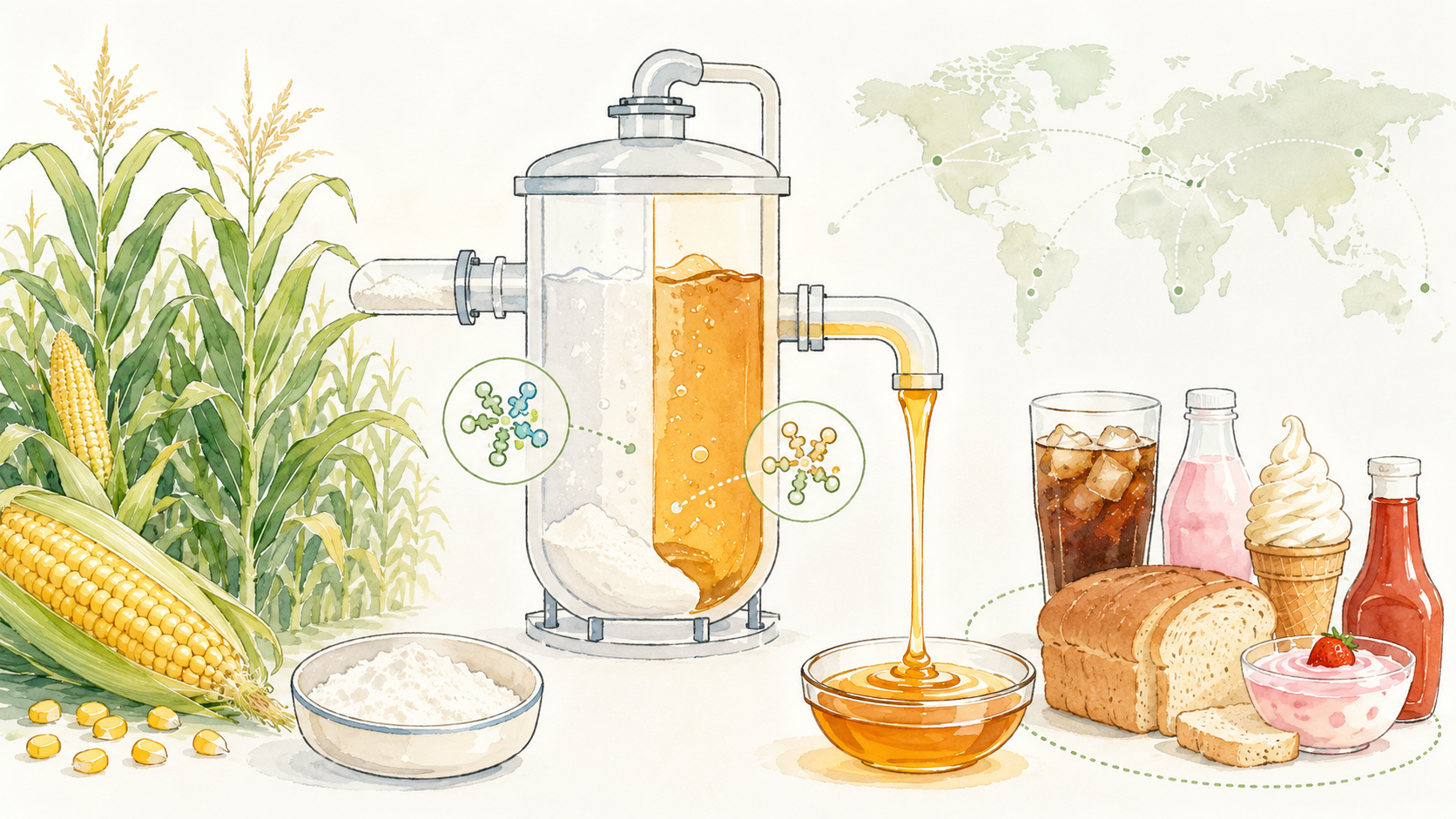
High-fructose corn syrup is often discussed mainly as a nutrition controversy. Technologically, however, it is also a major example of industrial biotechnology: plant starch, microbial enzymes, separation technology, and continuous processing combined at enormous scale.
From plant starch to a liquid sweetener
Starch from crops such as corn is hydrolyzed with enzymes including alpha-amylase and glucoamylase to produce glucose. Glucose isomerase then converts part of that glucose into fructose. The fructose proportion can be adjusted for different food applications.
This process became commercially important because immobilized enzymes can be reused continuously, allowing consistent large-scale production for beverages, frozen foods, condiments, and other products.
Two different health questions are often mixed together
The first question is whether high intake of free sugars and sugar-sweetened beverages is harmful. Evidence supports an association between high intake and increased cardiometabolic risk, and WHO recommends keeping free sugars below 10% of total energy intake.
The second question is whether HFCS is uniquely harmful compared with sucrose at comparable energy intake. A 2022 systematic review and meta-analysis of four studies with 767 participants found no clear differences for weight, BMI, blood glucose, lipids, or blood pressure, although CRP was slightly higher with HFCS. The evidence base was limited.
A 2025 systematic review focused narrowly on adult human evidence for liver injury and glucose metabolism found only one study that met its criteria, highlighting how little direct long-term evidence exists for HFCS-specific effects.
The most defensible conclusion is therefore neither “HFCS is harmless” nor “HFCS alone is toxic.” Total intake of added/free sugars and excess energy remains the more practical dietary issue.
Industrial success and nutritional value are different questions
HFCS is technically useful because it is liquid, easy to meter into continuous production lines, resistant to crystallization, and well suited to cold beverages. Those manufacturing advantages do not imply that high intake is nutritionally desirable.
It is best understood as both a successful plant-based bioprocess and a component of a food environment in which sweet products became easier and cheaper to manufacture at scale.
For related context, see Where Alternative Proteins Stand in 2026: Comparing Plant-Based, Microbial, Insect and Cultivated Meat.
For related context, see Chia Seed Research in 2026: Mucilage, ALA, Crop Science—and the Limits of Health Claims.
For related context, see Why Were Canadian Canola, Wheat and Peas Lower-Carbon? Production Conditions Can Outweigh Food Miles.
References
- Li X et al. The effect of high-fructose corn syrup vs. sucrose on anthropometric and metabolic parameters: A systematic review and meta-analysis. Front Nutr. 2022;9:1013310. https://doi.org/10.3389/fnut.2022.1013310
- The impact of high fructose corn syrup on liver injury and glucose metabolism: a systematic review. 2025.
- World Health Organization. Guideline: sugars intake for adults and children.


Comments