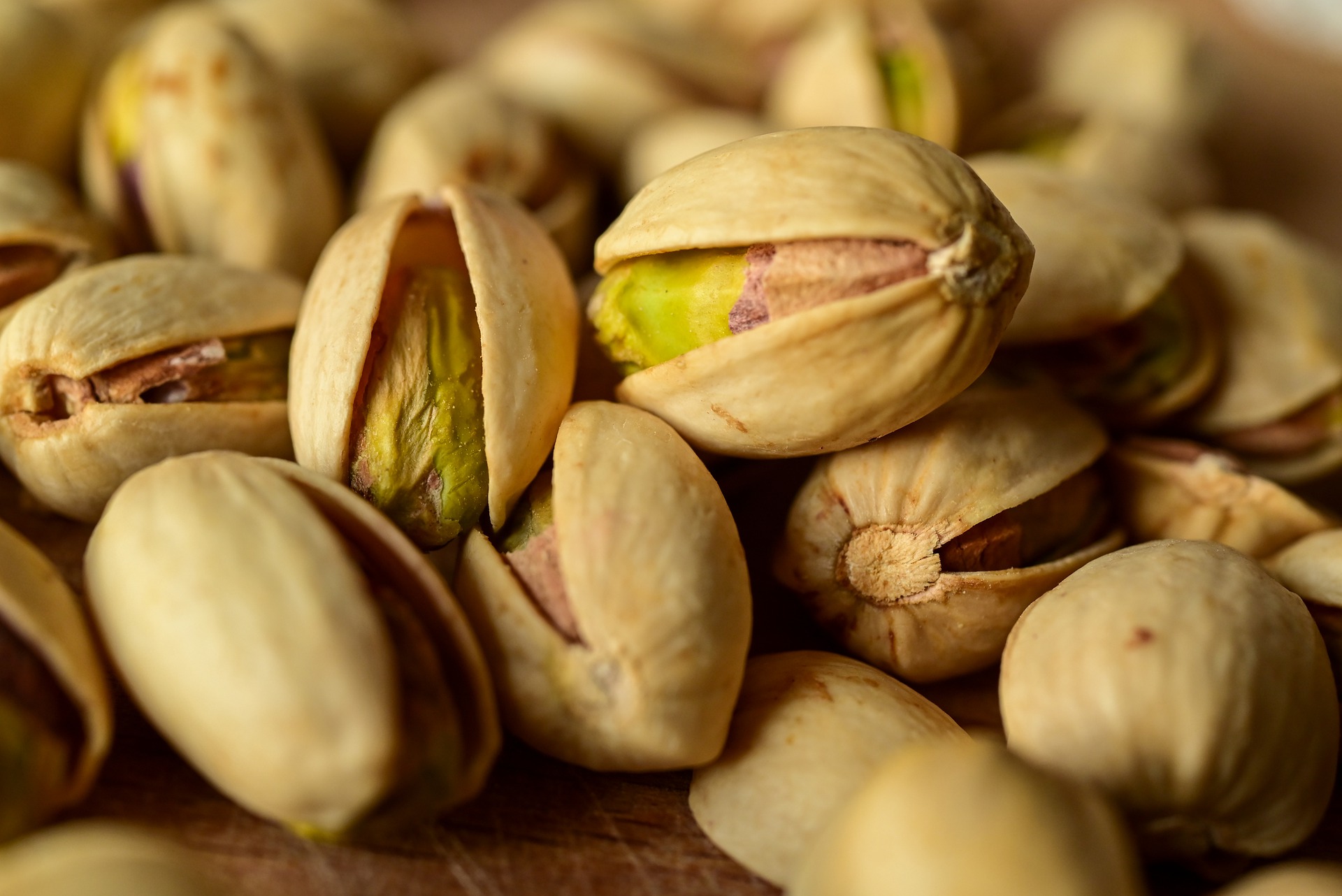
Pistachio processing generates large quantities of soft fruit hulls. A 2023 Scientific Reports study extracted essential oil (EO) from hulls of the Iranian ‘Ahmad-Aghaei’ cultivar and measured its chemical composition, antioxidant activity, and antimicrobial properties.
The oil showed biological activity in laboratory assays. But one important correction is needed: its antibacterial effect against Staphylococcus aureus and Bacillus subtilis was much weaker than the streptomycin and penicillin comparators. The original article does not support describing pistachio hull EO as a superior natural antibiotic.
GC-MS showed an alpha-pinene-rich oil

The essential-oil yield was 0.59%. GC-MS identified 19 compounds, with alpha-pinene (47.36%), terpinolene (10.57%), limonene (9.13%), L-bornyl acetate (8.57%), camphene (7.3%) and beta-pinene (5.39%) among the major constituents.
Essential-oil profiles can change with cultivar, maturity, geography and extraction conditions, so this composition should not be generalized to every pistachio hull.
Antioxidant activity was measured with a chemical assay
The study used the DPPH radical-scavenging assay. Scavenging increased with essential-oil concentration. This is an in-vitro chemical antioxidant test, not evidence that consuming the oil produces a clinical antioxidant benefit in humans.
Antibacterial activity was real—but weaker than antibiotics
MIC and MBC assays showed activity against S. aureus and B. subtilis. However, the paper explicitly reports substantially lower inhibitory activity than the antibiotic comparators.
That leaves open a possible role as a food-preservation or materials ingredient, but real products would need testing in food matrices, sensory analysis, stability, toxicology and realistic exposure conditions.
The antifungal result against Aspergillus flavus is interesting
The oil also inhibited Aspergillus flavus, and the measured activity was comparable to fluconazole under some assay conditions. This is relevant because A. flavus and aflatoxin contamination are major concerns in pistachio production.
Still, inhibition on laboratory media does not prove that the oil can safely control aflatoxin contamination in harvested pistachios. Postharvest trials and residue/safety data would be required.
A by-product valorization study, not a health supplement trial
The strongest interpretation of this paper is that pistachio hull waste contains a chemically interesting essential oil with potential for further materials, food-preservation or agricultural research. The authors themselves call for additional testing.
Eating pistachio kernels and being exposed to concentrated hull essential oil are also very different situations. Human-health or cosmetic claims require separate safety and clinical evidence.
For related context, see How Different Are the Phytochemicals of 20 Salvia Species? Chemometrics as a Screening Tool, Not a Treatment Guide.
For related context, see Can Hazelnut Seed Skins Become Food Ingredients? Polyphenols, Antimicrobial Activity and Allergen Caveats.
For related context, see Tea Polysaccharides Help Form Chitosan Nanoparticles That Suppress Rice Pathogens In Vitro and on Detached Leaves.
Reference
- Shahdadi F et al. GC-MS profiling of Pistachio vera L., and effect of antioxidant and antimicrobial compounds of its essential oil compared to chemical counterparts. Scientific Reports. 2023;13:21694. https://doi.org/10.1038/s41598-023-48844-5

Comments