Claims that “electricity makes plants grow” range from controlled bioelectrochemistry experiments to social-media gardening tricks involving copper rods. Those are not the same intervention.
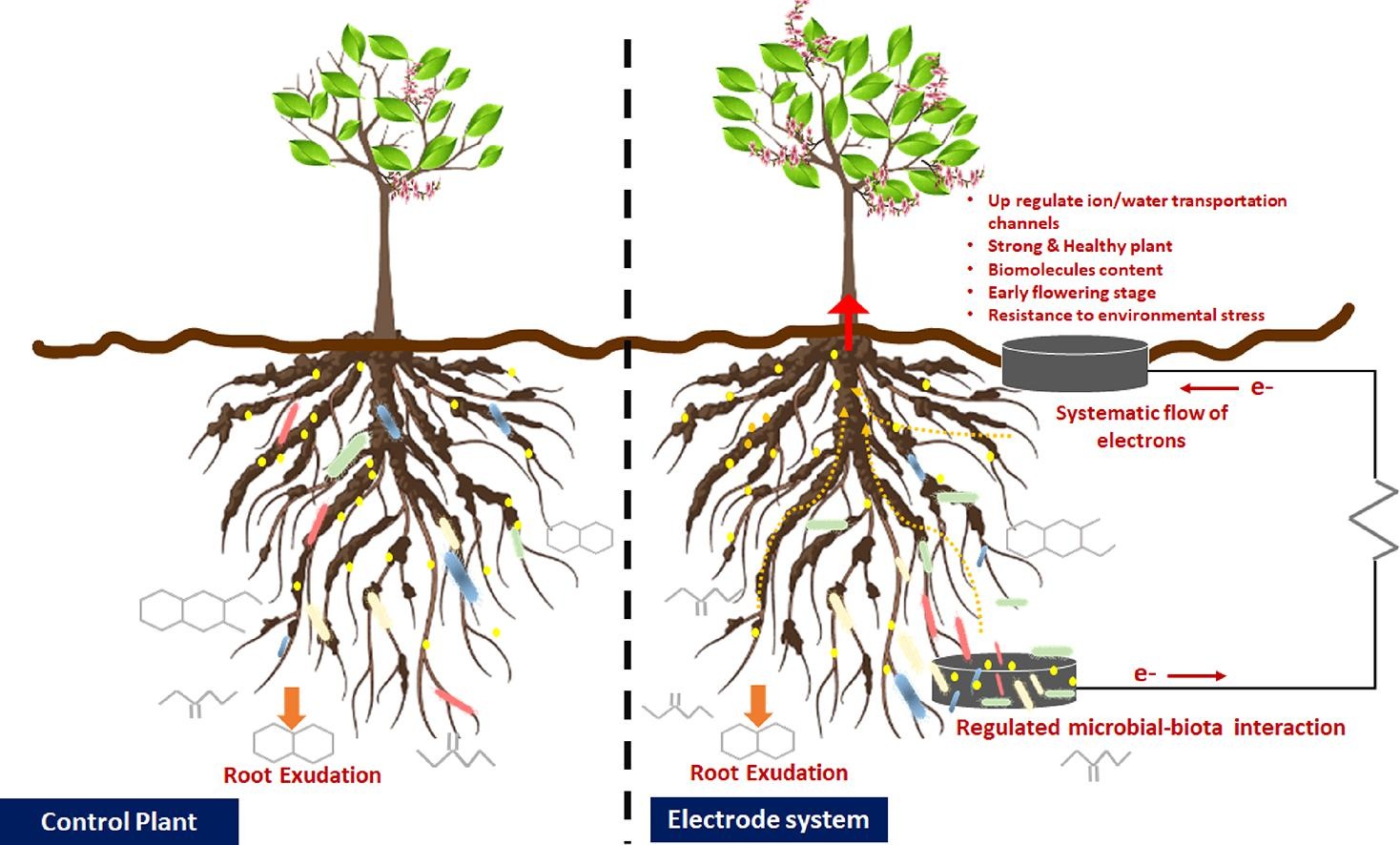
A 2023 Bioelectrochemistry study placed electrode assemblies in the rhizosphere of mung bean (Vigna radiata) and chickpea (Cicer arietinum) and compared different circuit configurations. Under a closed-circuit condition, the plants showed changes in growth, photosynthetic performance and gene expression.
Later work continued to find physiological responses to controlled electric fields, while a 2025 PLOS ONE experiment found that passive copper-rod “electroculture” did not reliably improve yield in home container gardening.
The 2023 experiment used rhizosphere biopotentials

The original study compared closed-circuit, open-circuit and short-circuit configurations with controls. The setup was designed around low self-induced biopotentials generated in the plant–rhizosphere system rather than simply forcing a large external current through plants.
The closed-circuit treatment improved several root, shoot and biomass measures, accelerated flowering and pod formation, and was associated with higher root aquaporin gene expression. Control plants required about ten additional days to mature compared with the closed-circuit condition.
These are interesting results, but the experiment involved two plant species in controlled pot systems. It does not establish that the same response will occur in every crop or field soil.
Controlled electric fields also affect Arabidopsis
A 2025 Bioelectrochemistry study investigated controlled electric fields in Arabidopsis thaliana. The authors reported increased water and mineral uptake, changes in electric charge within plant tissues and increased auxin accumulation associated with enhanced growth and development.
The same literature also emphasizes inconsistent responses among previous studies. Field strength, treatment duration, electrode geometry, substrate, species and developmental stage all matter.
Passive copper-rod electroculture is a different claim
In 2025, a PLOS ONE study tested the social-media practice of inserting copper or copper-wrapped rods into home container gardens. It did not find general evidence that the passive method increased vegetable yield. The authors noted that voltages generated by such passive setups are not equivalent to the controlled active electrical treatments used in experimental studies.
So evidence that a defined electric field can alter plant physiology should not be used as proof that any commercial or DIY “electroculture” device works.
The agricultural question is reproducibility
For an electrical treatment to become an agricultural technology, it has to work across cultivars, soils and seasons, scale to field conditions, and produce enough value to justify electrodes, power and maintenance. Long-term effects on yield quality and soil processes also have to be measured.
As of 2026, the evidence supports a careful conclusion: controlled electrical treatments can alter plant physiology and sometimes improve growth under defined conditions, but there is no general rule that electricity automatically increases crop yield.
For related context, see eSoil Increased Barley Seedling Dry Weight by 50% at Day 15—but It Is Not Yet a Proven Crop-Yield Technology.
For related context, see Tomato HY5 Links Light, Electrical Signaling and a Jasmonate Burst During Root-Knot Nematode Defense.
For related context, see Do Magnetic and Electric Fields Improve Soybean Germination? A Four-Cultivar Study Found Inconsistent Effects.
References
- Venkata Mohan S, Yeruva DK. In situ self-induced electrical stimulation to plants. Bioelectrochemistry. 2023;154:108550. https://doi.org/10.1016/j.bioelechem.2023.108550
- Electrocultivation of Arabidopsis thaliana increases water and mineral absorption, electric charge and auxin accumulation, enhancing growth and development. Bioelectrochemistry. 2025;163:108893. https://doi.org/10.1016/j.bioelechem.2024.108893
- Chier M et al. Passive electroculture using copper rods does not improve yield in home container vegetable gardening. PLOS ONE. 2025;20:e0329615. https://doi.org/10.1371/journal.pone.0329615
Comments