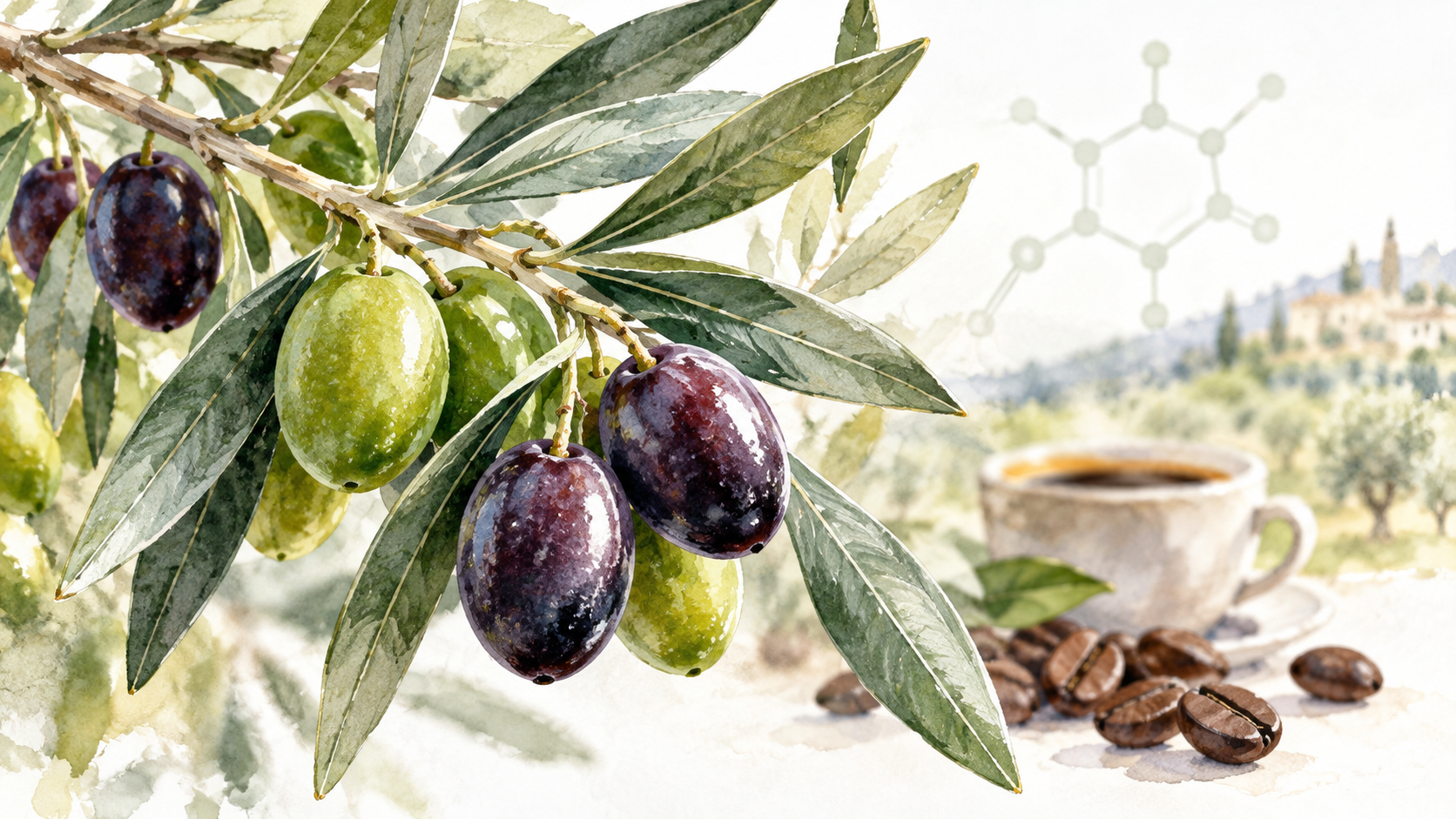
Caffeine is familiar as the compound in coffee and tea that helps keep us awake. But what happens when a plant receives a tiny amount of caffeine in its irrigation water?
A 2026 study in Horticulturae reported that low-dose caffeine treatment of olive trees (Olea europaea) was associated with a 21% increase in leaf net photosynthesis, along with changes in fruit coloration, oil accumulation, and phenolic compounds.
An intriguing detail: isotope-labelled caffeine was detected in roots, but not in leaves or fruits. How might treatment at the roots relate to responses elsewhere in the plant?
To answer this carefully, we distinguish the findings in the journal article from numbers presented in an apparently overlapping conference report—and separate observations from proposed mechanisms.
- From wastewater contaminant to a possible plant biostimulant
- The experiment: 52 days at 14 µg/L
- Photosynthesis increased—but transpiration nearly doubled
- Fruit coloration, oil accumulation, and ABA also changed
- A striking phenolic response: oleuropein about 3.5-fold
- Caffeine was detected in roots, not leaves or fruits
- Can the effect be generalized to other plants?
- Conclusion: a tool for investigating secondary metabolism?
- References
From wastewater contaminant to a possible plant biostimulant
Caffeine is an alkaloid naturally produced by coffee and some other plants. It is also found in wastewater because of widespread human consumption. Where treated wastewater is reused for irrigation, understanding how trace organic contaminants affect crops matters.
In a 2026 Acta Horticulturae conference paper, the research team presented caffeine-treated olive trees as a model for evaluating organic contaminants in irrigation water. The Horticulturae article explores physiological and fruit-related outcomes in a study with strongly overlapping conditions.
Importantly, the experiments used a carefully controlled caffeine solution—not brewed coffee, coffee grounds, or untreated sewage.
The experiment: 52 days at 14 µg/L
According to the conference report, olive cultivar ‘Leccino’, grafted onto ‘Canino’ rootstock, was grown in 9.5 L pots in a greenhouse. Trees received either control water or caffeine-containing water daily for 52 days.
The concentration was 0.014 mg/L, equivalent to 14 µg/L. Researchers used trimethyl-^13C-labelled caffeine to track the added compound within plant tissues.
These experimental details are explicitly documented in the conference report. We could not independently audit the complete methods and supplementary data of the later Horticulturae paper, so not every final methodological detail has been cross-checked. Neither report establishes an optimal dose across concentrations or demonstrates field-scale effectiveness.
Photosynthesis increased—but transpiration nearly doubled
The main changes reported in the Horticulturae abstract were:
| Variable | Change relative to control |
|---|---|
| Leaf net photosynthetic rate | +21% |
| Stomatal conductance | +44% |
| Transpiration rate | +95% |
| Fruit pigmentation index | +8.8% |
| Fruit oil accumulation | +14% |
| Fruit abscisic acid (ABA) | +44.2% |
Higher net photosynthesis indicates greater carbon assimilation under the measurement conditions. Greater stomatal conductance is consistent with enhanced gas exchange.
Yet the rise in transpiration far exceeded the rise in photosynthesis. The percentage changes alone are insufficient to calculate water-use efficiency rigorously, but they do not support any claim that caffeine made water use more efficient. This is a particularly relevant trade-off for olive cultivation in water-limited regions.
Fruit coloration, oil accumulation, and ABA also changed
The pigmentation index was 8.8% higher in treated fruits. Olive color changes during maturation, so this is consistent with an altered ripening state.
Fruit oil accumulation was reported to be 14% higher, and ABA—an important hormone in stress responses and fruit development—was 44.2% higher.
However, the study does not establish whether elevated ABA caused the apparent change in ripening or resulted from another physiological process. Nor does 14% higher oil accumulation in fruit establish a 14% increase in total harvest or extracted olive-oil output per tree. These are distinct measurements.
A striking phenolic response: oleuropein about 3.5-fold
The apparently related Acta Horticulturae report gives individual fruit-phenolic changes:
| Compound measured in olive fruit | Increase versus control |
|---|---|
| Oleuropein | +249.3% (about 3.5-fold) |
| Verbascoside | +188.5% (about 2.9-fold) |
| Ligstroside | +100.2% |
| Hydroxytyrosol | +59.9% |
| Chlorogenic acid | +42.0% |
| Rutin | +35.0% |
Source note: These compound-specific percentages come from the 2026 Acta Horticulturae conference report. They have not been verified against all final figures and tables in the later Horticulturae article. Overlapping cultivar, treatment duration, isotope tracer, and outcomes mean these reports cannot be treated as two independent replications.
Why is the oleuropein result especially interesting?
A separate 2022 study tracked ‘Leccino’ olive fruits across ripening stages and reported that oleuropein declined as fruits matured.
In the caffeine-treated olives, a higher pigmentation index was instead observed alongside a very large increase in oleuropein. This makes the result more interesting than simply saying that caffeine “accelerated ripening.”
However, the studies differed in growth conditions and analytical methods, and their fruits were not compared at strictly matched maturity. Therefore, it would be premature to conclude that caffeine directly boosted oleuropein biosynthesis. Slower breakdown, altered storage, transport, or other developmental effects could contribute.
Phenolics in whole olive fruits are not equivalent to phenolics in extracted olive oil. The study does not establish a comparable increase in the final oil or any human-health benefit.
Caffeine was detected in roots, not leaves or fruits
According to the conference report, labelled caffeine was found in roots at 1.62 ng per gram of fresh weight, but was not detected in leaves or fruits.
Not detected is not the same as absent. Levels below the detection limit, or movement of compounds produced after caffeine metabolism, cannot be excluded solely from this observation.
Root-level responses could conceivably affect other organs through hormones or systemic signals. But the pathway, molecular targets, and causal mechanism have not been identified. The results also do not prove that increased photosynthesis caused the observed changes in fruit composition.
The key observation is a response involving different organs. The mechanism remains a hypothesis.
Can the effect be generalized to other plants?
In 2024, the same group investigated caffeine, zinc, and their combination in tomatoes, reporting changes in some fruit-production and antioxidant-related measurements. But crop species, treatment dose, timing, and other inputs can strongly affect responses.
The olive experiment discussed here involved one cultivar in greenhouse pots for a limited period. Field replication, dose-response curves, multi-year studies, tree-level yield, irrigation efficiency, and the quality of extracted oil remain open questions.
It is therefore not evidence that pouring coffee or adding coffee grounds benefits garden plants.
Conclusion: a tool for investigating secondary metabolism?
At low concentration, caffeine treatment was associated with greater net photosynthesis and changes in olive fruit pigmentation, oil accumulation, and phenolic composition. At the same time, sharply higher transpiration raises questions about practical agronomic costs.
Most intriguing are the connection between labelled caffeine detected at the roots and physiological responses in aerial organs, and the increase in oleuropein alongside more advanced coloration.
Caffeine may offer a way to probe and perhaps eventually modulate plant metabolism, but its mechanism and agricultural utility remain unresolved.
References
- Vichi E, Francini A, Sebastiani L. (2026). From Photosynthesis to Polyphenols: Caffeine Enhances Fruit Quality, Ripening, and Secondary Metabolism in Olive (Olea europaea L.) cv. ‘Leccino’. Horticulturae 12(10), 1268. DOI: 10.3390/horticulturae12101268
- Vichi E, Francini A, Raffaelli A, Sebastiani L. (2026). Caffeine uptake and degradation in olive tree (Olea europaea L.): a model for studying organic contaminants in irrigation water. Acta Horticulturae 1446, 243–250. DOI: 10.17660/ActaHortic.2026.1446.33
- Effect of Ripening on the Phenolic and Sugar Contents in the Meso- and Epicarp of Olive Fruits (Olea europaea L.) Cultivar ‘Leccino’. (2022). Agriculture 12(9), 1347. DOI: 10.3390/agriculture12091347
- Effects of Caffeine, Zinc, and Their Combined Treatments on the Growth, Yield, Mineral Elements, and Polyphenols of Solanum lycopersicum L. (2024). Antioxidants 13(9), 1100. DOI: 10.3390/antiox13091100
Verification note: The publicly available primary-article abstract was checked against the related conference report and other studies. The complete final figures, supplementary materials, and statistical analyses in the Horticulturae paper were not fully audited. We explicitly distinguish source-specific numbers from unverified interpretations.

Comments