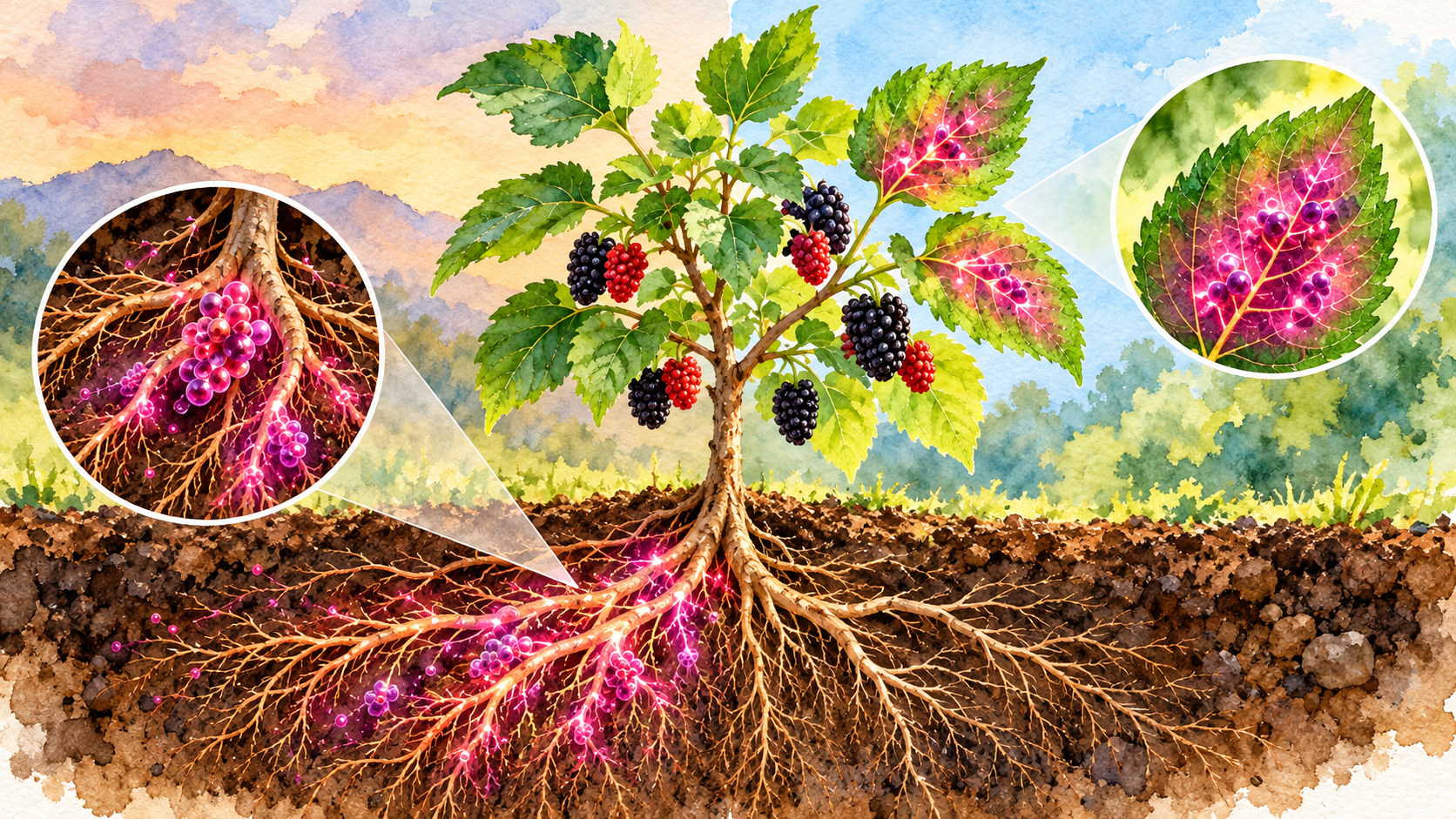
Plants do not manufacture their valuable compounds uniformly throughout their bodies. Many specialized metabolites are produced or accumulate predominantly in roots, leaves, fruits, or particular cell types. For anyone hoping to use these compounds as natural-product ingredients, where a plant makes them may matter almost as much as how much it makes.
What if a compound normally produced mainly in roots could also be synthesized in leaves? In principle, this could reduce the need to harvest underground organs and make biomass production and recovery more convenient.
A study published in Plant Physiology on October 22, 2026, offers an important molecular starting point. By overexpressing the transcription factor MnWRKY22 in mulberry leaves, researchers activated a group of stilbene synthase genes normally expressed most strongly in roots and callus tissue—and induced de novo resveratrol biosynthesis in leaves.
- Why mulberry roots are rich in stilbenoids
- MnWRKY22: one regulator for a cluster of STS genes
- Changing the production site, not necessarily the transport machinery
- What is genuinely new compared with earlier studies?
- When would leaf-based production be practical?
- Conclusion: engineering where plants manufacture compounds
- References
Why mulberry roots are rich in stilbenoids
Resveratrol belongs to the stilbenoids, a group of plant specialized metabolites synthesized through stilbene synthase (STS). It has roles in plant defense and is being studied for potential uses in foods and pharmaceuticals. The new study does not establish any human health benefit.
In a separate 2025 study, researchers used LC–MS to compare roots, stems, and leaves of Morus notabilis. Under the conditions tested, resveratrol and oxyresveratrol were detected in roots but not in stems or leaves.
That distinction matters: not detected under these conditions does not mean that leaves are inherently incapable of making the compounds. Environmental conditions and gene regulation can alter metabolite profiles.
The tissue measurements can be found in Figure 2 of Hu et al. (2025). That article is published under CC BY 4.0. Rather than reproducing its figure in this article, we link to the original source.
MnWRKY22: one regulator for a cluster of STS genes
Mulberry has 10 MnSTS genes, nine of which are arranged as tandem repeats in one genomic region. Earlier work in 2016 had already described the evolutionary expansion and arrangement of this gene family.
In the 2026 study, Xia and colleagues analyzed tissue-associated expression patterns and used weighted gene co-expression network analysis (WGCNA) to identify MnWRKY22 as a candidate regulator. The published abstract reports several lines of functional evidence:
- MnWRKY22 is expressed preferentially in roots and callus tissue.
- It directly binds W-box elements in the promoters of all MnSTS genes and activates their transcription.
- Reducing MnWRKY22 expression decreases MnSTS transcript abundance and resveratrol accumulation.
- Overexpressing MnWRKY22 increases MnSTS expression and resveratrol production.
- Overexpression in leaves activates normally low-expressed MnSTS genes and enables new resveratrol synthesis in leaf tissue.
The key point is not that multiple foreign biosynthetic enzymes were introduced. The researchers manipulated a native transcriptional regulator of enzymes that mulberry already possesses.
A major qualification remains: we could verify the 2026 article’s official abstract, but not its complete figures, supplementary results, or full methodology. The abstract alone does not establish the absolute leaf yield, the fold increase, whether the leaf assay used stable or transient expression, or long-term effects on plant growth.
Changing the production site, not necessarily the transport machinery
An intriguing application of this work is relocating biosynthesis to a tissue that is easier to harvest, without necessarily engineering metabolite transport itself.
In some plants, molecules synthesized in one tissue move to another for storage. Imagine a compound normally synthesized in roots and accumulated in leaves. If it could instead be made directly in leaves and retained there, the production system might become simpler. This is an application scenario, not something demonstrated by the mulberry study.
The mulberry example is more direct: if a compound is normally made and accumulated mainly in roots, enabling leaf biosynthesis might eventually allow repeated leaf harvest instead of destructive root harvest. That could be valuable for perennial species whose leaves can be collected several times.
However, synthesizing a metabolite in a new location is not the same as storing it there at a useful level. Precursors, competing pathways, degradation, toxicity, and sequestration within cells can all impose limits.
The MnWRKY22 study demonstrates inducible leaf biosynthesis. It does not demonstrate an engineered transport route, sustained leaf storage at commercial yields, or a validated production crop.
What is genuinely new compared with earlier studies?
It would be inaccurate to call this the first time resveratrol has been produced in leaves.
In 2006, lettuce transformed with an STS gene from another plant was shown to synthesize resveratrol in its leaves. In 2016, the mulberry STS family was characterized, and UV-C exposure was reported to trigger oxyresveratrol accumulation in mulberry leaves.
The new contribution is the identification and functional validation of MnWRKY22 as a native transcription factor that coordinately activates mulberry’s own STS gene family and can induce biosynthesis outside its usual high-expression tissues.
A related example comes from the medicinal plant Scutellaria baicalensis. In 2023, overexpression of transcription factors SbMYB45 and SbMYB86.1 was reported to increase baicalin accumulation in leaves. Together, such studies support a broader idea: the locations of plant specialized-metabolite production are, at least in some cases, amenable to regulatory engineering.
When would leaf-based production be practical?
Producing a detectable compound in leaves is not enough to establish a manufacturing platform. A simplified estimate of annual recoverable yield is:
Annual recovered product ≈ biomass per harvest × compound concentration × extraction/recovery efficiency × harvests per year
Even if leaves contain less of the target compound than roots, high leaf biomass and repeated harvesting might make them competitive. Conversely, a higher concentration is of limited value if plants grow poorly or the compound is expensive to extract.
Because MnWRKY22 is a transcription factor, effects on genes beyond the STS family also deserve study. Tissue-specific or inducible expression systems might eventually help balance growth and production. These are future engineering strategies, not methods validated by the 2026 paper.
The same distinction applies to medicinal plants. Producing a specified active compound in leaves does not automatically make those leaves interchangeable with root material defined by pharmacopoeial standards. Purified compound production and the substitution of an officially recognized crude drug are different objectives.
Conclusion: engineering where plants manufacture compounds
The key discovery in Xia and colleagues’ paper is that MnWRKY22 coordinately regulates the MnSTS gene family, helping explain the tissue specificity of resveratrol biosynthesis in mulberry. Modifying that regulation can turn on resveratrol synthesis in leaves.
The wider possibility is compelling: manufacture a desired compound in an accessible organ and, where feasible, accumulate it there—rather than accepting the plant’s usual anatomical constraints as fixed.
Plant metabolic engineering may increasingly be about not just what a plant can produce, but where it can be made to produce it. This study adds a promising example, while leaving the important questions of yield, stability, and scale-up open.
References
- Xia X, et al. (2026). MnWRKY22 Mediates Tissue-Specific Resveratrol Biosynthesis through Coordinated Regulation of the Stilbene Synthase Gene Cluster in Mulberry. Plant Physiology. DOI: 10.1093/plphys/kiag778.
- Hu M-W, et al. (2025). Functional characterization of key enzymes involved in the biosynthesis of distinctive flavonoids and stilbenoids in Morus notabilis. Horticulture Research 12: uhaf171. DOI: 10.1093/hr/uhaf171.
- Li H, et al. (2016). Evolutionary and functional analysis of mulberry type III polyketide synthases. BMC Genomics 17: 540. DOI: 10.1186/s12864-016-2843-7.
- Liu S, et al. (2006). High Content of Resveratrol in Lettuce Transformed with a Stilbene Synthase Gene of Parthenocissus henryana. Journal of Agricultural and Food Chemistry 54: 8082–8085. DOI: 10.1021/jf061462k.
- Fang S, et al. (2023). The transcription factors SbMYB45 and SbMYB86.1 regulate flavone biosynthesis in Scutellaria baicalensis. Plant Physiology and Biochemistry. DOI: 10.1016/j.plaphy.2023.107794.
Verification note: The official abstract of Xia et al. (2026) and the cited earlier studies were cross-checked. We have not independently reviewed the full text, all figures, or the supplementary materials of the 2026 paper; consequently, quantitative yields and practical outcomes not supported by the abstract have not been asserted. The featured watercolor illustration is an original conceptual visualization of possible production-site changes.

Comments