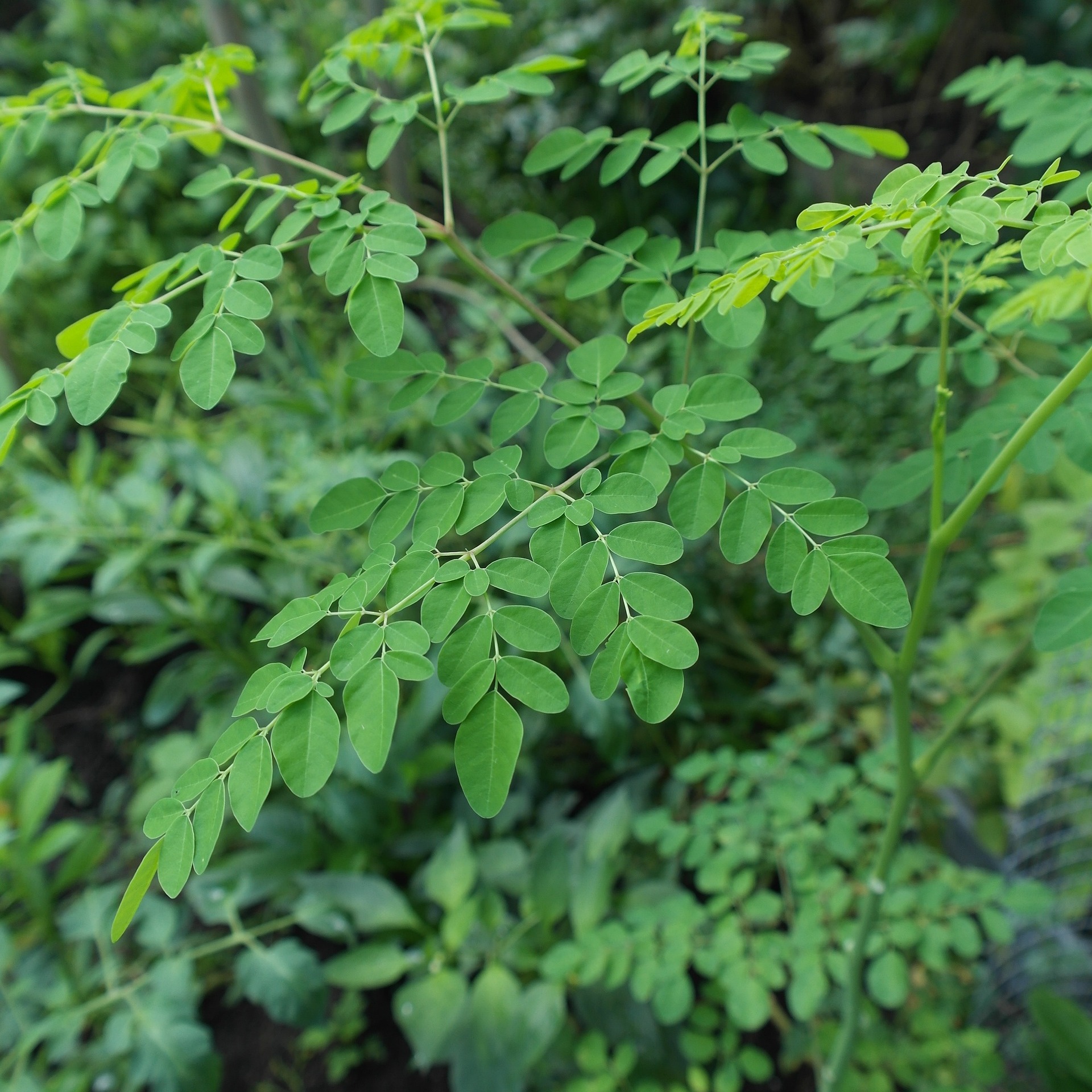
Moringa (Moringa oleifera) leaf extract produced calcium- and phosphate-rich deposits on dentin and cementum in a 2023 Scientific Reports study. That makes it an interesting candidate for biomimetic dental materials.
But the experiment did not show that moringa treats sensitive teeth in patients. It was an in-vitro study using extracted human premolars kept in artificial saliva. The distinction matters.
What the researchers actually tested

The study used 80 sound premolars. Forty were used for coronal dentin tests and forty for acellular cementum tests. Samples were assigned to native control, fluoride varnish, or varnish containing moringa leaf extract at 50 or 200 mg/mL. After surface treatment, the specimens were stored in artificial saliva at 37°C for 14 days.
Scanning electron microscopy (SEM) and energy-dispersive X-ray spectroscopy (EDX) were then used to evaluate surface morphology and calcium/phosphate deposition. The outcomes were material and surface measurements—not patient pain scores, long-term durability, or prevention of dental disease.
Dentin showed mineral-like surface deposition

Moringa-treated dentin showed a relatively continuous deposited layer and substantial coverage of dentinal-tubule openings. EDX measurements also showed increased calcium and phosphate.
Increasing extract concentration from 50 to 200 mg/mL did not produce a clear concentration-dependent increase in calcium and phosphate on coronal dentin, so the result should not be simplified to “more extract is always better.”
Cementum also showed increased deposition

On acellular cementum, the higher-concentration group showed greater calcium and phosphate deposition, with material covering grooves and microfissures. The different concentration responses in dentin and cementum are part of what makes the study mechanistically interesting.
The authors discussed minerals, polyphenols, flavonoids and collagen interactions as possible contributors. The study did not isolate each compound and prove its individual role.
Why this is not yet evidence for treating hypersensitivity
Dentin hypersensitivity is associated with fluid movement through exposed dentinal tubules, so materials that occlude tubules can be plausible treatment candidates. The SEM images therefore justify further research.
However, no hypersensitivity patients were treated in this experiment. The strongest conclusion is that moringa extract produced remineralization-like mineral deposition and tubule occlusion under controlled in-vitro conditions.
Other dental studies have explored moringa for different purposes. A randomized clinical study of moringa as a dentin crosslinking pretreatment did not find statistically significant differences in major clinical outcomes at 12 months, and a 2026 in-vivo study investigated moringa gel in pulp repair after pulpotomy. These are separate indications and should not be treated as direct confirmation of hypersensitivity treatment.
Food, toothpaste and experimental dental material are different exposures
The study used concentrated extract—50 to 200 mg/mL—formulated in varnish. It does not show that eating moringa or using an ordinary moringa-containing toothpaste reproduces the same effect.
Before such a material could become a routine clinical product, researchers would need standardized composition, safety testing, durability data, comparisons with established desensitizing/remineralizing materials, and patient trials.
For related context, see Carbon Quantum Dots Made from Hibiscus Leaves: Promising In-Vitro Scratch Assays, Not Yet a Wound Treatment.
For related context, see How Different Are the Phytochemicals of 20 Salvia Species? Chemometrics as a Screening Tool, Not a Treatment Guide.
For related context, see Can Hazelnut Seed Skins Become Food Ingredients? Polyphenols, Antimicrobial Activity and Allergen Caveats.
References
- Obeid RF, Ammar MM, Younis SH. Dentinomimetics and cementomimetics of Moringa oleifera leaves extract. Scientific Reports. 2023;13:19243. https://doi.org/10.1038/s41598-023-46656-1
- Clinical Assessment of Moringa oleifera as a Natural Crosslinker for Enhanced Dentin Bond Durability: A Randomized Controlled Trial. 2023. https://pmc.ncbi.nlm.nih.gov/articles/PMC10616685/
- Effect of Moringa oleifera leaf extract gel on pulp repair following pulpotomy: an in-vivo study. Scientific Reports. 2026. https://doi.org/10.1038/s41598-026-41452-z

Comments