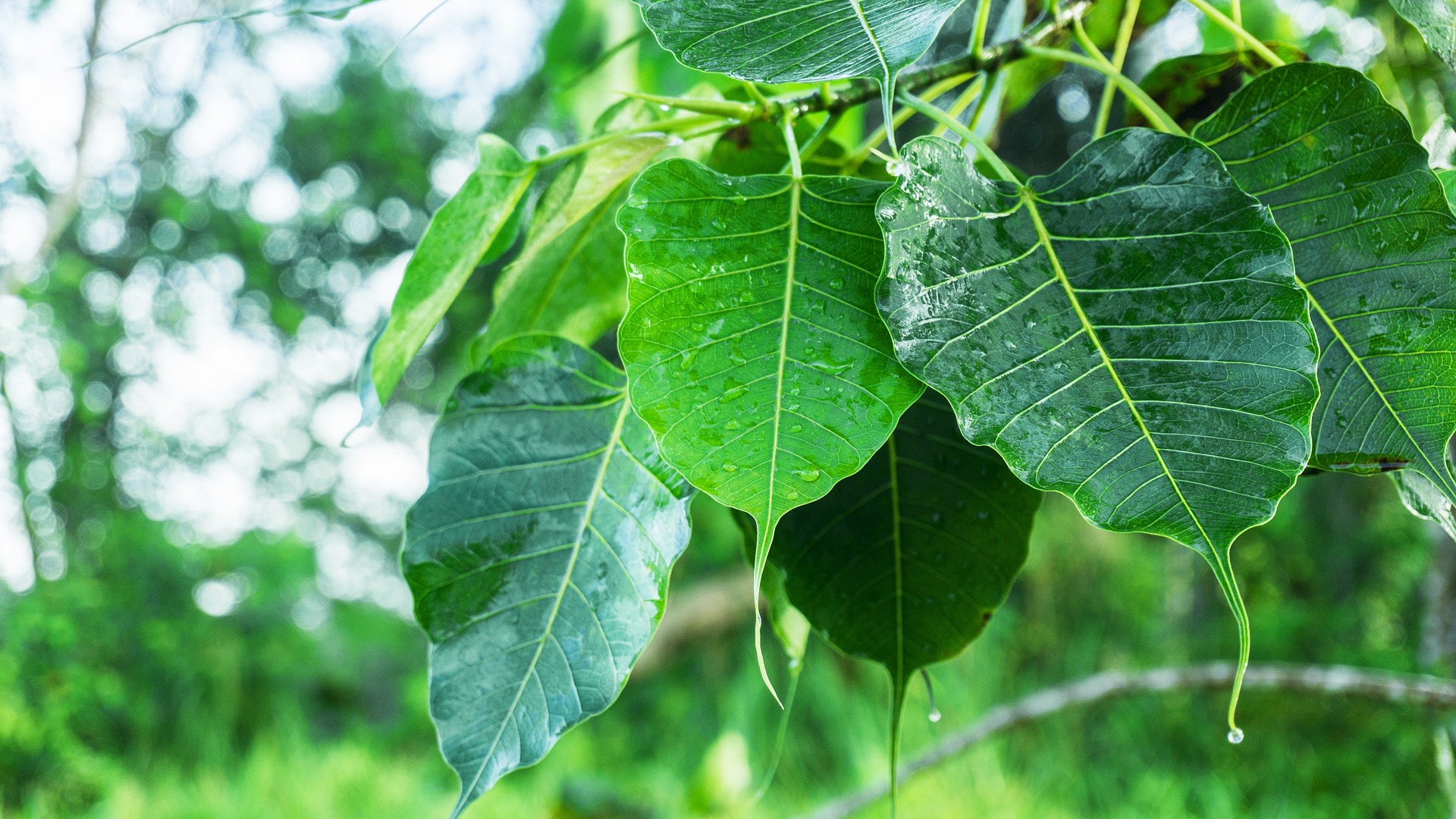
The long drip tip of Ficus religiosa (the bodhi tree) is an effective water-shedding structure. A 2023 Nature Communications study translated its reverse curvature and long tail into an engineered drip-irrigation emitter.
From leaf geometry to flow mechanics


Artificial PET leaves showed that reverse curvature controls convergence of water streams, while the long tail moves the droplet separation centroid beyond the apex and helps break contact-line pinning. An optimized reverse-curvature ratio near 0.618 was used in the biomimetic design.
BLAM produced smaller droplets at higher frequency

The Bodhi-Leaf-Apex-Mimetic (BLAM) emitter generated smaller, more frequent droplets and was tested on sandy soil with wheat, cotton, maize and other seedlings. A greenhouse pitcher plant was also maintained for more than a year using the system.
Large-scale field efficiency is still unproven

The work is primarily a prototype and controlled-experiment study. The authors explicitly identify large-scale field validation as future work.
Real irrigation performance will depend on pressure variation, clogging, soil type, wind, maintenance, manufacturing cost and system-scale water-use efficiency. The paper therefore does not yet justify a commercial water-saving percentage or cost-reduction claim.
Its strongest contribution is mechanistic biomimetics: it links a natural leaf geometry to a physical drainage mechanism and then to an engineering parameter.
For related context, see A Fog Harvester Inspired by Bushman Grass and Namib Beetles Reached 42% Collection Efficiency.
For related context, see A Fog-Harvesting Grass Creates ‘Fog-Plant-Oases’ That Fuel an Aboveground Food Web in the Namib Desert.
For related context, see Mud Cracks Can Help a Salt Marsh Recover: Physical Self-Organization in China’s Red Beach.
Reference
- Liu S et al. Efficient agricultural drip irrigation inspired by fig leaf morphology. Nature Communications. 2023;14:5934. https://doi.org/10.1038/s41467-023-41673-0
Comments