Biostimulants are often associated with seaweed extracts, humic substances, amino acids, or microbes. Japan’s Ministry of Agriculture, Forestry and Fisheries, however, does not define the category simply by whether an ingredient is natural. Its 2025 guideline focuses on claimed effects, evidence, use information, and safety.
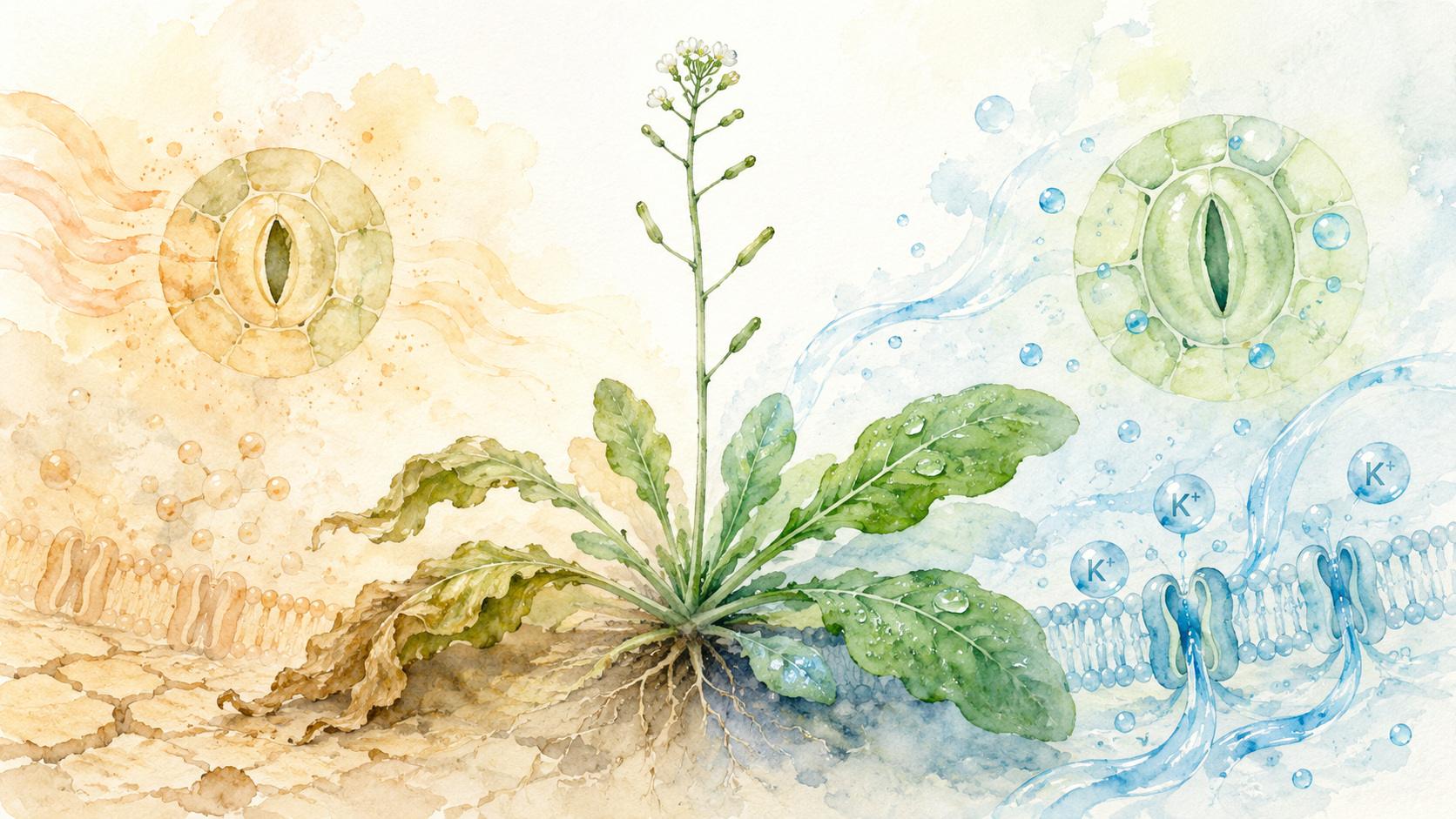
A 2026 Nature Communications study illustrates a more targeted direction. Researchers screened small molecules against KAT1, an inward-rectifying potassium channel in Arabidopsis guard cells, then optimized a compound that promoted stomatal closure and improved survival under experimental drought.
From screening natural materials to choosing a molecular target first
Guard cells take up K+ during stomatal opening. The researchers reasoned that inhibiting a key K+ channel could make stomata harder to open. They screened 135 ion-channel-active compounds, identified NS5806, and developed the stronger derivative UA49.
This resembles pharmacology: identify a target protein, screen compounds, optimize chemical structure, and test the physiological outcome.
Drought protection was demonstrated in Arabidopsis
NS5806 and UA49 altered guard-cell K+ behavior, promoted stomatal closure, and caused leaf-temperature changes consistent with reduced transpiration. Treated 17-day-old Arabidopsis plants also showed improved recovery after a 13-day water-withholding experiment.
That does not establish a field-ready crop product. Effects on crop yield, treatment timing, residue, environmental safety, and long-term gas exchange remain open questions. Stomata are both water-loss pores and CO2 entry points.
Regulatory classification is not automatic
Japan’s MAFF issued its biostimulant labeling guideline on May 30, 2025 and continued implementation discussions in 2026. A synthetic molecule may fit some biostimulant concepts, but a compound that directly modifies plant physiology can also intersect with plant-growth-regulator or pesticide regulation depending on claims and mode of action.
UA49 should therefore be described as a research-stage candidate that challenges the boundary between biostimulants and targeted plant regulators — not as an approved commercial biostimulant.
Toward ‘plant drug discovery’
Plants contain thousands of receptors, ion channels, transporters, and enzymes that could become targets for drought tolerance, nutrient efficiency, or other traits. If target-based small-molecule discovery matures, agricultural-input development may increasingly resemble drug discovery.
For related context, see When a Phytotoxin Promotes Growth: Fusicoccin Activates the Guard-Cell H+-ATPase–14-3-3 System.
For related context, see Upper and Lower Leaf Stomata Use Different K⁺ Channel Compositions for Light-Induced Opening.
For related context, see Bacteria Make the Plant Hormone IAA Too: Auxin as a Plant–Microbe Communication Signal.
References
- Synthetic ion channel inhibitors enhance plant drought tolerance. Nature Communications. 2026.
- Japan MAFF. Guideline on labeling and related matters for biostimulants. May 30, 2025.
- Regulation (EU) 2019/1009.

Comments