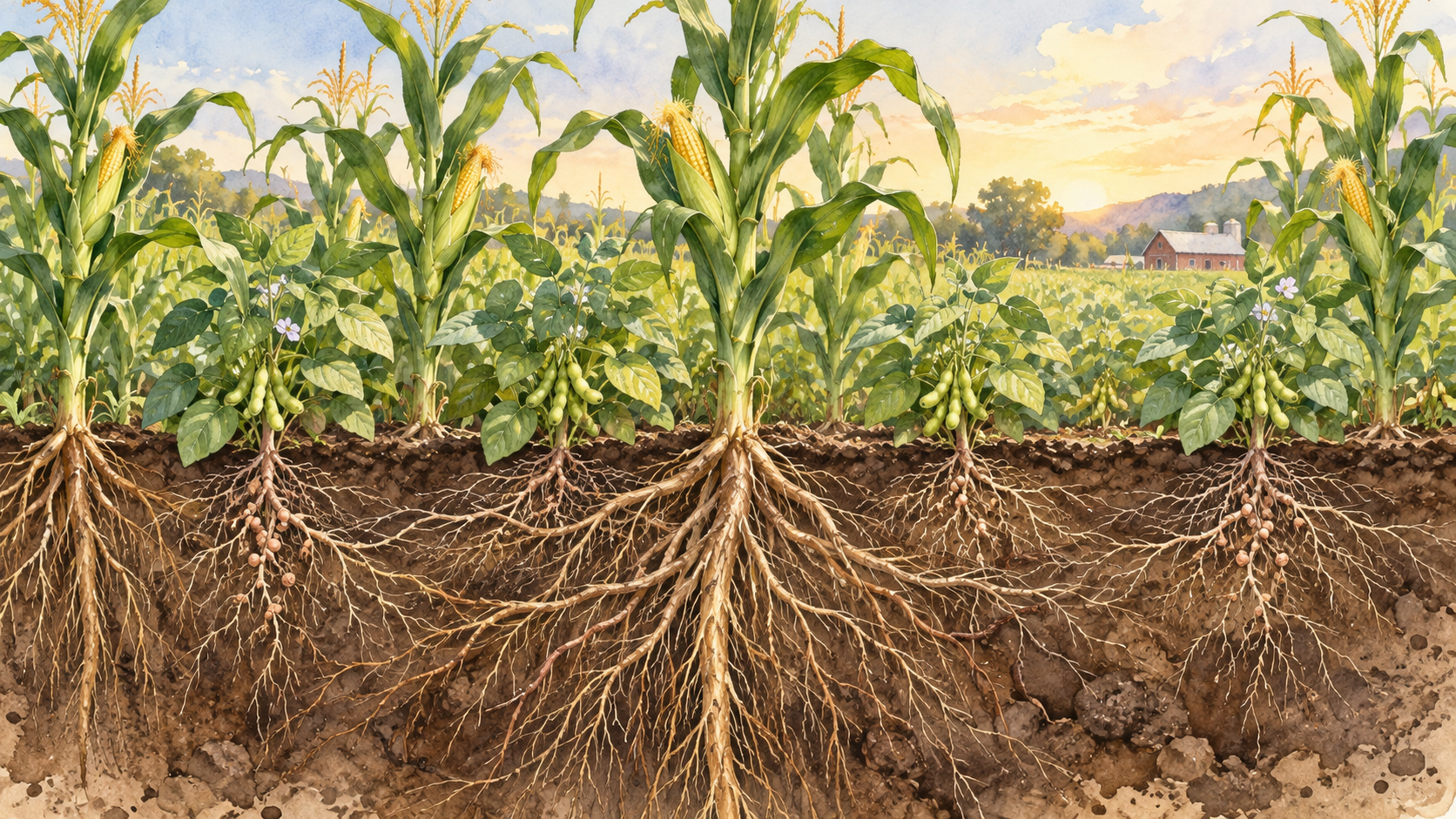
Maize, beans, and squash.
In the Indigenous North American agricultural tradition known as the Three Sisters, these crops have long been grown together in the same field.
The system is often introduced as an example of plants helping one another: maize provides a structure for climbing beans, legumes use atmospheric nitrogen through symbiosis with rhizobia, and sprawling squash covers the soil, helping suppress weeds and reduce evaporation.
The Three Sisters were not merely a cultivation technique. They were deeply connected to food systems, culture, and ceremony in Indigenous societies of North America. The U.S. Department of Agriculture’s National Agricultural Library describes maize–bean–squash intercropping as a system developed through Indigenous agricultural practices.
There is, however, an important distinction.
The beans traditionally grown in the Three Sisters were not soybean. They were primarily common beans and related Phaseolus crops. Soybean originated in East Asia, and the first well-documented introduction of soybean to North America dates to 1765.
Even so, there is a striking connection to modern agriculture.
Humans have long used cropping systems that grow grasses and legumes together. Modern science is now beginning to resolve those systems at the level of root placement, chemical signaling, metabolism, and gene expression.
What is emerging is more complicated than a simple story of plants helping one another.
- Is intercropping really a system of friendly cooperation?
- Intercropping increased maize root biomass by 33.6%
- RNA-seq looks at how genes are being used
- Maize appears to “go after more”
- Soybean, in contrast, reorganizes its metabolism
- Fewer signals for starting new nodules—but more investment in existing nodules?
- The chemical “conversation” between roots is not a simple on/off switch
- Cooperation and competition are not opposites
- Competition may push species toward different strategies
- Humans used the system before science could see its mechanisms
- But the mechanism is not yet “solved”
- Cooperation or competition?
- References and sources
Is intercropping really a system of friendly cooperation?
Growing different crops together can certainly create complementary effects.
If species place their roots at different depths, for example, they can explore different portions of the same soil for water and nutrients. A 2014 study in Annals of Botany examined the Three Sisters system itself and found that maize, common bean, and squash differed in root placement. Their contrasting root-foraging strategies could make soil exploration more complementary in polyculture.
Legumes also have a fundamentally different route to nitrogen acquisition because their rhizobial symbiosis allows them to use atmospheric N₂ rather than relying exclusively on mineral nitrogen in soil.
And plants do more than occupy different physical spaces. In a 2016 PNAS study, maize root exudates altered flavonoid release and nodulation-related gene expression in faba bean, promoting nodulation and symbiotic N₂ fixation.
Roots are not simply avoiding one another underground. They can interact chemically as well.
A 2026 paper in BMC Plant Biology goes one level deeper:
“Transcriptomic profiling of roots reveals species-specific adaptive strategies in maize and soybean intercropping.”
The researchers grew maize and soybean either alone or together, then compared root traits, elemental composition, soybean nodulation, and RNA-seq profiles.
Intercropping increased maize root biomass by 33.6%
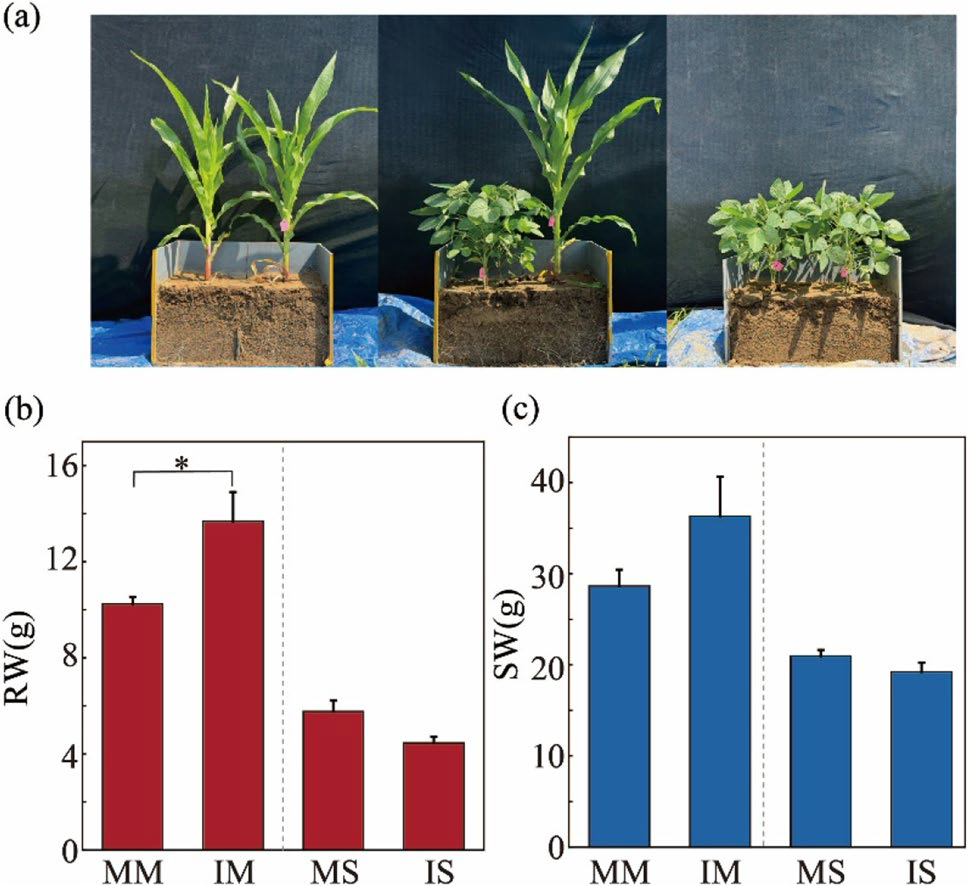
The plants were grown in root boxes without physical barriers between the two species, allowing unrestricted belowground interaction. Samples were collected 60 days after sowing, when maize was at V9 and soybean at V7.
In intercropped maize, root dry biomass increased by 33.6% compared with monoculture.
Soybean root and shoot biomass tended to decrease, although those differences were not statistically significant. In soybean roots, nitrogen concentration fell from 22.87 to 20.82 g/kg, while the C/N ratio rose from 18.60 to 20.56.
In other words, maize and soybean were exposed to the same intercropping environment, but they did not respond in the same way.
What was happening inside their roots?
RNA-seq looks at how genes are being used
This is where RNA-seq becomes useful.
Plant cells contain thousands of genes, but those genes are not all used at the same level all the time. When the environment changes, cells can increase the expression of some genes and reduce the expression of others.
RNA-seq measures RNA molecules across the transcriptome, allowing researchers to estimate which genes are being expressed and how strongly.
Genes whose expression differs significantly between two conditions are called differentially expressed genes, or DEGs.
This does not mean that the DNA sequence itself has changed. It means that the way the gene is being used has changed.
In this study, intercropping was associated with:
Maize: 422 DEGs Soybean: 3,544 DEGs
Those numbers should not be interpreted as soybean simply responding “eight times more strongly.” The two species differ in genome architecture, annotation, and mapping efficiency, and the authors explicitly caution against directly comparing absolute DEG counts between species.
The more informative question is which pathways changed.
And there, the contrast was striking.
Maize appears to “go after more”
In intercropped maize roots, genes involved in central carbon and nitrogen metabolism were prominently upregulated.
These included NRT2.1, a high-affinity nitrate transporter, and nitrate reductase, which participates in nitrate assimilation. Fourteen of 15 genes highlighted in glycolysis, pyruvate metabolism, and carbon metabolism were upregulated.
Taken together with the 33.6% increase in root biomass, the pattern is consistent with maize shifting toward:
more root growth, stronger energy metabolism, and greater investment in the machinery used to acquire and assimilate nitrogen.
Rather than reducing resource acquisition in the presence of another species, maize appears to move in the opposite direction—toward a more aggressive resource-acquisition strategy.
There is an important caveat. Higher NRT2.1 expression does not prove that actual nitrogen uptake increased. High-affinity nitrate transport systems can also be induced when nitrogen becomes limiting. Direct isotope tracing with ^15N would be needed to quantify the change in nitrogen acquisition itself.
Soybean, in contrast, reorganizes its metabolism
Soybean showed a very different pattern.
Among the strongest changes were pathways related to phenylpropanoid, flavonoid, and isoflavonoid metabolism.
Of 107 DEGs assigned to these pathways, 99 were downregulated. All 18 detected genes encoding CHS, CHR, and IFS—key enzymes in the isoflavonoid biosynthetic network—were downregulated.
This matters because soybean isoflavonoids are not merely compounds of nutritional interest to humans. They also function in communication between soybean roots and rhizobia.
Compounds such as daidzein and genistein can act as signals that activate rhizobial nodulation programs.
So the broad suppression of isoflavonoid-biosynthesis genes raises an obvious question:
Is soybean shutting down its symbiosis with rhizobia under competition with maize?
The answer was not that simple.
Fewer signals for starting new nodules—but more investment in existing nodules?
Several genes involved in the early stages of nodulation signaling, including LYK, CNGC15, NSP1, and NSP2, were downregulated.
At the same time, some genes associated with nodule development and function—including NIN2a, ENOD93, ENOD75, and CPX—were upregulated.
Nodule number and total nodule dry weight did not differ significantly between monoculture and intercropping.
But leghemoglobin content increased by 21% in intercropped soybean nodules.
Leghemoglobin helps regulate oxygen conditions inside nodules and supports the environment required for nitrogen fixation.
The pattern therefore suggests a possible shift away from initiating new nodules and toward maintaining or adjusting the function of nodules that already exist.
One way to think about it is:
instead of building more factories, soybean may be reallocating resources toward the factories it already has.
But this remains a hypothesis. The researchers measured leghemoglobin, not the nitrogen-fixation rate itself. A 21% increase in leghemoglobin does not mean that nitrogen fixation increased by 21%.
The chemical “conversation” between roots is not a simple on/off switch
There was another surprising result.
Despite the large transcriptional suppression of isoflavonoid-biosynthesis genes, the soybean root exudates did not show significant decreases in the canonical nodulation-related compounds daidzein, daidzin, and genistein.
Instead, formononetin, medicarpin, and genistin increased.
So the relationship was not simply:
lower gene expression → less isoflavonoid secretion overall.
The data are more consistent with a reorganization of the isoflavonoid profile, potentially shifting metabolic output among different branches of the pathway.
The underground chemical environment is therefore not simply switched “on” or “off.” It is being reconfigured.
Cooperation and competition are not opposites
This brings us back to the Three Sisters.
The system is often described as an example of crops helping one another, and that is not necessarily wrong.
But from the perspective of the plants themselves, cooperation is only part of the story.
Plants growing in the same space also compete for light, water, nitrogen, phosphorus, and rooting space.
In the 2026 maize–soybean study, soybean root nitrogen concentration declined under intercropping, while maize increased root biomass and upregulated genes related to nitrogen acquisition.
That is difficult to describe as simple harmony.
The important point is that facilitation and competition can occur at the same time.
Competition may push species toward different strategies
If we simplify the results of this study, the contrast looks like this:
Maize
More root growth and stronger resource-acquisition machinery
Soybean
A broad reorganization of metabolism and symbiotic investment
The advantage of intercropping may therefore lie not only in plants “helping” one another, but in the fact that competition can push different species toward different resource-use strategies, making their use of the environment more complementary.
This idea connects directly to niche complementarity in ecology.
Plants sharing the same field do not necessarily need to take the same resources, from the same places, at the same times, in the same way.
They can alter where roots grow, which nitrogen sources they rely on, how they interact with microbes, and where they invest carbon and metabolic resources.
A competitor can therefore become part of the environmental signal that changes a plant’s strategy.
Humans used the system before science could see its mechanisms
This is one of the most interesting aspects of intercropping.
Humans were combining different crop species long before RNA-seq existed.
That does not mean traditional farmers understood the molecular mechanisms described today. Nor does this maize–soybean experiment directly test the Three Sisters system. The crops, environments, and management practices are different.
But the broader connection is still useful:
Humans have long used cropping systems that grow grasses and legumes together. Modern science is now beginning to resolve those systems at the level of root placement, chemical signaling, metabolism, and gene expression.
What was once visible mainly as an agronomic observation—“these crops can work well when grown together”—can now be examined layer by layer.
Researchers can map where roots grow, identify compounds released into the rhizosphere, study microbial interactions, measure metabolites, and now ask which genes change their expression when another species becomes a neighbor.
But the mechanism is not yet “solved”
The 2026 study also has important limitations.
It was a single-season root-box experiment rather than a field experiment. It used a replacement-series design, meaning that plant density and species composition changed together. As the authors note, the effects of interspecific competition cannot be completely separated from density effects.
The experiment therefore shows how plants responded to the intercropping system as a whole, not the isolated causal effect of soybean on maize or maize on soybean.
The RNA-seq results are also correlational. Changes in gene expression occurred alongside changes in root biomass, nitrogen status, and nodule traits, but the study did not demonstrate that individual genes caused those phenotypes.
The authors describe their interpretation as a hypothetical model and call for functional genetic experiments, controlled rhizobial inoculation, and field validation.
So this is not a story in which RNA-seq has finally “proven” that an old farming practice was correct.
The more interesting conclusion is almost the opposite.
The cropping systems humans learned to use empirically contain biological interactions that are far more complex than a simple story of mutual help.
Cooperation or competition?
The answer may be: both.
Plants compete. But the presence of competitors can also change where roots grow, how metabolism is organized, and how plants interact with microorganisms.
If different species respond by adopting different resource-use strategies, the resulting agricultural system can behave very differently from either monoculture.
Intercropping is not simply a way for plants to live together peacefully.
It may be a system in which plants compete—and, through that competition, change the way they live.
Humans have used these complex relationships for a very long time. We are only now beginning to read them in the language of molecules.
References and sources
- Liu X, et al. (2026) Transcriptomic profiling of roots reveals species-specific adaptive strategies in maize and soybean intercropping. BMC Plant Biology. https://doi.org/10.1186/s12870-026-09947-z
- Zhang C, Postma JA, York LM, Lynch JP. (2014) Root foraging elicits niche complementarity-dependent yield advantage in the ancient ‘three sisters’ (maize/bean/squash) polyculture. Annals of Botany 114:1719–1733. https://doi.org/10.1093/aob/mcu191
- Li B, et al. (2016) Root exudates drive interspecific facilitation by enhancing nodulation and N2 fixation. PNAS 113:6496–6501. https://doi.org/10.1073/pnas.1523580113
- USDA National Agricultural Library. The Three Sisters of Indigenous American Agriculture. https://www.nal.usda.gov/collections/stories/three-sisters
- Hymowitz T. (1991) Origin of the Soybean and Germplasm Introduction and Development in North America. CSSA Special Publications. https://doi.org/10.2135/cssaspecpub17.c9

Comments