eSoil is a porous bioelectronic growth scaffold made from cellulose and the conducting polymer PEDOT:PSS. In a 2024 PNAS study, barley (Hordeum vulgare ‘KWS Irina’) grown hydroponically in eSoil received a low-voltage electrical treatment.
The stimulated seedlings reached a mean dry weight of 0.111 g versus 0.074 g in controls at day 15—an average increase of 50%. But this was a short seedling experiment in hydroponics, not a field trial or a full-season grain-yield study.
- eSoil was first tested as a passive growth substrate
- Electrical stimulation lasted five days, not the full 15-day experiment
- Nitrate uptake itself did not significantly increase
- Low voltage is attractive, but system-level cost is unknown
- As of 2026, strong field-scale replication is still missing
- Reference
eSoil was first tested as a passive growth substrate
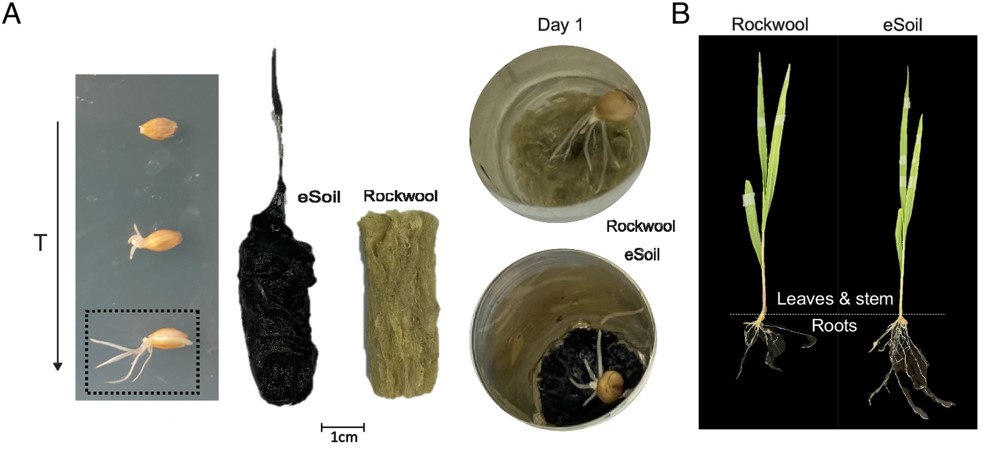
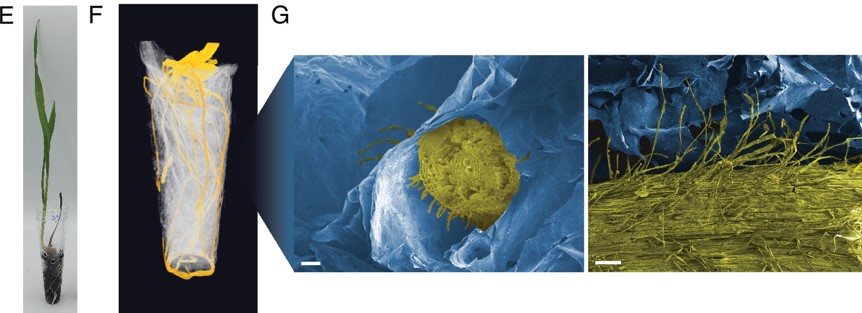
Without electrical stimulation, barley grown in eSoil and conventional rockwool did not differ significantly in dry weight or length in a small 15-day comparison. Micro-CT and SEM showed roots penetrating the porous conductive matrix, creating intimate contact for later electrical stimulation.
Electrical stimulation lasted five days, not the full 15-day experiment
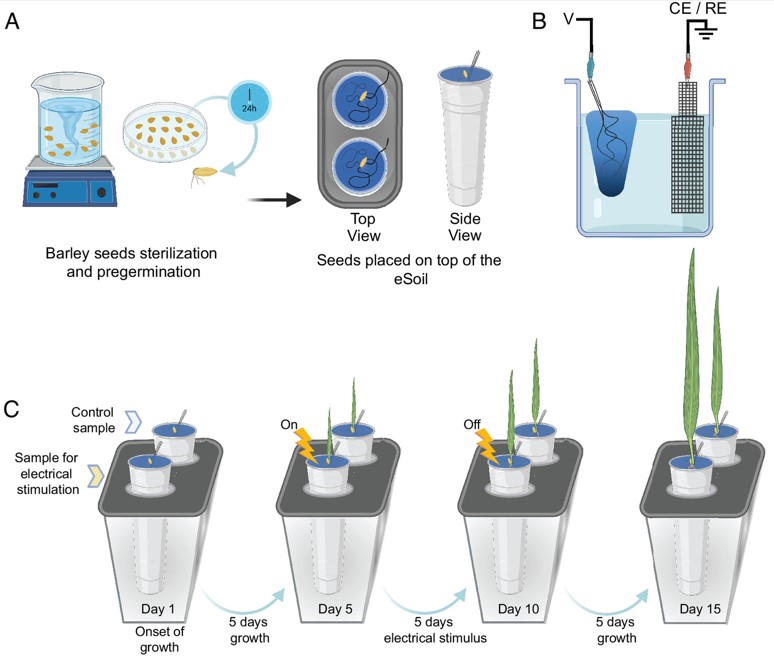
Plants first grew for five days. A constant +0.5 V was then applied from day 5 to day 10, followed by another five days with no stimulation before harvest at day 15.
A time-course experiment found little dry-weight difference immediately at day 10. The major growth difference emerged during days 10–15 after stimulation had ended, suggesting a delayed physiological response rather than simple instantaneous electro-growth.
Nitrate uptake itself did not significantly increase
15N tracing did not show a significant increase in nitrate uptake or total nitrogen allocation caused by stimulation. Instead, stimulated plants had lower residual nitrate pools and evidence consistent with more efficient nitrate reduction/assimilation.
That is interesting mechanistically, but it does not demonstrate that fertilizer application can already be reduced by a specific percentage.
Low voltage is attractive, but system-level cost is unknown
Operating near 0.5 V makes eSoil fundamentally different from many high-voltage electroculture concepts. Agricultural deployment, however, would also have to account for scaffold manufacture, wiring, durability, cleaning/reuse, power distribution and crop-specific treatment optimization.
As of 2026, strong field-scale replication is still missing
In our August 2026 literature re-check, we did not identify a strong peer-reviewed direct replication showing eSoil yield gains in full-season field crops or commercial hydroponics. That does not invalidate the original result; it means the technology remains an early proof of concept.
The strongest current conclusion is that low-voltage bioelectronic root stimulation can change barley-seedling growth and nitrate metabolism under defined hydroponic conditions. Translating that into an agronomic yield technology requires longer, larger and crop-diverse trials.
For related context, see Does Electricity Really Make Plants Grow Better? What Controlled Electrostimulation Studies Actually Show.
For related context, see Tomato HY5 Links Light, Electrical Signaling and a Jasmonate Burst During Root-Knot Nematode Defense.
For related context, see A 4.5-µm Transparent Plant E-Skin Monitors Leaf Growth and Surface Temperature in Real Time.
Reference
- Oikonomou VK et al. eSoil: A low-power bioelectronic growth scaffold that enhances crop seedling growth. PNAS. 2024;121:e2304135120. https://doi.org/10.1073/pnas.2304135120

Comments