A fine line between poison and medicine. The growth-promoting effect of the substance “fusicoccin,” which has been regarded as a poison for plants.

Research

It has been discovered that a substance, previously recognized as a poison, can show the opposite effect, “growth promotion,” if under appropriate conditions. That substance is “fusicoccin.” It was isolated from a plant pathogen and recognized as a poison that causes the death of trees. However, when analyzing the mechanism of action of fusicoccin, it was found that while it indeed causes fatal damage to plants, under certain conditions, it can act not as a poison, but promote plant growth.

Fungal toxin fusicoccin enhances plant growth by upregulating 14-3-3 interaction with plasma membrane H+-ATPase - Scientific Reports
Fusicoccin-A (FC-A) is a diterpene glucoside produced by a pathogenic fungus. Since its discovery, FC-A has been widely ...

Fusicoccin that withers plants

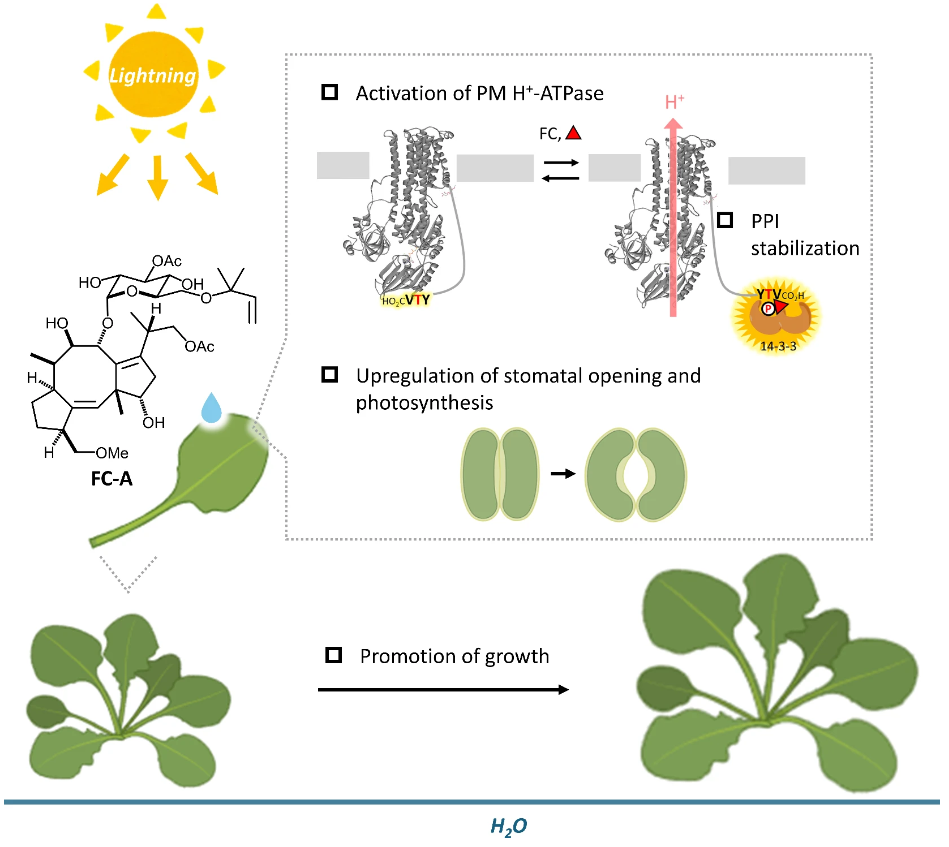
Fusicoccin is a substance produced by the plant pathogen Phomopsis amygdali. This substance acts on the “stomata” of plants, keeping the stomata open. Plants exchange oxygen and carbon dioxide through stomata, and they also regulate their water content by evaporating water through them. If the stomata remain open, excessive water evaporates, and in an environment where there is insufficient water in the root zone, the plant will wither.

The mechanism by which fusicoccin acts on stomata has been further elucidated. Fusicoccin acts on the cells responsible for the opening and closing of stomata. The affected cells experience an increase in osmotic pressure, causing their shape to change, leading the stomata to open. The toxicity of fusicoccin arises from the fact that this reaction occurs in a way that the plant cannot stop, even if it wants to. It’s similar to a situation in humans where you want to stop sweating, but it continues, leading to dehydration and heatstroke.

On the other hand, researchers thought, “If there is sufficient water, wouldn’t it be better for the stomata to remain open?”

What happens to the effects of fusicoccin if there is no water shortage?

The opening and closing of stomata are important factors that influence plant growth. When the stomata are open, oxygen for respiration and carbon dioxide for photosynthesis are supplied. In addition, the evaporative stream caused by water evaporation through the stomata has the physical effect of promoting water absorption from the roots. However, in the natural world, having the stomata open continuously is dangerous because if water supply from the roots ceases, the water content within the plant decreases, causing it to wither. Therefore, the opening and closing of stomata are strictly controlled, and they do not open easily.

Normally, the effects of fusicoccin function negatively, but in an environment with sufficient water supply, they function positively. Respiration and photosynthesis are promoted, and water absorption through the evaporative stream is also enhanced. Usually, when sufficient gas exchange and transpiration occur, the stomata close, but with the continuous effect of fusicoccin keeping the stomata open, the plant’s growth limit was raised.

The effects of fusicoccin addition under sufficient water conditions

When fusicoccin was added while providing sufficient water, a constant open state of the stomata was achieved, leading to a growth-promoting reaction.

Specifically, the addition of fusicoccin promoted “photosynthesis.” This is believed to be due to the sufficient uptake of carbon dioxide needed for photosynthesis because the stomata were open. Photosynthesis also requires water, and the enhancement of water absorption by the evaporative stream likely contributed to the increased photosynthetic capacity.

As a result of the enhanced photosynthesis, plant growth itself was promoted, and a clear result was obtained, showing that the plants treated with fusicoccin grew larger than the untreated plants.

The effect of fusicoccin addition lasted for 12 to 24 hours, and after 48 hours, the difference with the untreated plants almost disappeared. It works when used in the right amount, but if you use too much, it can be harmful… It’s like the reaction of an energy drink.

The potential of fusicoccin as a new biostimulant

In recent years, the market for biostimulants (BS), substances that stimulate plant growth, has been expanding. As the name suggests, these are substances that act on plants to stimulate and promote growth. The effect of fusicoccin seems to be potentially useful as a BS.

One challenge is that the synthesis of fusicoccin is expensive, making it difficult to apply fusicoccin itself as a BS at present. However, a solution has been considered: using intermediates in fusicoccin biosynthesis, which are slightly less effective than fusicoccin but easier to purify, thus offering a better cost-performance ratio.

In this study, the effects were confirmed not only in the model plant Arabidopsis thaliana but also in komatsuna. It is believed that it could be used for various plants.

If used in environments like “plant factories,” where water control is possible, there is a possibility that fusicoccin’s toxicity could be converted into a growth-promoting effect. In the future, we might eat vegetables with labels like “Grown with Fusicoccin!

コメント

Copied title and URL