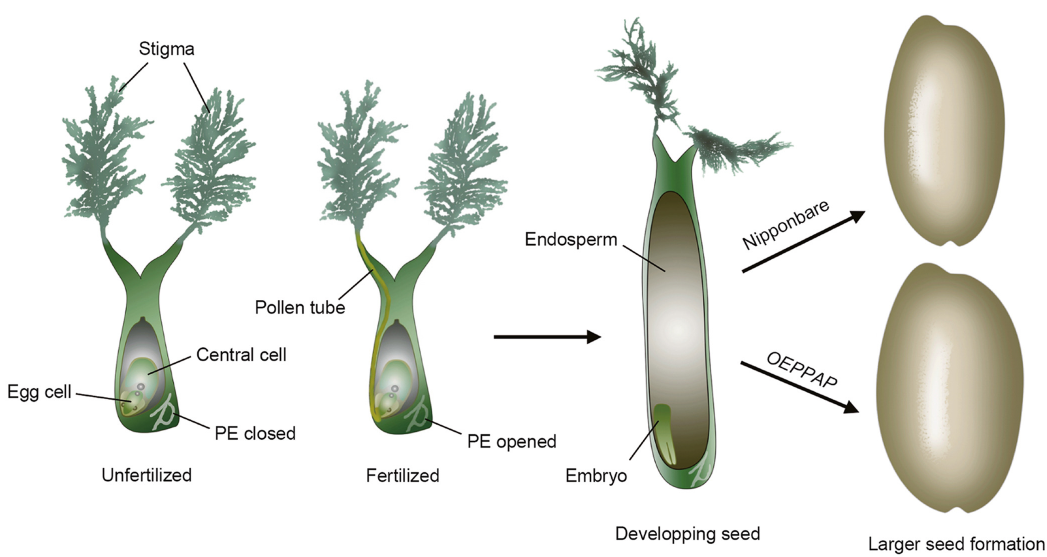
A 2025 Current Biology study identified a fertilization-dependent gate at the chalazal end of the ovule. Before fertilization, callose blocks the phloem-end pathway; after central-cell fertilization, callose is degraded and nutrient transport into the developing seed begins.
Callose keeps the gate closed before fertilization
Unfertilized mature ovules retain callose at the phloem end. After successful central-cell fertilization, the callose signal falls and sucrose and other transported solutes can enter the seed. Fertilization-defective ovules keep the callose barrier and fail to activate this transport.
AtBG_ppap loss made seeds 8.4% smaller
The team identified the ovule-expressed β-1,3-glucanase AtBG_ppap. A CRISPR loss-of-function mutant incompletely removed callose after fertilization and produced mature seeds 8.4% smaller than wild type. Complementation restored seed size.
Overexpression increased seed area in Arabidopsis and rice
AtBG_ppap overexpression increased Arabidopsis seed area by 16.5%. A PPAP-overexpressing rice line produced seeds about 9% larger than wild type, providing a cross-species proof of concept.
Larger seeds do not automatically mean higher field yield
The study establishes a mechanism for controlling seed size, not a demonstrated yield-increase technology. Seed number, total yield, grain filling, quality and source–sink balance still need crop and field validation.
For related context, see SW14 Rebalances Soybean Seed Weight, Protein and Oil by Disrupting a LEC1-Containing NF-Y Complex.
For related context, see How miR159 and CKX6 Control Rose Petal Size Through Cytokinin Turnover.
For related context, see Indica OsNLP4 Raised Yield and Nitrogen-Use Efficiency in Japonica Rice Across Multi-Location Field Trials.
Reference
- Liu X et al. Fertilization-dependent phloem end gate regulates seed size. Current Biology. 2025;35:2049-2063.e3. https://doi.org/10.1016/j.cub.2025.03.033


Comments