When reading research on plant biostimulants, the first question is usually straightforward: did the product work on the plant? Did growth improve? Did the plant tolerate drought better? Did nutrient-use efficiency increase? Those are essential questions.
But if a biostimulant is going to be used in agriculture, is looking at the plant alone enough?
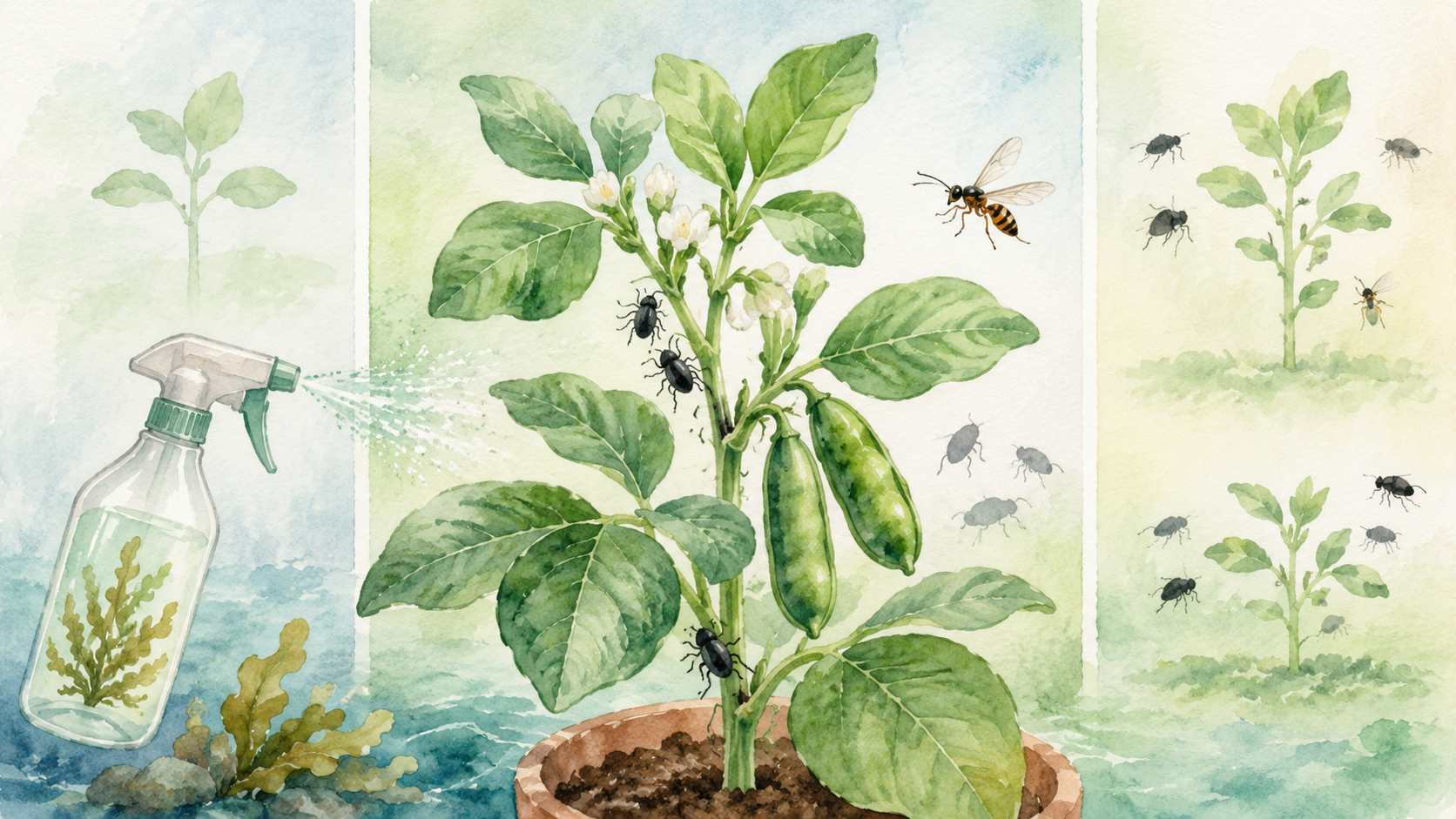
A study published in Arthropod-Plant Interactions on August 28, 2026 tested a commercial seaweed extract derived from Ascophyllum nodosum not only on faba bean, but across a three-level system involving the crop, an aphid herbivore, and a parasitoid used for biological control.
Original paper: Target and side effects of Ascophyllum nodosum in a plant-herbivore-parasitoid system
What makes this paper interesting is not mainly the magnitude of its results. It is the decision to ask a broader question: how should a biostimulant be evaluated when the crop is part of an agroecosystem rather than an isolated plant?
This is also timely from a regulatory perspective. In 2025, Japan’s Ministry of Agriculture, Forestry and Fisheries (MAFF) issued its first guideline on the labeling and handling of biostimulants, including the need to confirm evidence for claimed effects and safety. As biostimulants become more widely used, ecological compatibility with other components of crop protection may become another important evaluation axis.
- Looking beyond the crop: faba bean, aphids, and a parasitoid
- Most outcomes showed no detectable effect of the biostimulant
- The biggest problem: the biostimulant never clearly worked on the plant
- “No significant difference” is not the same as proving equivalence
- Behavioral effects were also largely invisible in this setup
- Japan has moved toward evidence-based biostimulant use
- Biostimulant evaluation may need to move beyond the plant
- References
Looking beyond the crop: faba bean, aphids, and a parasitoid
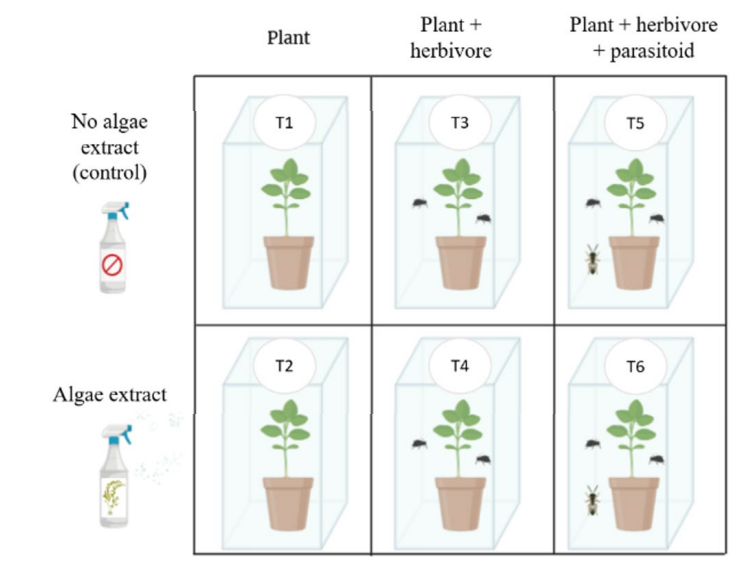
The study used faba bean (Vicia faba), the black bean aphid Aphis fabae, and the parasitoid Aphidius matricariae.
The researchers created six treatments by combining three trophic conditions—plant only, plant plus aphids, and plant plus aphids plus parasitoids—with or without the seaweed extract. The full experiment was repeated three times, with four replicates per treatment in each run, for a total of 72 plants.
The commercial A. nodosum extract was applied at the manufacturer-recommended dilution of 3.5 mL/L. Plants received three applications: the first as a soil drench and the second and third as foliar sprays.
The measurements also went beyond plant growth. Plant height, leaf number, leaf area, and dry weight were recorded. Aphid abundance was measured, while parasitoid performance was assessed using aphid mummy abundance and individual mummy weight.
Most outcomes showed no detectable effect of the biostimulant
The main results can be summarized simply.
| Endpoint | Effect of the seaweed biostimulant |
|---|---|
| Plant height | No significant effect |
| Leaf number | No significant effect |
| Leaf area | No significant effect |
| Dry weight | No significant effect |
| Aphid abundance | No significant effect |
| Parasitoid-mediated aphid suppression | No detectable impairment by the biostimulant |
| Mummy weight | No significant effect |
| Mummy abundance | No clear trend; too little data for inferential analysis |
Introducing parasitoids clearly reduced aphid abundance. Importantly, the seaweed extract did not significantly weaken this suppression.
The authors therefore concluded that, under the tested conditions, the A. nodosum extract and parasitoid biological control were not antagonistic and preliminarily pointed to ecological compatibility.
That is useful news. It shows that using a biostimulant does not automatically mean disrupting biological control, and that compatible combinations may exist.
But it would be premature to generalize this result as evidence that the product is broadly “safe for the ecosystem.” The paper also contains limitations that are highly relevant to how future biostimulant evaluations should be designed.
The biggest problem: the biostimulant never clearly worked on the plant
This is the most important weakness in the experiment.
The seaweed extract did not significantly improve plant height, leaf number, leaf area, or dry weight. It also did not improve plant status under aphid infestation.
In other words, the study never clearly established a condition in which the biostimulant was measurably active on the plant.
The authors explicitly acknowledge this as a methodological constraint. The experiment did not include a positive abiotic-stress control, such as drought, that could independently confirm the bioactivity of the A. nodosum extract and whether the chosen dose was appropriate for this system.
That matters because the broader ecological question is really:
If a biostimulant changes plant physiology, does that change the herbivore and then the natural enemy?
What this experiment actually established was closer to:
Biostimulant treatment → no measurable plant change → no clear aphid change → no clear change in parasitoid suppression.
The more informative experiment would be:
Biostimulant treatment → confirmed physiological response in the plant → then test whether herbivore and parasitoid responses change.
For example, if the A. nodosum product first demonstrated a reproducible benefit under drought stress, the same crop–aphid–parasitoid experiment under that condition could ask whether the biological-control relationship remains intact when the biostimulant is genuinely exerting its target effect.
This is why the paper is useful in two ways at once. It introduces a valuable evaluation concept, while also showing that the methodology for evaluating ecological compatibility still needs refinement.
“No significant difference” is not the same as proving equivalence
There is another statistical issue worth emphasizing.
Parasitoid mummy abundance was low and strongly zero-inflated, so the authors could not perform inferential modeling for that endpoint. They explicitly describe the absence of a visible difference as a preliminary observation rather than confirmed statistical equivalence.
That distinction matters.
Failing to detect a significant difference with a conventional hypothesis test does not demonstrate that two treatments are equivalent.
If ecological compatibility becomes a formal product-evaluation objective, it may be more appropriate to define an acceptable margin in advance—for example, that a biostimulant must not reduce natural-enemy control efficacy by more than a specified percentage—and then use an equivalence or non-inferiority framework.
That would align the statistical test with the actual practical question: not “can we detect any difference?” but “is any reduction small enough to be acceptable?”
Behavioral effects were also largely invisible in this setup
The aphids and parasitoids were introduced directly into confined cages. They could not freely choose among treated and untreated plants.
This means the experiment was poorly suited to detect effects mediated through plant choice or volatile cues. If a biostimulant changes plant volatile emissions, aphids might avoid or prefer the plant, while parasitoids might become more or less attracted to it. Those effects can matter even if survival or reproduction within a no-choice cage remains unchanged.
Previous work on plant-associated microbes and related inputs has shown both directions: natural enemies can become more attracted in some systems and less attracted in others. Changes in plant physiology can propagate through herbivores to higher trophic levels.
The authors therefore identify insect-choice experiments and multigenerational responses as important next steps. Other limitations include different parasitoid sources across experimental runs and the relatively short 35-day study period.
Japan has moved toward evidence-based biostimulant use
On May 30, 2025, Japan’s Ministry of Agriculture, Forestry and Fisheries published its Guideline on the Labeling and Handling of Biostimulants.
The guideline addresses the definition of biostimulants, labeling of effects and use conditions, confirmation of supporting evidence, and safety considerations. MAFF describes the objective as creating an environment in which farmers can select and use effective biostimulants with confidence.
Europe has also incorporated plant biostimulants into the EU Fertilising Products Regulation, including requirements related to safety, quality, labeling, and the effects claimed for target plants.
None of this means that effects on parasitoids or other natural enemies are already a universal regulatory requirement for biostimulants. They are not.
But as biostimulants are increasingly used alongside integrated pest management, biological-control agents, and other crop-protection tools, compatibility with non-target organisms and ecosystem functions is a plausible next area of evaluation.
This study makes that future question unusually concrete.
Biostimulant evaluation may need to move beyond the plant
A more mature evaluation framework could proceed in stages.
First, confirm the target efficacy of the biostimulant under the conditions where it is expected to work. If the product is intended to improve drought, heat, or salinity tolerance, demonstrate a reproducible plant response under that stress.
Then examine herbivore responses, including population growth, survival, feeding, and host choice. Next, test natural enemies such as parasitoids and predators for biological-control performance, development, and behavior. Where relevant, extend the work across generations and into semi-field and field conditions.
Only then can we get closer to a stronger statement:
This biostimulant works on the crop, and when it is working, it does not disrupt important ecological functions used in crop production.
Adding more evaluation criteria is not necessarily bad news for the biostimulant industry.
Better evidence can distinguish products that reliably work from those that do not, and products that integrate well with existing agricultural practices from those that create unwanted trade-offs. That ultimately makes it easier for growers to select useful products with confidence.
This single study does not prove the ecological safety of A. nodosum products as a category. What it does show is that evaluating biostimulants only at the level of the crop may become increasingly insufficient.
The crop–herbivore–natural enemy perspective is a useful next step. At the same time, the weaknesses of this experiment make the next methodological steps unusually clear.
As new evaluation axes emerge, the methods used to test them will also need to improve. If that process helps identify biostimulants with both demonstrable efficacy and good ecological compatibility, that is a positive direction for both researchers and growers.
References
- Zambrano GLR, Pozzi CM, Jacobsen SK. Target and side effects of Ascophyllum nodosum in a plant-herbivore-parasitoid system. Arthropod-Plant Interactions 20, 70 (2026).
- Ministry of Agriculture, Forestry and Fisheries of Japan: Guideline announcement for biostimulant labeling and handling
- European Union: Regulation (EU) 2019/1009 on EU fertilising products


Comments