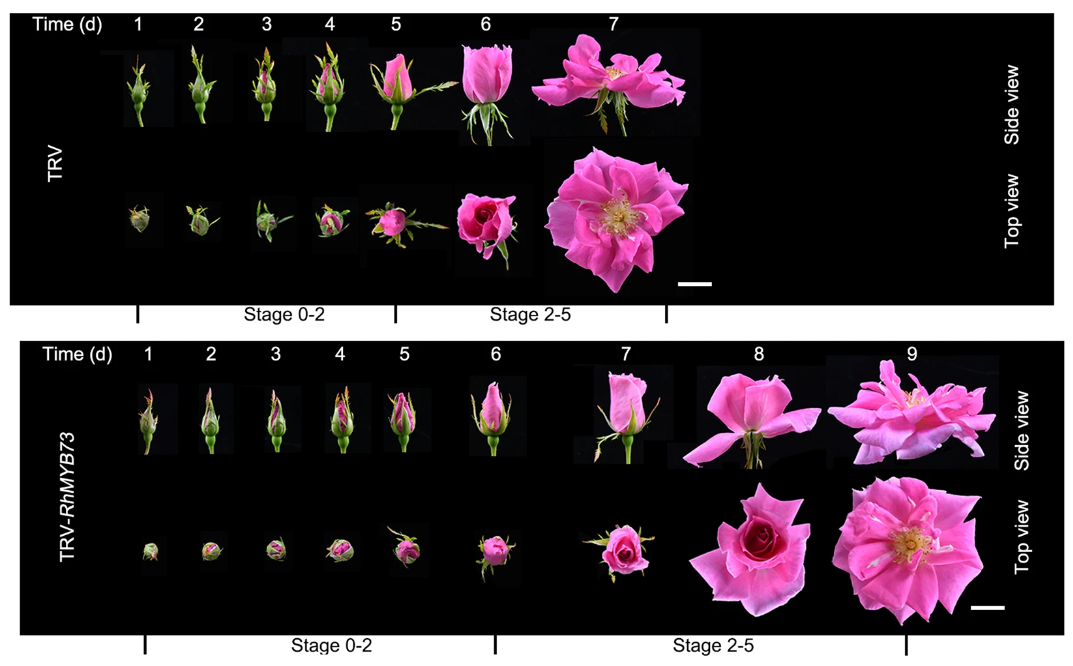
A 2023 Nature Communications study showed that rose petal size depends in part on how long young petal cells continue dividing. The regulatory chain links miR159 to the cytokinin-degrading enzyme RhCKX6.
Lower miR159 produced smaller petals

Using TRV-mediated short tandem target mimic technology, the researchers reduced miR159 abundance. The cell-proliferation phase became shorter and mature petals were smaller, mainly because they contained fewer epidermal cells.
RhCKX6 is a direct miR159 target
The study identified miR159-mediated cleavage of RhCKX6 transcripts. When miR159 was reduced, RhCKX6 accumulated and active cytokinins such as iP and trans-zeatin were cleared earlier.
Silencing RhCKX6 had the opposite effect: cytokinin accumulated, cell proliferation lasted longer and petals became larger. Exogenous 6-BA treatment produced a similar extension of proliferation.
Upstream control involves a MYB73/TPL/HDA19 complex
The pathway is more complex than “MYB73 controls miR159.” RhMYB73 forms a repressor complex with TOPLESS and HDA19 that changes H3K9 acetylation at the MIR159 promoter and suppresses MIR159 expression.
The resulting chain can be summarized as:
MYB73/TPL/HDA19 → miR159 → RhCKX6 → cytokinin clearance → duration of cell division → petal size.
This is not yet a recipe for breeding larger roses
The causal experiments relied on transient silencing, overexpression and hormone treatment. They did not demonstrate a commercial cultivar with stable, agronomically useful larger flowers. RhCKX6 also participates in petal dehydration tolerance and senescence, so changing this pathway may have trade-offs.
The main advance is therefore a mechanistic one: a molecular circuit connecting chromatin regulation, microRNA control, cytokinin turnover and petal growth.
For related context, see Plant 'Thorns' Are Not All the Same: LOG Genes Repeatedly Shaped Prickle Evolution Across 150 Million Years.
For related context, see What Controls Cucumber Pedicel Length? An EMS Mutant Points to Cytokinin-Dependent Cell Number.
For related context, see OsMYB8 Controls When Rice Florets Open—A Tool for Synchronizing Indica × Japonica Hybrid Seed Production.
Reference
- Jing W et al. Petal size is controlled by the MYB73/TPL/HDA19-miR159-CKX6 module regulating cytokinin catabolism in Rosa hybrida. Nature Communications. 2023;14:7106. https://doi.org/10.1038/s41467-023-42914-y

Comments