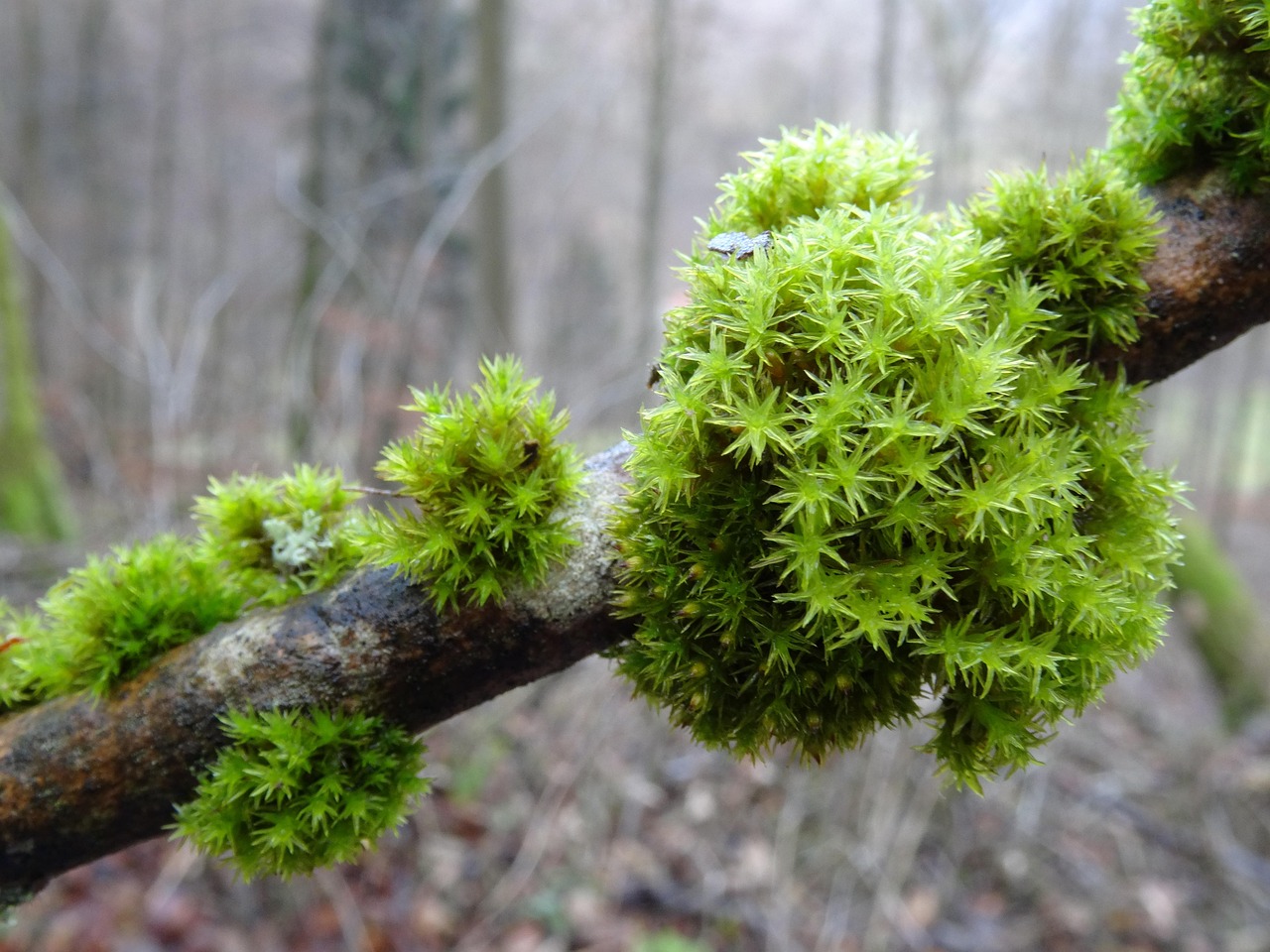
A 2025 Science Advances study grew the model moss Physcomitrium patens at 1, 3, 6 and 10 times Earth’s gravity and measured canopy photosynthesis, CO₂ diffusion, anatomy and gene expression.
Photosynthesis rose 36–52% at 6G and 10G
The 3G treatment did not produce a significant increase, whereas 6G and 10G increased canopy photosynthesis by 36–52% and CO₂ diffusional conductance by 35–56%. Larger chloroplasts and more gametophores increased the effective canopy surface for CO₂ diffusion.
IBSH1 reproduced much of the hypergravity phenotype
Several moss-specific AP2/ERF transcription factors were upregulated at 10G. Overexpression of Pp3c1_32440 reproduced many 10G traits even at 1G, including chloroplast enlargement, gametophore growth and increased photosynthesis; a dominant repressor attenuated the 10G response. The gene was named ISSUNBOSHI1 (IBSH1).
Evolutionary interpretation remains a hypothesis
The authors discuss whether AP2/ERF expansion may have contributed to early land-plant adaptation, but the direct experiment concerns hypergravity responses in modern P. patens. It does not prove that the same pathway caused terrestrial adaptation in evolutionary history.
Nor does it show that manipulating an equivalent gene in crop plants would automatically increase photosynthesis.
For related context, see Plants Were Not Grown in Real Moon Soil: Bacteria Improved a Lunar Regolith Simulant.
For related context, see Can Red Laser Treatment Change Gladiolus Growth? What a 635-nm Experiment Shows—and What It Does Not.
For related context, see What If Crops Could Use Far-Red Light? A 3D Soybean Canopy Model Predicts Up to 26% More CO₂ Assimilation.
Reference
- Hanba YT et al. First contact with greater gravity: Moss plants adapted via enhanced photosynthesis mediated by AP2/ERF transcription factors. Science Advances. 2025;11:eado8664. https://doi.org/10.1126/sciadv.ado8664
Comments