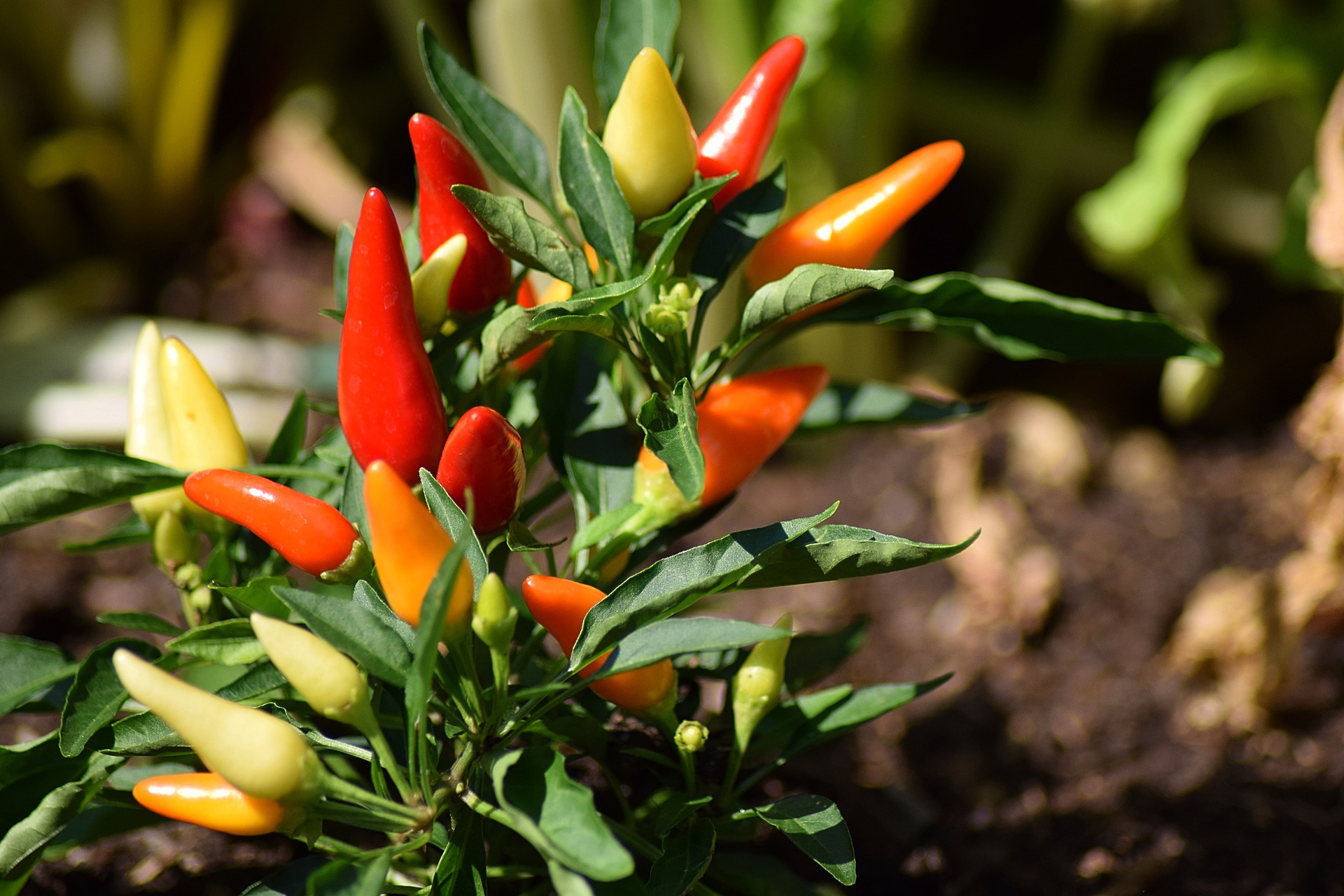
Capsaicin does not create a conventional taste. It primarily activates TRPV1, an ion channel involved in detecting heat and painful chemical stimuli. The result is the familiar burning sensation of chili.
But TRPV1 responses differ among animals. Many mammals avoid capsaicin, whereas Chinese tree shrews can consume pungent plants and birds are generally far less sensitive to chili heat. These observations are often compressed into one coevolution story, but the evidence is clearer if we separate molecular adaptation in tree shrews from seed-dispersal ecology in wild chilies.
- A single TRPV1 amino-acid change lowers sensitivity in tree shrews
- What selected the variant remains a strong hypothesis, not a witnessed history
- Birds and chili peppers are a separate evolutionary-ecology story
- TRPV1 research has become more mechanistically detailed
- Livestock and health applications require separate evidence
- References
A single TRPV1 amino-acid change lowers sensitivity in tree shrews

A 2018 PLOS Biology study showed that Chinese tree shrews (Tupaia belangeri chinensis) did not strongly reduce food intake when capsaicin was added, unlike mice. Functional analysis identified a specific amino-acid substitution in tree-shrew TRPV1 that reduces sensitivity to capsaicinoids.
The residue was conserved across 155 wild tree shrews sampled from five populations, supporting the interpretation that the variant is fixed at the species level.
What selected the variant remains a strong hypothesis, not a witnessed history
Chili peppers (Capsicum) originated in the Americas, so Asian tree shrews did not evolve this trait by historically eating New World chilies. The researchers instead identified a capsaicin-like compound, Cap2, in the local pungent plant Piper boehmeriaefolium, whose geographic range overlaps with the tree shrew. They proposed that feeding on such plants could have provided selection pressure favoring reduced TRPV1 sensitivity.
This is a well-supported adaptive hypothesis built from geography, chemistry, feeding behavior and genomic selection signals. It is not direct observation of the historical selection event.
Birds and chili peppers are a separate evolutionary-ecology story

Avian TRPV1 differs from mammalian TRPV1 and is generally much less responsive to capsaicin. That physiology allows many birds to eat pungent fruits.
Wild-chili ecology adds another layer. Experiments and field studies support the “directed deterrence” hypothesis: capsaicin discourages seed-destroying rodents while having much less effect on effective avian seed dispersers. In field tests, wild chili fruits were removed predominantly by birds, and the birds carried viable seeds.
This does not mean a plant consciously “designed” capsaicin for birds. It means a chemical trait can alter interactions with different consumers, and those interaction differences can influence plant reproduction and selection.
TRPV1 research has become more mechanistically detailed
A 2025 Nature Chemical Biology study mapped how capsaicin accesses the buried vanilloid-binding site in TRPV1 using structural, computational and functional approaches. It was not a new tree-shrew evolution experiment, but it provides a deeper molecular framework for understanding how changes around TRPV1 can alter capsaicin responses.
Livestock and health applications require separate evidence
Capsaicin and other botanical compounds are also studied in livestock nutrition, antimicrobial systems and metabolism. Those applications must be evaluated by species, dose, formulation and safety. The tree-shrew evolution paper and wild-chili seed-dispersal studies do not themselves prove that a feed additive improves animal performance.
Capsaicin is scientifically interesting because the same plant chemical can produce very different sensory consequences across animal lineages—and those differences can propagate into ecological interactions.
For related context, see Two T2T Pepper Genomes Reveal How Capsaicinoid Pungency Evolved and Became Placenta-Specific.
For related context, see Pollen Species Change Honey-Bee Metabolism: Six Monodiets Altered Fat Body and Energy Reserves.
For related context, see The 4.83-Gb Ophrys sphegodes Genome Links Sexual Deception to Odor-Gene Duplications and an LTR Burst.
References
- Han Y et al. Molecular mechanism of the tree shrew’s insensitivity to spiciness. PLOS Biology. 2018;16:e2004921. https://doi.org/10.1371/journal.pbio.2004921
- Tewksbury JJ, Nabhan GP. Directed deterrence by capsaicin in chillies. Nature. 2001;412:403–404. https://doi.org/10.1038/35086653
- Levey DJ et al. A field test of the directed deterrence hypothesis in two species of wild chili. Behavioral Ecology. 2006. PMID: 16896774
- Sun MY et al. Mechanism of capsaicin entry into buried vanilloid sites in TRPV1. Nature Chemical Biology. 2025;21:1957–1969. https://doi.org/10.1038/s41589-025-01966-5

Comments