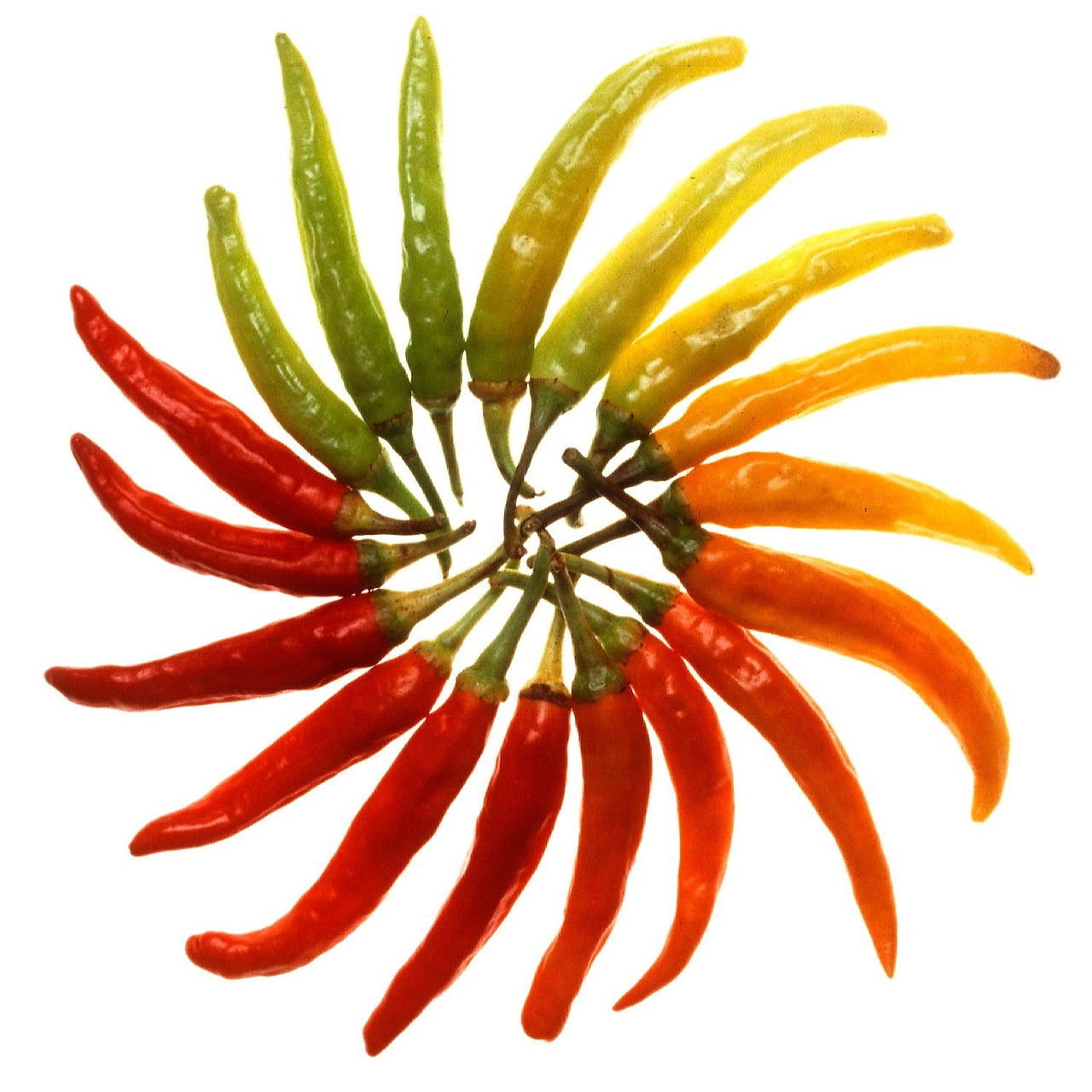
A 2024 Nature Communications study assembled telomere-to-telomere, gap-free genomes for pungent Capsicum annuum and its nonpungent wild relative C. rhomboideum to examine the evolution and tissue specificity of capsaicinoid biosynthesis.
Gap-free genomes for repeat-rich Capsicum
Pepper genomes are roughly 3 Gb and ~80% repetitive, making complete assembly difficult. The new T2T resources support detailed comparison of centromeres, gene duplications and regulatory regions.
Capsaicinoid biosynthesis evolved through pathway assembly and gene regulation
Capsaicinoids combine precursors from phenylpropanoid and branched-chain fatty-acid metabolism through capsaicin synthase-related activity. Phylogenomics helps reconstruct duplication and loss of pathway components, but the authors emphasize that too few high-quality genomes exist across the >40 Capsicum species to completely resolve every evolutionary step.
Placenta-specific open chromatin helps localize pungency
RNA-seq, ATAC-seq and methylation profiling identified placenta-associated open chromatin around CS-2 and regulators such as MYB31 and MYB48. Nonpungent C. annuum accessions carried a 2.4-kb deletion affecting the CS-2 upstream open-chromatin region.
Thus pungency depends not only on coding genes but also on when and where the pathway is accessible and expressed.
The genomes are valuable breeding and engineering resources, but they do not yet provide a simple recipe for designing any desired capsaicinoid level.
For related context, see Why Tree Shrews Can Eat Spicy Food: TRPV1 and Chili's Selective Deterrence Strategy.
For related context, see How Are Japanese Soybeans Genomically Different? A 462-Accession Pangenome—and Two Author Corrections.
For related context, see Indica OsNLP4 Raised Yield and Nitrogen-Use Efficiency in Japonica Rice Across Multi-Location Field Trials.
Reference
- Chen W et al. Two telomere-to-telomere gapless genomes reveal insights into Capsicum evolution and capsaicinoid biosynthesis. Nature Communications. 2024;15:4295. https://doi.org/10.1038/s41467-024-48643-0

Comments