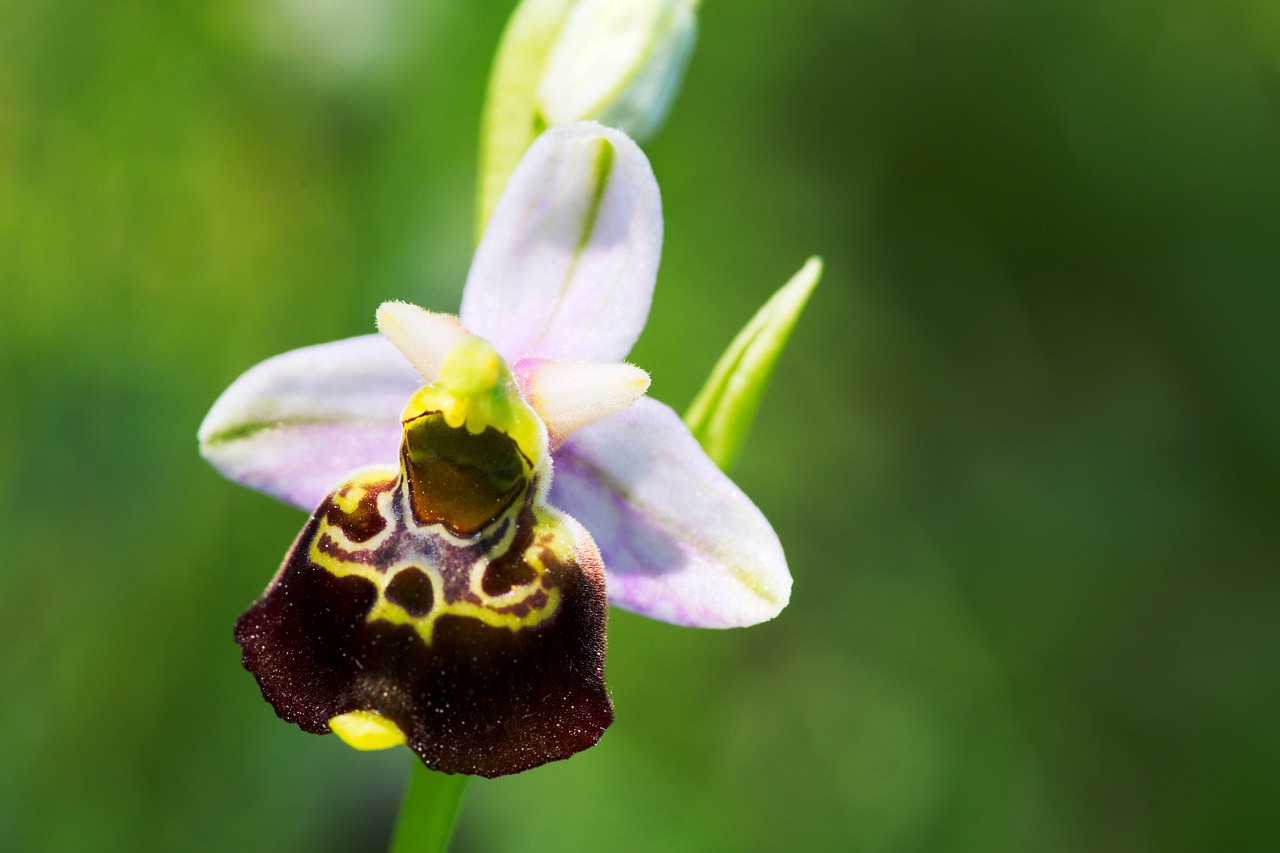
Sexually deceptive Ophrys orchids mimic female insects, including their sex-pheromone chemistry, to induce pseudocopulation by male pollinators. A 2024 Nature Communications study produced a chromosome-level genome for the early spider-orchid Ophrys sphegodes.
A 4.83-Gb genome on 18 pseudochromosomes

Flow cytometry estimated a 4.83-Gb haploid genome with 1.28% heterozygosity. Nanopore, Illumina and Hi-C data were integrated into 18 pseudochromosomes corresponding to the species’ 2n=36 karyotype.
LTR activity peaked about 1.3–0.8 million years ago
Recent LTR insertions increased from around 3 Ma and peaked at approximately 1.3–0.8 Ma, overlapping or preceding the <1-Ma radiation of a species-rich Ophrys lineage. The timing coincides with Mediterranean glacial/interglacial oscillations, but the study does not prove that climate caused the LTR burst or that the burst caused speciation.
Candidate pollinator-attraction gene families expanded
Alkene hydrocarbons are key components of female-pollinator pheromone mimicry. The genome shows expansion of candidate families including fatty acyl-CoA reductases and chalcone synthases, plus tandem duplication of SAD1/SAD2-type stearoyl-ACP desaturases. Four SAD1/SAD2 copies occur in a chromosome-4 cluster.
The work identifies genomic architecture consistent with pollinator adaptation; it does not demonstrate that a specific transposon insertion directly created a particular flower shape or odor.
For related context, see How Mirror-Image Flowers Are Built: A Supergene and Gravity Place Pollen on Opposite Sides of Pollinators.
For related context, see How miR159 and CKX6 Control Rose Petal Size Through Cytokinin Turnover.
For related context, see Plant 'Thorns' Are Not All the Same: LOG Genes Repeatedly Shaped Prickle Evolution Across 150 Million Years.
Reference
- Russo A et al. Genome of the early spider-orchid Ophrys sphegodes provides insights into sexual deception and pollinator adaptation. Nature Communications. 2024;15:6308. https://doi.org/10.1038/s41467-024-50622-4


Comments