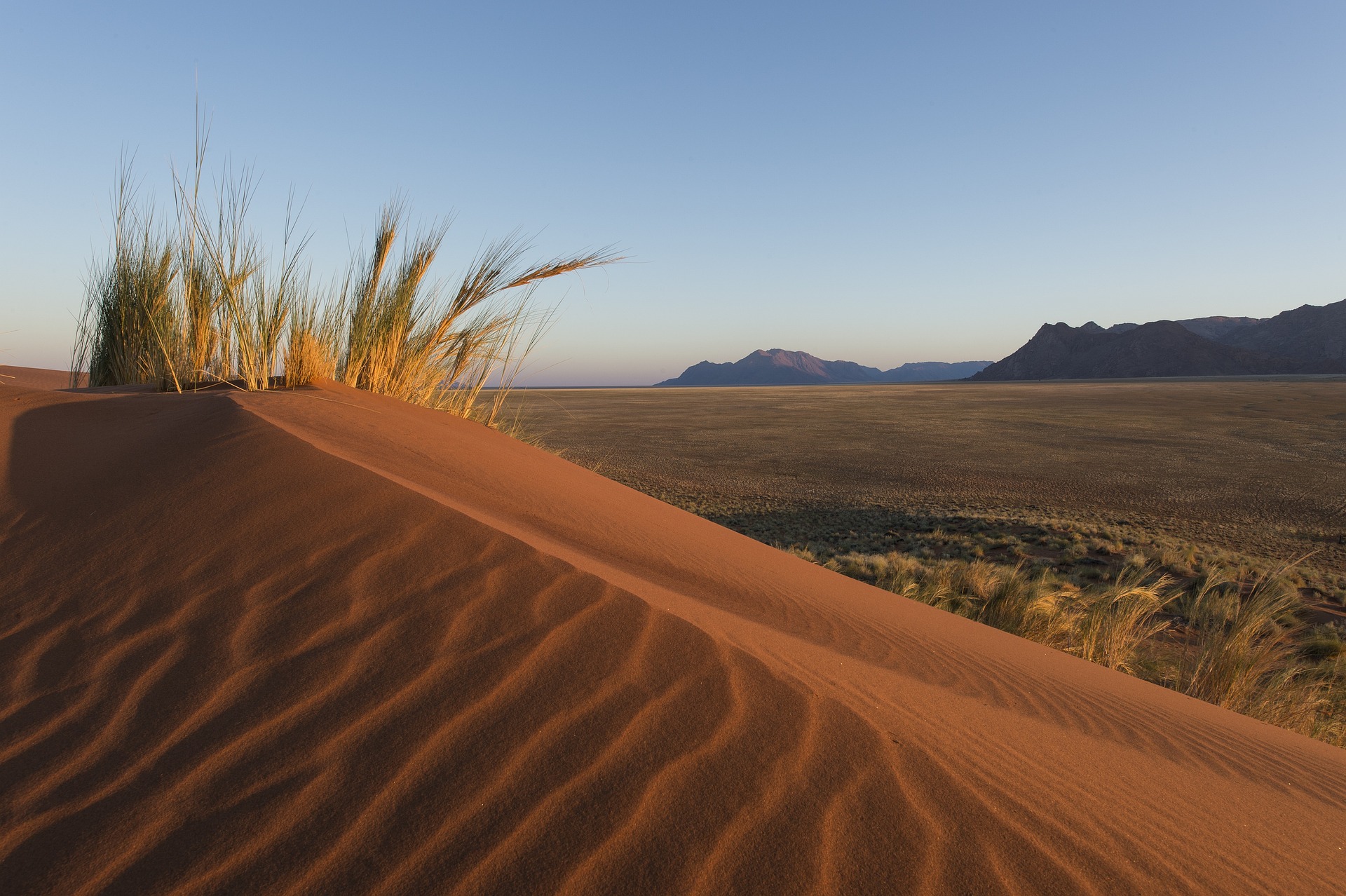
In parts of the hyperarid Namib Desert, fog is a more regular moisture source than rainfall. A 2024 Scientific Reports study treated tussocks and sand hummocks formed by the fog-harvesting grass Stipagrostis sabulicola as “Fog-Plant-Oases” (FPOs) and used stable isotopes to examine their food webs.
Seven FPOs near Gobabeb—three young and four mature—were surveyed. Mature hummocks reached roughly 10 × 9 m and grass tussocks up to about 2 m.
The grass fuels the aboveground carbon web


δ13C/δ15N and mixing models showed that S. sabulicola carbon supports flows from consumers to higher trophic levels in the aboveground invertebrate community.
Belowground nematodes had different isotope signatures, suggesting a more separate soil niche where wind-blown sediments or detritus may be more important energy sources.
This is an ecosystem study, not a trial showing that planting the grass can green arbitrary deserts. Its significance is demonstrating how one fog-harvesting perennial concentrates water, shelter, detritus and carbon into local biodiversity islands.
For related context, see A Fog Harvester Inspired by Bushman Grass and Namib Beetles Reached 42% Collection Efficiency.
For related context, see Mud Cracks Can Help a Salt Marsh Recover: Physical Self-Organization in China’s Red Beach.
For related context, see When Does Tree Planting Stop Cooling the Climate? Albedo Accounting Across 172 Carbon-Market Projects.
Reference
- Gan HY et al. The hidden oases: unveiling trophic dynamics in Namib’s fog plant ecosystem. Scientific Reports. 2024;14:13334. https://doi.org/10.1038/s41598-024-61796-8


Comments