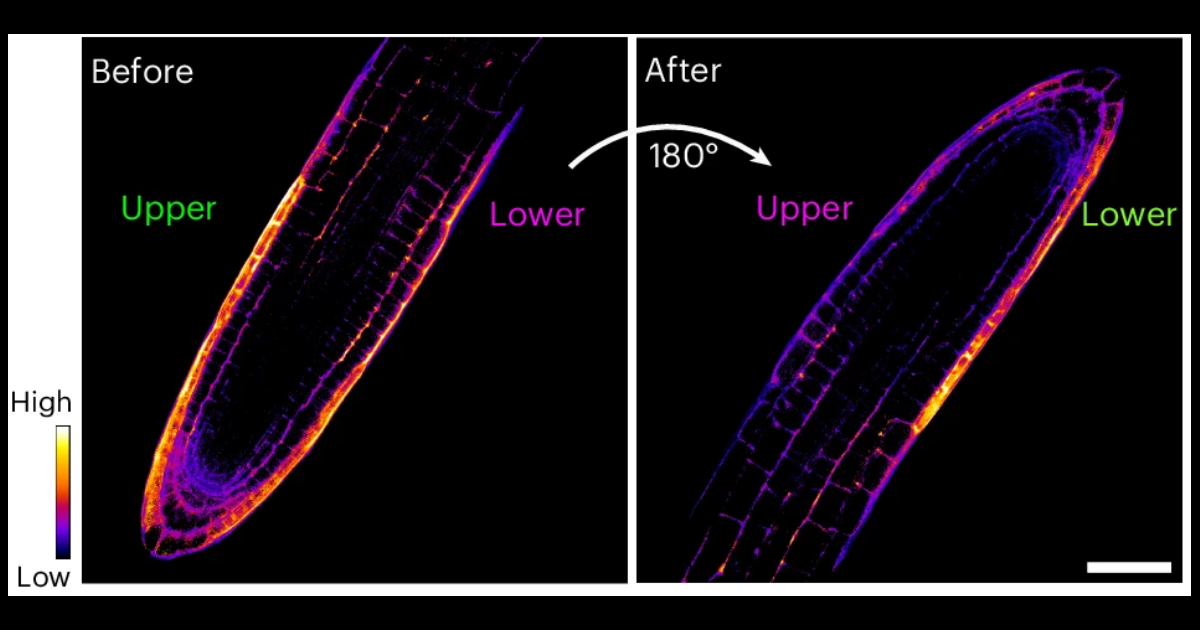
The acid-growth model links cell-wall acidification to wall loosening and turgor-driven expansion. A Nature Plants paper published on 17 July 2026 developed the genetically encoded wall-anchored pH sensor WALLΦ and tested that relationship at cellular resolution in Arabidopsis roots.
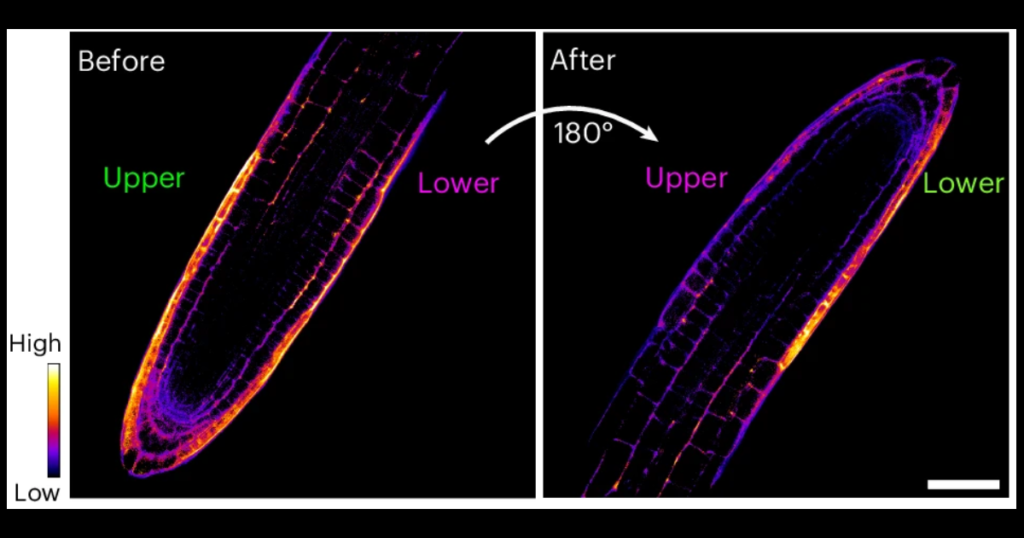
WALLΦ measures pH close to the cell-wall matrix
WALLΦ combines a cellulose-binding module with the pH-sensitive mNeonGreen and relatively pH-insensitive mCherry fluorophores. Ratiometric imaging therefore tracks pH dynamics in the wall matrix rather than relying only on root-surface measurements.
The fastest-growing region was not the most acidic
Cell-wall pH rose from about 4.5 in the meristem to about 5.5 in the transition/early elongation zone, then fell again toward the differentiation zone. Local wall pH and local strain rate did not map onto one another in a simple way. Longitudinal and transverse walls also showed different pH values within individual cells.
Acidification still changes growth
External-pH shifts and activation of H+-ATPases with fusicoccin changed wall pH and root growth. The key conclusion is therefore not that acid growth is false: wall-pH changes can be sufficient to alter elongation, but the normal developmental zonation of root growth cannot be explained by pH alone.
The sensor has technical limits
Intracellular fluorescence produced during WALLΦ maturation must be removed computationally, and absolute pH estimates depend on calibration. The study is best read as a higher-resolution test of a classical model rather than its simple rejection.
For related context, see When a Phytotoxin Promotes Growth: Fusicoccin Activates the Guard-Cell H+-ATPase–14-3-3 System.
For related context, see Upper and Lower Leaf Stomata Use Different K⁺ Channel Compositions for Light-Induced Opening.
For related context, see A Pumpkin mRNA Moves into Grafted Cucumber Shoots: CmoKARI1 Raises Isoleucine and JA-Ile to Improve Chilling Tolerance.
Reference
- Krupař P et al. Root developmental zonation is independent of cell wall pH. Nature Plants. 2026;12:1334–1343. https://doi.org/10.1038/s41477-026-02339-z


Comments