A blueberry with a crisp bite feels very different from one that softly yields in the mouth. Firmer berries may withstand handling better, but does greater firmness necessarily mean better flavor, eating quality, or commercial value?
A study published in Frontiers in Plant Science on October 8, 2026 compared two blueberry genotypes and investigated changes in cell-wall composition and gene expression during ripening. The researchers also tested the function of a candidate fruit-softening gene, VcβGAL369. Their findings offer a molecular explanation for part of the softening process, while raising a broader question: what degree of firmness is desirable for eating, shipping, harvesting, and processing?
- The unusually firm blueberry genotype 2017D
- Why do blueberries become softer?
- RNA-seq identified the candidate gene VcβGAL369
- Are firmer blueberries necessarily tastier?
- Why shipping and mechanical harvesting may favor firmer fruit
- Processing demands different definitions of quality
- Could genome editing optimize firmness for different uses?
- Conclusion: Softening is a normal part of ripening, not automatically a defect
- References and figure permissions
The unusually firm blueberry genotype 2017D
Blue fruit differed by approximately 5.4-fold in firmness
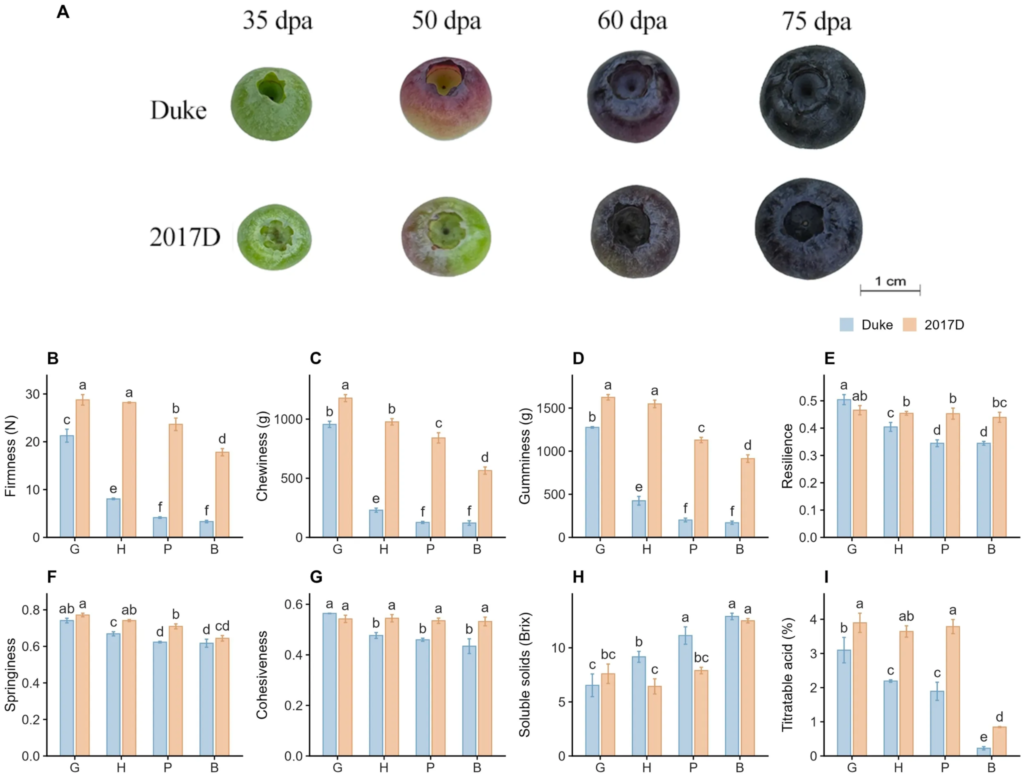
The researchers compared the commercial cultivar ‘Duke’ with a firm-fruited genotype called ‘2017D’. Plants were grown under shared field management, and berries were measured at 35, 50, 60, and 75 days post-anthesis (dpa).
| Measurement | Duke | 2017D |
|---|---|---|
| Firmness at 35 dpa (green stage) | 21.27 N | 28.77 N |
| Firmness at 75 dpa (blue stage) | 3.32 N | 17.81 N |
| Decrease from 35 to 75 dpa | ~84.4% | ~38.1% |
At 75 dpa, when both genotypes had blue fruit, measured firmness was about 5.4 times higher in 2017D. These values represent the force obtained by an instrument compressing a berry, not a claim that consumers experience a 5.4-fold difference when chewing.
The letters G, H, P, and B in the original Figure 1 indicate green, turning, purple, and blue stages. Duke is typically considered a reasonably firm commercial cultivar; in this experiment it was soft relative to the particularly firm 2017D. The comparison should not be taken to mean that Duke is universally a soft cultivar.
One limitation is also worth keeping in mind. Equal days after flowering and a similar blue skin color do not guarantee identical internal maturity. 2017D had higher titratable acidity across development, so differences in ripening progression may also contribute to the observed differences.
Beyond the firmness measurement
The authors measured other instrumental texture characteristics, including chewiness, gumminess, resilience, springiness, and cohesiveness. Several of these were maintained at higher levels in 2017D. Tissue observations also suggested relatively better continuity of the mesocarp structure at the blue stage.
However, a high instrumental chewiness or gumminess value does not by itself mean a more pleasant mouthfeel. Skin toughness, juiciness, sweetness, acidity, and the sensation of biting through the fruit all matter.
Why do blueberries become softer?
A major factor is remodeling of the plant cell wall. Cellulose microfibrils provide an essential structural framework, while hemicelluloses and pectins contribute to the organization of cell walls and cohesion between neighboring cells.
As fruit matures, these polymers can be modified, fragmented, and solubilized. The mechanical properties of the tissue change and the fruit may soften. Water status and cell turgor also contribute, so softening cannot be explained by cell-wall chemistry alone.
In the 2026 study, 2017D generally retained more hemicellulose and insoluble pectin. Duke had higher soluble pectin during later development. It is therefore misleading to say that “more pectin always means firmer fruit.” The chemical and physical state of the pectin matters.
Enzyme activities also differed. Polygalacturonase (PG) breaks down parts of pectin backbones, while β-galactosidase (β-GAL) releases galactose residues from cell-wall polysaccharides. PG activity was lower in 2017D across all sampled stages; β-GAL activity was lower in several stages.
Not all cell-wall-related enzymes followed the same pattern. Cellulase and pectin methylesterase varied with developmental stage. Berry softening is a network of related biochemical and physical changes, not the action of one universal softening enzyme.
RNA-seq identified the candidate gene VcβGAL369
To identify genes associated with the difference, the researchers performed RNA sequencing of blue-stage fruit, with three biological replicates per genotype. They detected 6,168 differentially expressed genes and investigated 50 candidates associated with cell-wall metabolism. A β-galactosidase gene, VcβGAL369, emerged as an important candidate.
Expression differences alone do not establish causality. Genes can change expression simply because fruit are at different stages of physiological maturation. The critical next step was therefore to change VcβGAL369 expression experimentally.
Silencing the gene increased fruit firmness
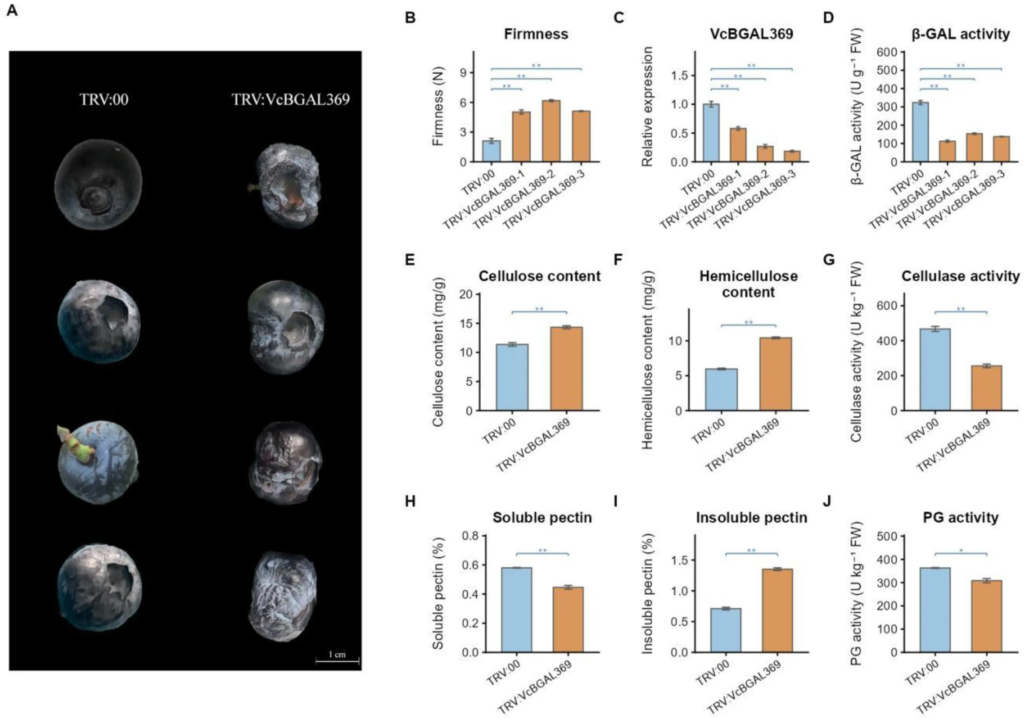
The team used tobacco rattle virus–based virus-induced gene silencing (VIGS) to transiently suppress VcβGAL369. At 14 days after infiltration, silenced fruit were significantly firmer than the empty-vector control (TRV:00).
Reduced gene expression coincided with lower β-GAL activity, increased cellulose and hemicellulose, more insoluble pectin, and less soluble pectin. Activities of PG and cellulase were also reduced.
These changes support a functional contribution from VcβGAL369 to cell-wall remodeling and fruit softening.
Overexpression caused the opposite response
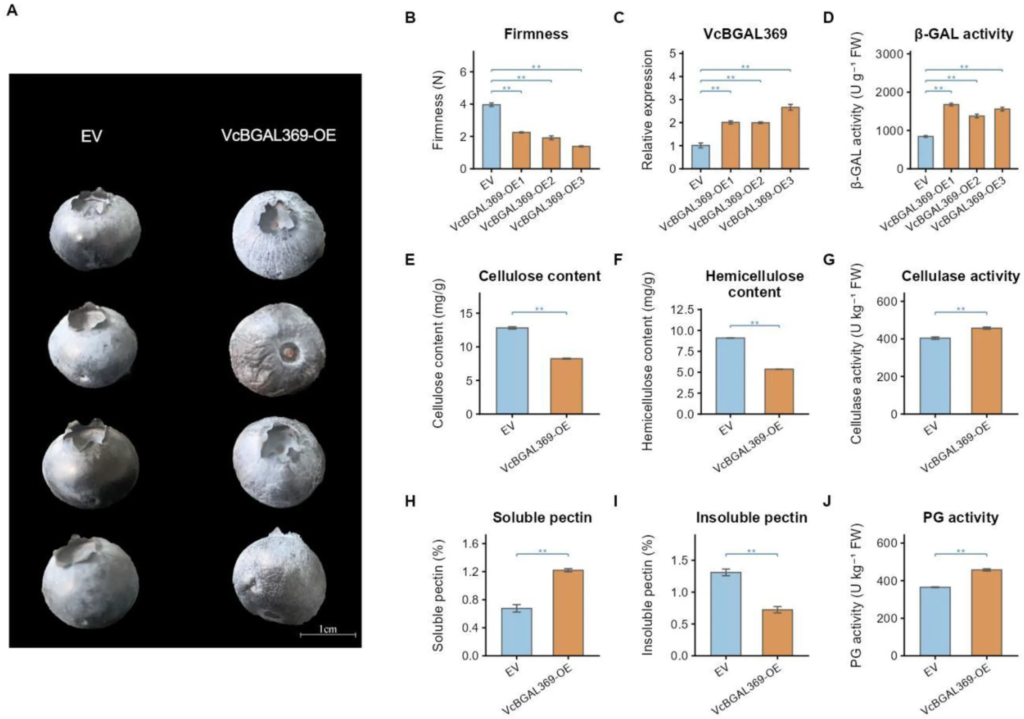
In a separate experiment, Agrobacterium-mediated transient overexpression increased VcβGAL369 expression. At three days after infiltration, treated fruit were significantly softer than empty-vector (EV) controls.
β-GAL activity increased, with higher soluble pectin and lower insoluble pectin, consistent with a shift toward a softer cell-wall state.
Lower VcβGAL369 expression increased firmness, whereas higher expression decreased firmness. This bidirectional functional evidence makes the study more convincing than a simple RNA-seq comparison.
Nevertheless, the direct substrate specificity of VcβGAL369 and its precise interactions with other wall-modifying enzymes remain unclear. The VIGS and overexpression studies also used different durations and control conditions; their absolute firmness values should not be compared directly.
Are firmer blueberries necessarily tastier?
High firmness may be advantageous in handling, but consumer preference is another dimension of quality.
A 2025 study in The Horticulture Journal assessed sensory characteristics and preferences for 34 blueberry cultivars among Japanese consumer panelists. Its correlations with overall liking were:
| Perceived attribute | Correlation with overall liking |
|---|---|
| Liking of texture | r = 0.66 |
| Sweetness intensity | r = 0.58 |
| Flavor intensity | r = 0.42 |
| Perceived firmness | r = 0.22 |
The distinction is striking: liking the texture was strongly associated with overall liking, while firmness by itself had a weaker association. This study measured perceived sensory firmness; it did not report the same compression metric as the 2026 genotype comparison. Nor can one consumer panel represent all populations.
A blueberry can be satisfyingly crisp and juicy, or unpleasantly tough and resistant to chewing. These outcomes are not distinguished adequately by a single compression-force number. Research combining consumer sensory testing with multiple mechanical measurements likewise suggests that texture is multidimensional.
Importantly, the 2026 study did not conduct a sensory panel for 2017D. Its exceptional instrumental firmness is not evidence that people would find it tastier than Duke.
Why shipping and mechanical harvesting may favor firmer fruit
Initial firmness is not the same as shelf life
After harvesting, blueberries encounter grading, packing, vibration, impacts, changes in humidity, cold storage, and retail handling. Fruit that become excessively soft may deform or bruise more readily. Maintaining suitable firmness therefore has clear potential commercial value.
But it is incorrect to infer postharvest life directly from fruit firmness at harvest. A review by Moggia and Lobos (2023) explains that harvest firmness alone cannot reliably predict softening after long storage. Water loss can lower cell turgor and affect measured firmness even if aspects of cell-wall structure remain intact.
The 5.4-fold difference reported by Wang and colleagues was measured during fruit development on the plant. The researchers did not show that 2017D lasts 5.4 times longer, sustains less shipping damage, or has better long-distance transport performance. Those claims require dedicated storage and shipment trials.
Mechanical harvesting calls for impact resistance
In mechanical harvesting, berries may collide with equipment or catching surfaces. A variety that resists internal bruising and subsequent discoloration is valuable, but compression firmness alone cannot guarantee impact tolerance. Harvester and packing-line design matter as well.
The ideal target is therefore not necessarily the maximum possible firmness, but the combination of physical traits that preserves marketable quality through actual handling.
Processing demands different definitions of quality
The importance of firmness also changes with the end product.
| Use | Key quality traits | Importance of firmness |
|---|---|---|
| Fresh consumption | Pleasant mouthfeel, juiciness, sweetness, acidity | Appropriate rather than maximal firmness |
| Fresh shipping | Damage resistance, shape retention, storage quality | High |
| Mechanical harvesting | Impact tolerance, reduced internal bruising | Important but insufficient alone |
| Frozen whole berries / fruit inclusions | Shape retention, thawed texture, drip loss | Depends on the product |
| Jam and purée | Flavor, acidity, color, processing properties | Initial firmness may be less important |
| Juice | Yield, flavor, color, composition | Often secondary |
A whole-fruit frozen product or yogurt inclusion may benefit from shape retention. For jam or juice, fresh-fruit compression firmness may be less important than other traits of the raw material and processing behavior.
This does not mean all soft berries are suitable for processing. Normal ripening-associated softening must be distinguished from excessive bruising, microbial spoilage, and decay.
Could genome editing optimize firmness for different uses?
The functional experiments suggest that VcβGAL369 could be studied as a breeding target. Suppressing its action might help maintain fruit firmness during development.
However, the paper did not generate a stable genome-edited blueberry cultivar. Transient expression changes are not equivalent to permanent gene disruption, especially in blueberries with complex genetic backgrounds and multiple related β-GAL genes.
Future studies will need to examine stable edited lines, effects on maturity, sensory qualities, fruit size and yield, postharvest water loss, impact resistance, and performance in multiple environments.
The most useful goal may be to produce berries with the right combination of texture and handling qualities for their purpose, rather than creating the hardest possible berry for every market.
Conclusion: Softening is a normal part of ripening, not automatically a defect
Wang and colleagues demonstrated a large genotype-dependent difference in blueberry firmness and provided functional evidence that VcβGAL369 contributes to fruit softening. These findings advance our understanding of cell-wall remodeling during ripening.
Yet greater hardness does not automatically imply improved flavor, a more enjoyable texture, longer shelf life, or better processing performance.
The important question is not simply how to make blueberries firmer, but how to maintain the qualities that matter for the intended consumer and supply chain. Genes such as VcβGAL369 may eventually provide useful tools to explore that possibility.
References and figure permissions
- Wang B, Yu C, Ma Y, Tang X, Li Y, Sun H. (2026). Integrated physiological and transcriptomic analyses reveal cell wall remodeling underlying firmness retention in a firm-fruited blueberry genotype. Frontiers in Plant Science 17:1962192. DOI: 10.3389/fpls.2026.1962192.
- Hiraiwa N, Yamane H, Nishiyama S, Tao R. (2025). Favored Blueberry Fruit Attributes by Japanese Consumers: Preferences and Sensory Evaluation of Blueberry Taste and Texture. The Horticulture Journal 94(2):174–183. DOI: 10.2503/hortj.SZD-017.
- Oh H, et al. (2024). Prediction of blueberry sensory texture attributes by integrating multiple instrumental measurements. Postharvest Biology and Technology 218:113160. DOI: 10.1016/j.postharvbio.2024.113160.
- Moggia C, Lobos GA. (2023). Why measuring blueberry firmness at harvest is not enough to estimate postharvest softening after long term storage? A review. Postharvest Biology and Technology 198:112230. DOI: 10.1016/j.postharvbio.2022.112230.
- Oregon State University Extension Service. Blueberry Cultivars for the Pacific Northwest.
Figures 1, 6 and 7 from Wang et al. (2026) are reproduced without modification. © 2026 Wang, Yu, Ma, Tang, Li and Sun. Licensed under CC BY 4.0.

Comments