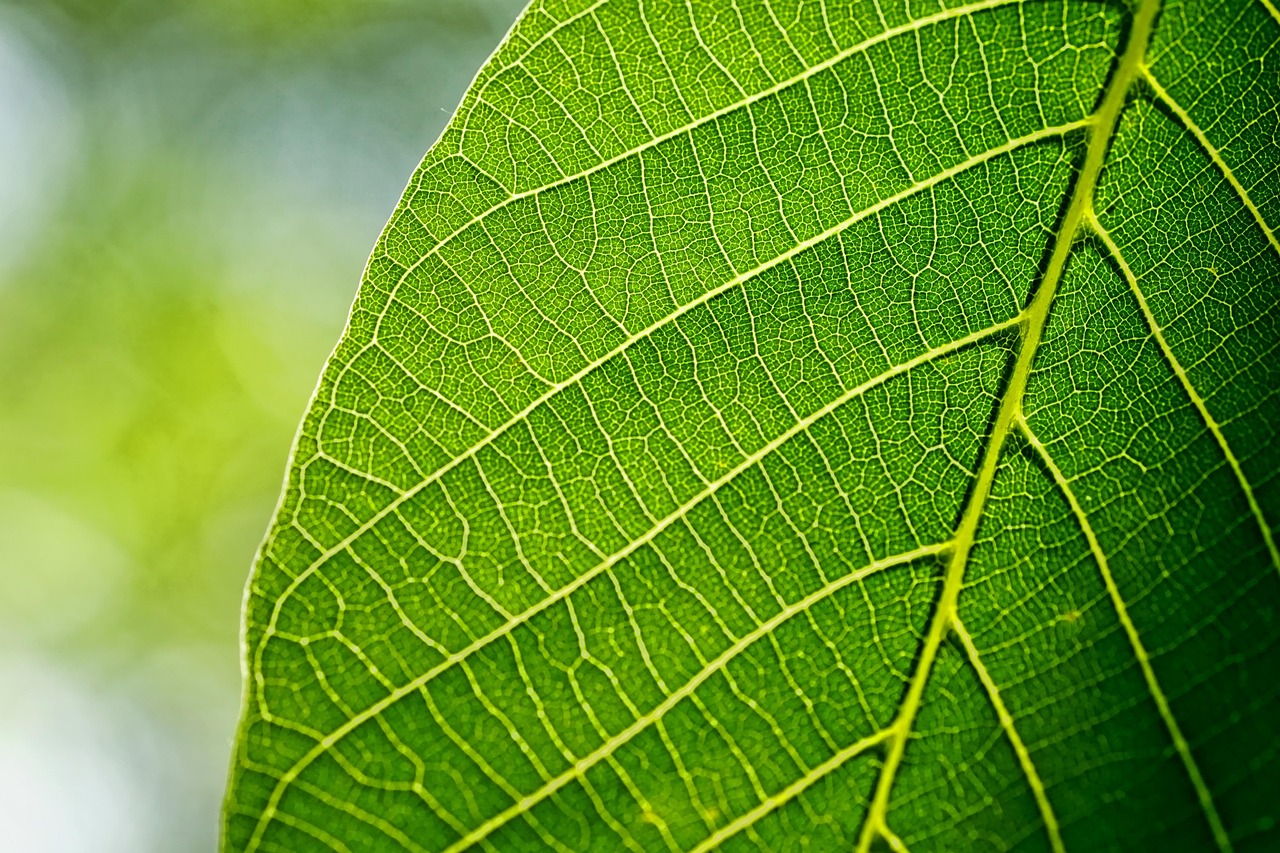
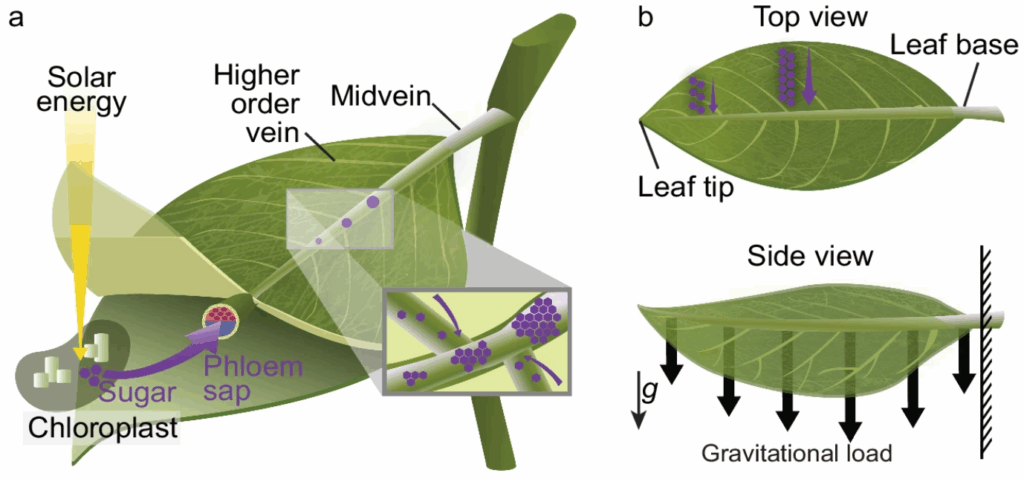
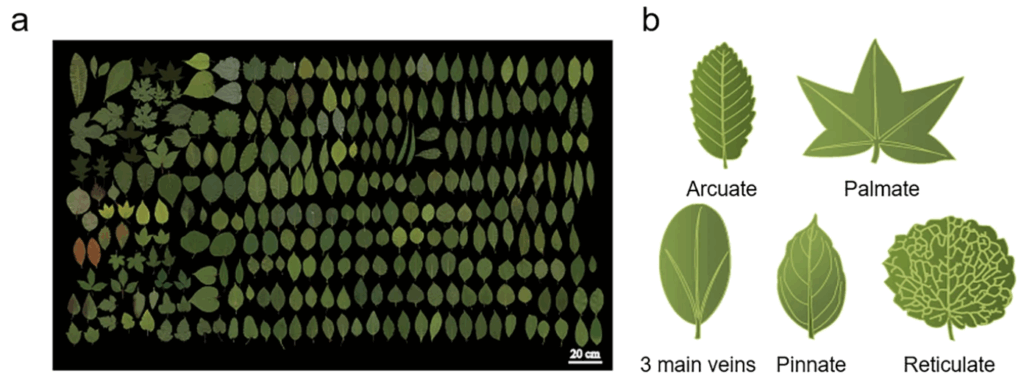
Leaf midveins transport water, photoassimilates and signals while also acting as structural beams. A 2025 npj Science of Plants study compared leaf and midvein geometry across 147 species and theoretical models of transport and mechanical stability.
The dataset spanned midrib lengths of 30–307 mm
Across diverse leaf shapes and habitats, veins generally widened from tip to base, with a measurable link between leaf shape and vein diameter.
The tip matched transport optimization; the base matched mechanical optimization
A phloem-translocation model and a gravitational mechanical-support model predicted different optimal diameter profiles. Observed veins were closer to the transport optimum near the tip and the mechanical optimum near the base.
The result suggests position-dependent specialization rather than one uniform compromise along the whole midvein.
Thicker veins improve both transport capacity and stiffness but cost biomass and occupy non-photosynthetic area. The often-cited possibility of veins occupying up to 50% of leaf area comes from background literature, not a 50% measurement across all 147 species in this study.
The architecture is potentially useful for biomimetic engineering, but this paper did not construct or validate an artificial pipe network, heat exchanger or structural material.
For related context, see Why Are Macadamia Shells So Hard? 3D Cellular Structure, Crack Deflection and Composite Reuse.
For related context, see A Light-Responsive Maple-Samara Microflier Can Tune Its Descent and Landing Distribution.
For related context, see 3D-Printing Wood from Lignin and Cellulose: 200-µm DIW and Hot-Pressed Flexural Performance Beyond Balsa.
Reference
- Hong S et al. A trade-off between transport and mechanics determines plant leaf vein architecture. npj Science of Plants. 2025;1:8. https://doi.org/10.1038/s44383-025-00007-3

Comments