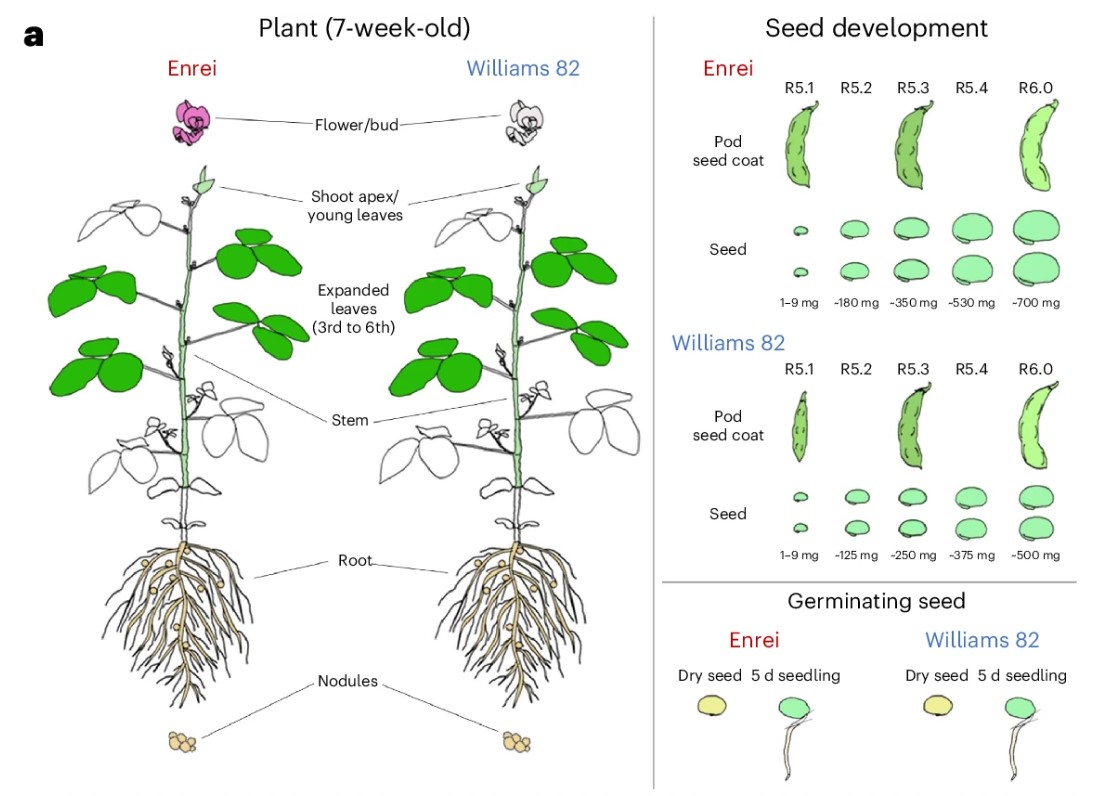
Japanese soybean breeding has emphasized food uses such as tofu, miso and boiled beans, often favoring seed-size and quality traits that differ from breeding priorities in North America. A 2025 Nature Genetics study built 11 long-read genome references and analyzed gene-level structural variation across a pangenome of 462 global soybean accessions.
The paper received two Author Corrections in 2025. Neither overturns its central conclusions, but the current version of record should be used because a phylogenetic-method description and Figure 6c labels were corrected.
- Eleven high-quality references were assembled with long reads
- Asm2sv maps gene-level structural variation
- Japanese and US breeding left different selection signatures
- Seed-size and flowering-related candidate regions were also identified
- June 2025 correction: phylogenetic-tree method
- September 2025 correction: Figure 6c labels
- References
Eleven high-quality references were assembled with long reads
The study generated genome references for seven Japanese, three North American and one primitive soybean line, primarily using Oxford Nanopore sequencing. Multiple references make it possible to see structural differences that can be missed when every accession is forced against a single Williams 82 reference.
Asm2sv maps gene-level structural variation
The authors developed the assembly-comparison pipeline Asm2sv to identify gene-level structural variations, including presence–absence variation. Combining these variants with resequencing data from 462 accessions enabled pangenome analysis, selective-sweep scans and GWAS.
Japanese and US breeding left different selection signatures
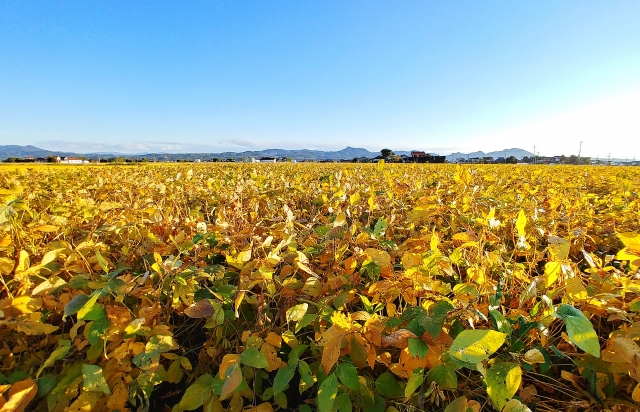
One major sweep difference includes the pod-shattering gene PDH1. US breeding strongly favored alleles suited to mechanical harvest and reduced shattering, while Japanese populations retained different allele frequencies.
This is not a hierarchy of “better” and “worse” soybeans. Different food markets, seed sizes, climates and harvest systems create different breeding objectives and therefore different genomic selection histories.
Seed-size and flowering-related candidate regions were also identified
GWAS and structural-variation analysis highlighted candidate genes and genomic regions associated with the large, round seeds characteristic of many Japanese food soybeans and other traits. Candidate association, however, is not the same as a guarantee that editing a single gene will produce an elite cultivar.
Breeding value still has to be tested in genetic backgrounds and field environments, including trade-offs among yield, quality and adaptation.
June 2025 correction: phylogenetic-tree method
The first correction (10.1038/s41588-025-02256-5) amended the Methods section. The dissimilarity matrix was used to build the phylogenetic tree with UPGMA, whereas the initial text had incorrectly said neighbor joining.
September 2025 correction: Figure 6c labels
The second correction (10.1038/s41588-025-02356-2) fixed missing/incorrect x-axis frequency percentages in three right-hand Figure 6c panels to “0; 30; 60” and added the missing Harosoy #7 label. The online article and PDF were updated.
These corrections matter for accurate interpretation and reproducibility, but they do not retract the main pangenome and selection findings.
The broader value of this work is not merely a list of CRISPR targets. It provides a structural-variation-aware resource for choosing germplasm, reconstructing breeding history and designing crosses that use diversity invisible to a single reference genome.
For related context, see SW14 Rebalances Soybean Seed Weight, Protein and Oil by Disrupting a LEC1-Containing NF-Y Complex.
For related context, see Why Cultivated Soybean Pods Resist Shattering: Natural Mutations in Sh1 and Pdh1.
For related context, see How Much “Breeding” Happened in This AI Breeding Study? Reading a Synthetic-Data bioRxiv Proof of Concept.
For related context, see A Full-Length Arabidopsis eccDNA Atlas Reveals Centromeric Hotspots, Transposons and Epigenetic Regulation.
References
- Yano R et al. The genomic landscape of gene-level structural variations in Japanese and global soybean Glycine max cultivars. Nature Genetics. 2025;57:973–985. https://doi.org/10.1038/s41588-025-02113-5
- Author Correction. https://doi.org/10.1038/s41588-025-02256-5
- Author Correction. https://doi.org/10.1038/s41588-025-02356-2

Comments