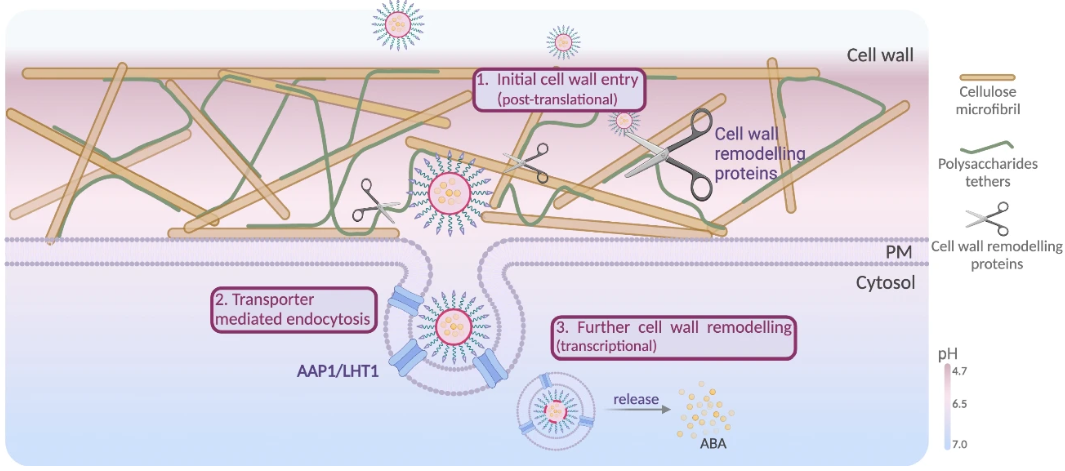
A 2025 Nature Communications study developed an aspartic-acid-decorated polymer micelle, Asp/PDPA-NP, that uses endogenous plant amino-acid transporters as receptors for autonomous nanoparticle uptake.
AtAAP1 and AtLHT1 support clathrin-dependent endocytosis
In Arabidopsis, uptake depended on AtAAP1 and AtLHT1 and was reduced by endocytosis inhibition, supporting a transporter-associated clathrin-dependent entry mechanism. Cell-wall-remodeling responses were also observed, although the exact mechanism by which the particles cross the wall remains incompletely resolved.
Spray or co-culture delivered cargo within 10 minutes
Fluorescent cargos were delivered into multiple plant tissues and cell types by simple spray or co-culture, with uptake observed within 10 minutes. Delivery was demonstrated in Arabidopsis, soybean, maize and other tested plants without mechanical penetration.
The paper describes the platform as species-independent across the tested systems; this should not be read as proof that every plant species will behave identically.
ABA-loaded particles produced drought responses at 1 nM
ABA-loaded Asp/PDPA-NP reduced the effective ABA dose to 1 nM, described by the authors as a one-million-fold reduction relative to a 1 mM free-ABA comparison. Soybean and maize also showed improved water-withholding responses after foliar application.
This is a powerful proof of concept, not yet evidence that field agriculture can universally cut ABA use by one million-fold.
The delivery route is more important than the ABA example
The platform could potentially carry other chemicals and biomolecules, but generalized delivery of nucleic acids, proteins or genome-editing machinery was not established in this paper. Field use will require environmental-fate, degradation, non-target, cost and regulatory studies.
For related context, see Agricultural Nanotechnology in 2026: Nano-Fertilizers and Nano-Pesticides Move from Efficacy to Safety and Regulation.
For related context, see Can Nanomaterials Improve Cotton Verticillium Wilt Tolerance? PEI-MXene Quantum Dots and ROS Homeostasis.
For related context, see A 4.5-µm Transparent Plant E-Skin Monitors Leaf Growth and Surface Temperature in Real Time.
For related context, see Oxidized Acetosyringone Can Switch Gene Expression in E. coli—but This Is Not Yet an Agrobacterium Transformation Method.
Reference
- Xia X et al. Amino acid transporters mediate autonomous delivery of nanoparticle vehicles into living plants. Nature Communications. 2025;16:6715. https://doi.org/10.1038/s41467-025-60829-8

Comments