Agricultural nanotechnology now spans fertilizers, pesticides, sensors and delivery systems for biomolecules. By 2026, however, the central question has shifted from “can nanoparticles improve delivery?” to what happens to them in soil, food systems and ecosystems—and how should they be regulated?
A 2026 Nature Reviews Earth & Environment review estimates that nano-agrochemicals still account for less than 1% of the global agrochemical market. This is an active technology platform, not yet the default form of crop input.
Nanotechnology aims to deliver smaller amounts more precisely
Nano-fertilizers and nano-pesticides can encapsulate active ingredients, control release rates or alter uptake. Performance depends on particle size, surface chemistry, coating, application route, soil texture, pH and ionic strength.
The 2026 review summarizes studies in which nanoformulations increased crop yield by roughly 20% on average, largely through improved nutrient-use efficiency—but responses vary strongly across crops and environments.
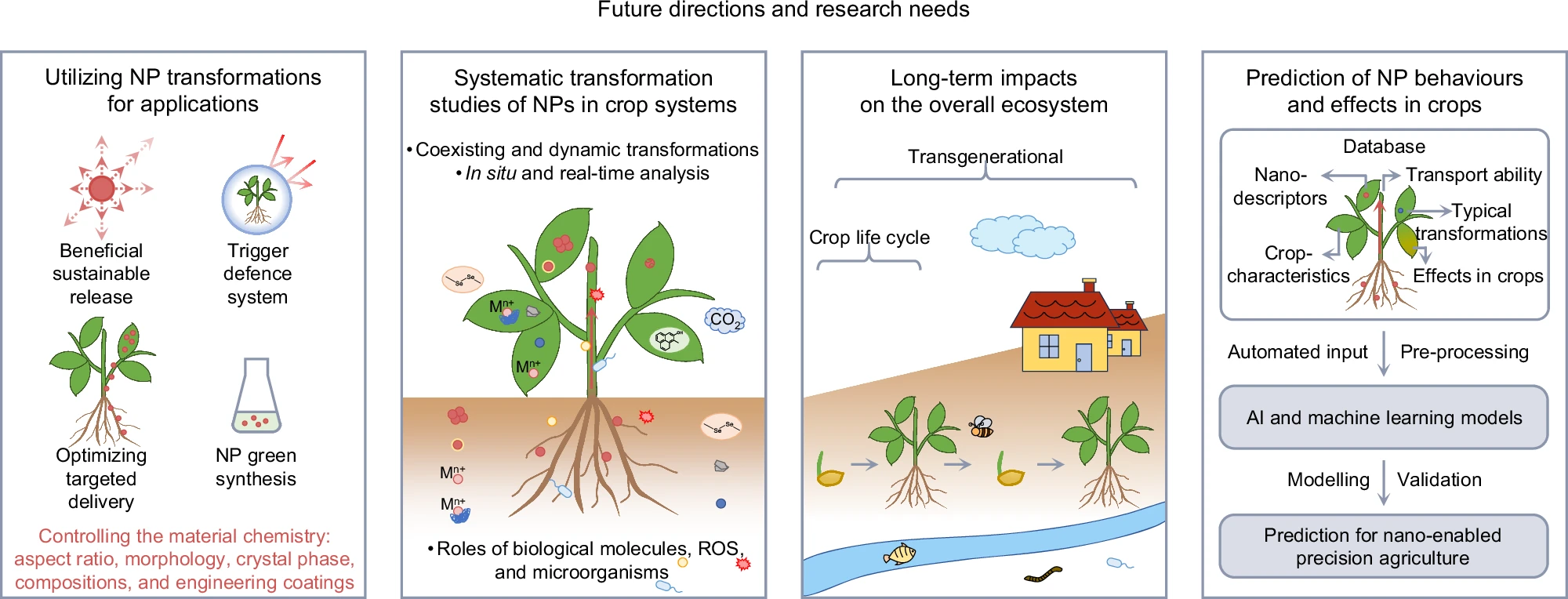
Nanoparticles transform after entering soil
Aggregation, dissolution, redox reactions, organic-matter binding and biological coatings can change nanoparticle behavior. Root exudates, microbes and soil fauna further modify mobility and bioavailability.
Risk assessment therefore has to follow transformation products and long-term fate, not just the pristine material applied at the beginning.
Nano-pesticides can reduce conventional exposure while creating new exposure pathways
Targeted or controlled release can reduce leaching and non-target exposure to active ingredients. But carrier materials and transformed nanoparticles may introduce new persistence, bioaccumulation or ecotoxicology questions.
There is no useful rule that “nano is safer” or “nano is more dangerous.” Risk depends on the specific material, formulation, dose and environment.
Regulation remains heterogeneous
The 2026 review describes contrasting regulatory approaches across the EU, United States, China, Brazil and India. A major unresolved issue is whether conventional pesticide/fertilizer frameworks adequately capture nano-specific properties such as size distribution, surface chemistry and environmental transformation.
The field is increasingly calling for life-cycle assessment and a One Health framework linking crop productivity, human exposure, animal health and ecosystem effects.
As of 2026, agricultural nanotechnology has moved well beyond a laboratory curiosity, but broad deployment still requires reproducible performance, standardized characterization, long-term environmental data and fit-for-purpose regulation.
For related context, see Can Nanomaterials Improve Cotton Verticillium Wilt Tolerance? PEI-MXene Quantum Dots and ROS Homeostasis.
For related context, see Tea Polysaccharides Help Form Chitosan Nanoparticles That Suppress Rice Pathogens In Vitro and on Detached Leaves.
For related context, see Using Amino Acid Transporters as Nanoparticle Entry Receptors: Asp/PDPA-NP Delivers Cargo into Plant Cells Within Minutes.
References
- Xiao Z et al. Nano-agrochemical use in sustainable agriculture and environmental protection. Nature Reviews Earth & Environment. 2026;7:447–468. https://doi.org/10.1038/s43017-026-00796-w
- Luo C et al. The interaction and regulation of nano-agrochemicals in plant–soil microenvironment systems. Environmental Science: Nano. 2026;13:703–722. https://doi.org/10.1039/D5EN01016K
Comments