A 2024 Science Advances study developed a moisture absorption–evaporation cycling fabric (Mac-fabric) inspired by directional water transport and evaporation in plants.
A 1 × 2 cm unit sustained ~0.85 V for more than a month

A typical unit measured 1 cm × 2 cm × 0.025 cm and combined a cellulose nonwoven/LiCl moisture-absorption layer, PAN drainage layer and P(VDF-TrFE) evaporation layer. Around 40% RH and 20°C, a unit sustained ~0.85 V open-circuit voltage for over a month and reached a peak area power output of 0.144 W/m².
Water flow and electrode redox both contribute

The mechanism is not simply cellulose generating electricity from transpiration. Aluminum-electrode redox supplies ions, while directional moisture cycling and charged micro/nanochannels promote ion movement and charge separation.
Large integration: 350 V, 33.76 mA and a phone demo
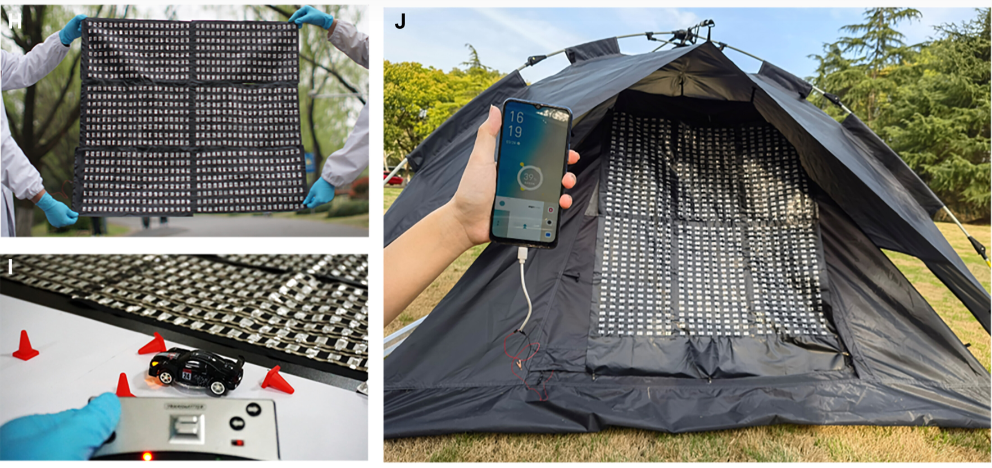
At 25% RH and 20°C, 500 units in series produced 350 V and 300 units in parallel produced 33.76 mA. A tent integrating 1,920 units over 0.384 m² reached 55.3 mW peak output and powered commercial portable electronics including a mobile phone.
This is a series/parallel engineering demonstration, not simply “one square meter of cloth charges a phone.” Manufacturing footprint, electrode consumption, cost and long-term outdoor durability still require broader assessment.
For related context, see A Fog Harvester Inspired by Bushman Grass and Namib Beetles Reached 42% Collection Efficiency.
For related context, see Aloe-Vera-Assisted NiO Nanoparticles Delivered 239 F/g in a Symmetric Supercapacitor.
For related context, see A Fog-Harvesting Grass Creates ‘Fog-Plant-Oases’ That Fuel an Aboveground Food Web in the Namib Desert.
Reference
- Hu Y et al. Phyto-inspired sustainable and high-performance fabric generators via moisture absorption-evaporation cycles. Science Advances. 2024;10:eadk4620. https://doi.org/10.1126/sciadv.adk4620

Comments