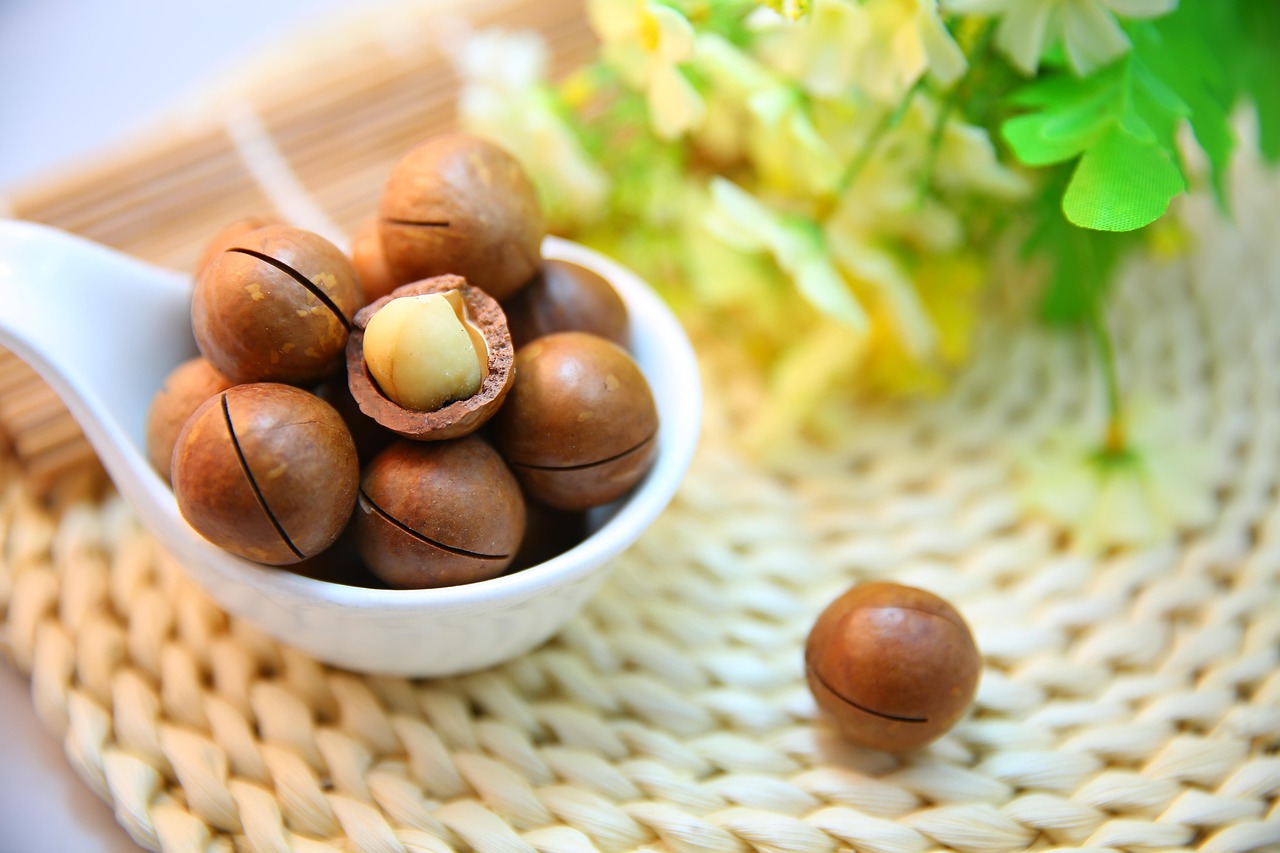
Macadamia nutshell is a low-density biological cellular material with unusually high strength and fracture toughness. Its performance is not explained by lignin alone: randomly oriented cellular structures, vascular bundles and interfaces can divert or arrest cracks.

Reported mechanical properties vary by position and condition, with Young’s moduli around 4.4–7.8 GPa, strengths around 46–61 MPa and fracture toughness around 0.64–0.9 MPa√m. These values do not justify a blanket claim that shell is ‘stronger than aluminium’ across material properties.
A 2025 Materials study moved from biological inspiration toward direct by-product utilization, incorporating 10–15 wt% macadamia-shell powder into epoxy cores for carbon-skin sandwich structures. Particle size and loading altered flexural and short-beam properties, demonstrating a circular-material route rather than a fully biomimetic replica of shell architecture.
For related context, see 3D-Printing Wood from Lignin and Cellulose: 200-µm DIW and Hot-Pressed Flexural Performance Beyond Balsa.
For related context, see Coconut-Mat Layers Reduced Thermal Conductivity of a Geopolymer Panel by Up to 41%.
For related context, see Why Do Leaf Midveins Taper? 147 Species Reveal Position-Specific Optimization for Transport and Mechanics.
References
- Fleck C et al. Microstructural features influencing failure in Macadamia nuts. Bioinspir Biomim. 2012.
- Sesana R et al. Procedia Structural Integrity. 2020. https://doi.org/10.1016/j.prostr.2020.02.088
- Development of Novel Composite Core Using Powdered Macadamia Nutshell… Materials. 2025;18:4369. https://doi.org/10.3390/ma18184369


Comments