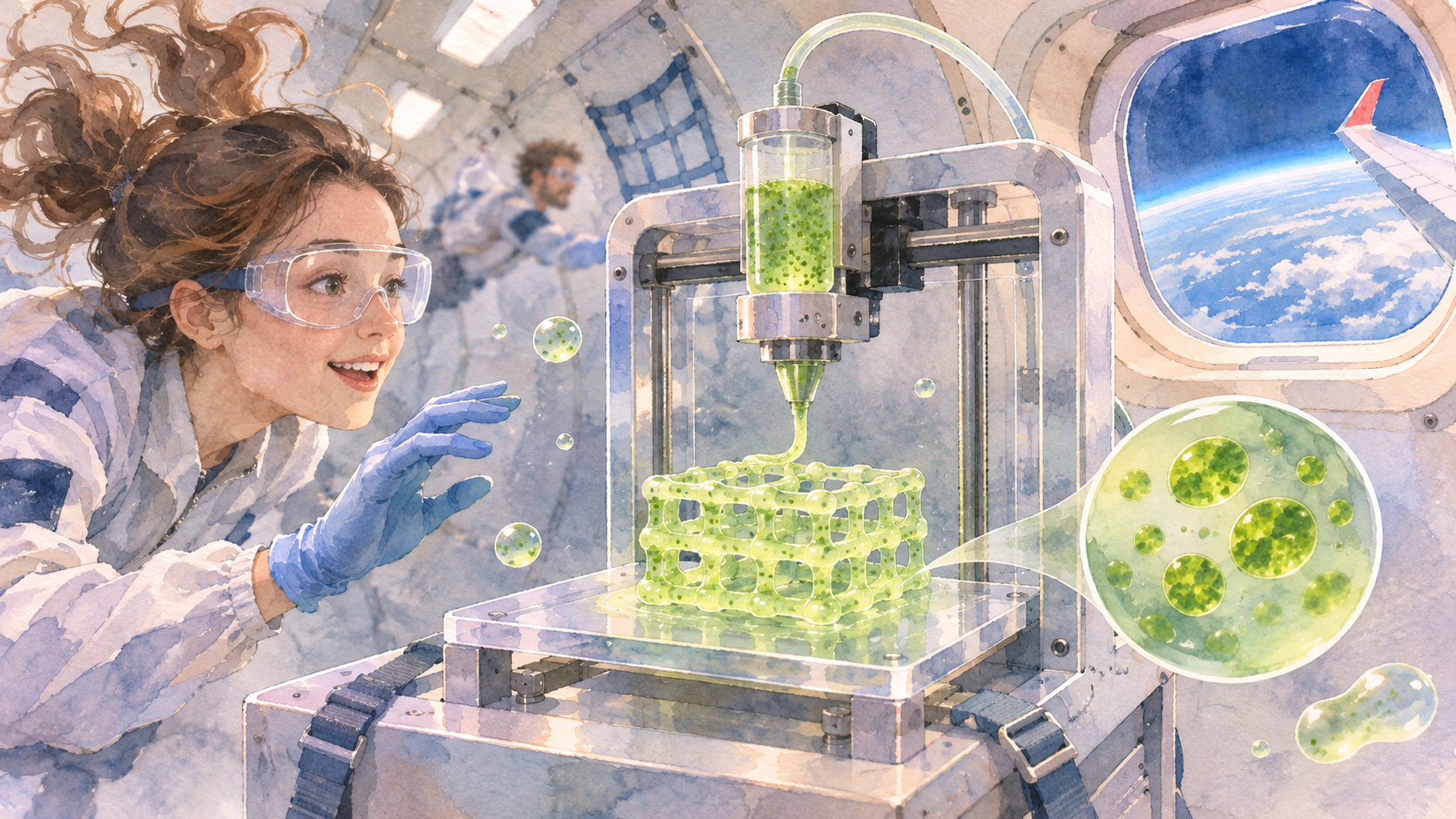
Imagine using just 22 seconds of microgravity to 3D-print a gel containing living algae. It sounds like an ambitious science-fiction experiment, but researchers have actually done it.
On October 30, 2026, a team involving researchers from TU Dresden published a study in npj Microgravity exploring extrusion bioprinting under altered gravity. The living components in their bioink were photosynthetic microalgae.
But why print algae in microgravity at all? Wouldn’t an ordinary culture vessel be enough?
The study offers an unexpected answer: reduced gravity may not just be a challenge for manufacturing. It could sometimes make certain shapes easier to print.
- Just 22 seconds of microgravity to print a structure
- A manufacturing advantage: printing without gravity pulling the gel down
- Did the algae survive being printed?
- Does changing gravity affect photosynthesis?
- Why 3D-print algae in space instead of simply growing them?
- What 22 seconds can—and cannot—tell us about living manufacturing in space
Just 22 seconds of microgravity to print a structure
The experiments did not take place aboard the International Space Station. They were conducted on an aircraft performing parabolic flights.
During this special flight maneuver, the aircraft follows a trajectory that produces approximately 22 seconds of microgravity, at around 0.01 g, per parabola. Those brief periods are preceded and followed by phases of higher acceleration, approximately 1.8 g.
The team therefore had only a short window in which to operate an extrusion-based 3D printer.
They used a gel-like ink based on alginate and methylcellulose. A nozzle extruded thin filaments of material, layering them into three-dimensional structures.
The researchers succeeded in printing structures with up to four layers during microgravity.
That was not the only question they investigated. They also asked whether low gravity could be an advantage.
A manufacturing advantage: printing without gravity pulling the gel down
One of the study’s most striking experiments involved spanning an empty gap with a soft gel filament.
On Earth, a freshly extruded horizontal filament tends to sag under its own weight. Printing overhangs or bridges therefore often requires supports or rapid solidification.
During microgravity, the effect of weight on the filament is greatly reduced.
The researchers tried printing a gel bridge between two supports, without any material underneath.
Under normal gravity, they could not reliably bridge gaps exceeding approximately 16 mm. During microgravity, they successfully printed a bridge across 128 mm—about eight times that reference distance.
There are two important qualifications. First, 128 mm was the longest gap tested in the setup, not a measured physical maximum for the material. Second, the unsupported bridge subsequently collapsed in the approximately 1.8 g phase. The uncrosslinked gel was not permanently stable.
Still, it is a compelling proof of principle: a low-gravity environment may enable soft-material shapes that are difficult to fabricate on Earth.
This bridge experiment did not contain algae. It used a separate, cell-free gel ink, so the result cannot automatically be extended to long-span printing of living bioinks.
Did the algae survive being printed?
For the biological experiments, the team worked with two green microalgae:
- Chlorella vulgaris
- Scenedesmus sp.
They mixed the cells into an alginate–methylcellulose formulation, producing a bioink that could be extruded through a printer nozzle.
During the brief microgravity interval, the team printed three-layer lattice-like constructs, around 6 × 6 mm in size.
Here is a crucial distinction: printing took place in microgravity, but subsequent crosslinking and cultivation did not.
After printing, the constructs were stabilized with calcium chloride under normal gravity and then cultured on Earth.
Seven days later, the reported cell viability was remarkably high:
| Species | Viability after seven days |
|---|---|
| Chlorella vulgaris | 97% |
| Scenedesmus sp. | More than 99% |
In addition, measurements of chlorophyll fluorescence using pulse-amplitude-modulated (PAM) fluorometry indicated that the printed algae retained photosynthetic functionality. The effective quantum yield of photosystem II, Y(II), reached roughly 0.6 for both species.
So the experiment demonstrated more than a printable shape: many cells remained viable and photosynthetically active after the printing process and subsequent culture.
However, the seven-day results were obtained after cultivation at normal gravity. They cannot exclude temporary effects during flight that may have disappeared during recovery. Nor do high viability figures by themselves establish long-term growth rates or productivity.
Does changing gravity affect photosynthesis?
The team carried out another, separate experiment to address this question.
They measured photosynthetic parameters during the flight, comparing algae in liquid cultures with algae contained in gel constructs that had been printed on Earth the day before.
With PAM fluorometry, they measured the effective PSII quantum yield, Y(II), alongside Y(NPQ) and Y(NO), indicators related to how absorbed light energy is allocated and dissipated.
Comparisons across the main gravity phases—approximately 1 g, 0.01 g, and 1.8 g—did not show significant differences in mean values for these parameters.
That does not mean gravity has no impact on algal photosynthesis.
For example, Y(II) in liquid-cultured Scenedesmus declined from roughly 0.5 to 0.3 over five successive parabolas. The researchers also observed species-dependent patterns and transient responses in energy-dissipation parameters.
The cautious interpretation is that core photosynthetic functionality was largely maintained through short gravity transitions, while some time-dependent or species-specific effects remain possible.
It is also important not to confuse this in-flight fluorescence experiment with the experiment in which algae were printed during microgravity: the samples used for real-time PAM readings had been prepared on the ground.
Why 3D-print algae in space instead of simply growing them?
At this point, the most natural question is also the most difficult one: if the goal is to cultivate algae in space, why not use conventional liquid culture?
Microalgae can use light energy to fix carbon dioxide and release oxygen. They are being explored for potential roles in life-support systems, food and biomass production, and wastewater treatment. For long-duration space missions, the ability to recycle resources could be particularly valuable.
A 3D-printed algal construct might, in principle, offer a different kind of control: living cells could be positioned within a designed structure rather than simply suspended in a liquid.
A future device might use carefully arranged geometries to improve illumination or manage contact between cells, water, and gases. Low gravity could also offer new options for creating delicate shapes without conventional supports.
But these are potential applications, not outcomes established by this paper.
The study did not demonstrate that printed algae produced more oxygen, fixed more CO₂, or grew more efficiently than liquid cultures. Indeed, immobilizing cells in a gel might itself introduce problems such as reduced light penetration or limited mass transfer.
Being able to print a complex shape is not the same as creating a more efficient bioreactor.
What 22 seconds can—and cannot—tell us about living manufacturing in space
It would be premature to say that this study created a functional, long-duration photosynthetic system for space.
The researchers demonstrated short-term extrusion printing under genuine microgravity, followed by stabilization and cultivation at normal gravity. A separate experiment assessed photosynthetic fluorescence during changing gravitational conditions.
The findings nevertheless matter for two reasons.
First, they show that a bioink containing living microalgae can be extruded into a defined structure during real microgravity.
Second, they demonstrate a potential manufacturing benefit of reduced gravity: unsupported soft-material bridges can span distances that are much more challenging on Earth, at least while the low-gravity interval lasts.
Space manufacturing is often discussed as an attempt to make terrestrial technologies operate despite a difficult environment. This work suggests a different possibility: some aspects of that environment may actually be useful.
Microgravity may not merely be something to overcome. For certain forms of biomanufacturing, it could become a design tool.
Whether algae-filled structures will ever outperform conventional cultures in a working life-support system remains an open question. But the study provides an intriguing first step: 22 seconds of microgravity were enough to test a new way of shaping living photosynthetic material.
Reference
Windisch, J., Richter, R. F., von Witzleben, M., et al. (2026). Characterizing the extrusion bioprinting process and microalgal photosynthetic efficiency in bioprinted constructs during parabolic flights. npj Microgravity, 12, Article 90.
DOI: 10.1038/s41526-026-00669-y
Published: October 30, 2026.
This article distinguishes results directly demonstrated in the study from proposed future applications. The featured watercolor illustration is conceptual artwork, not a photograph of the experiment.

Comments