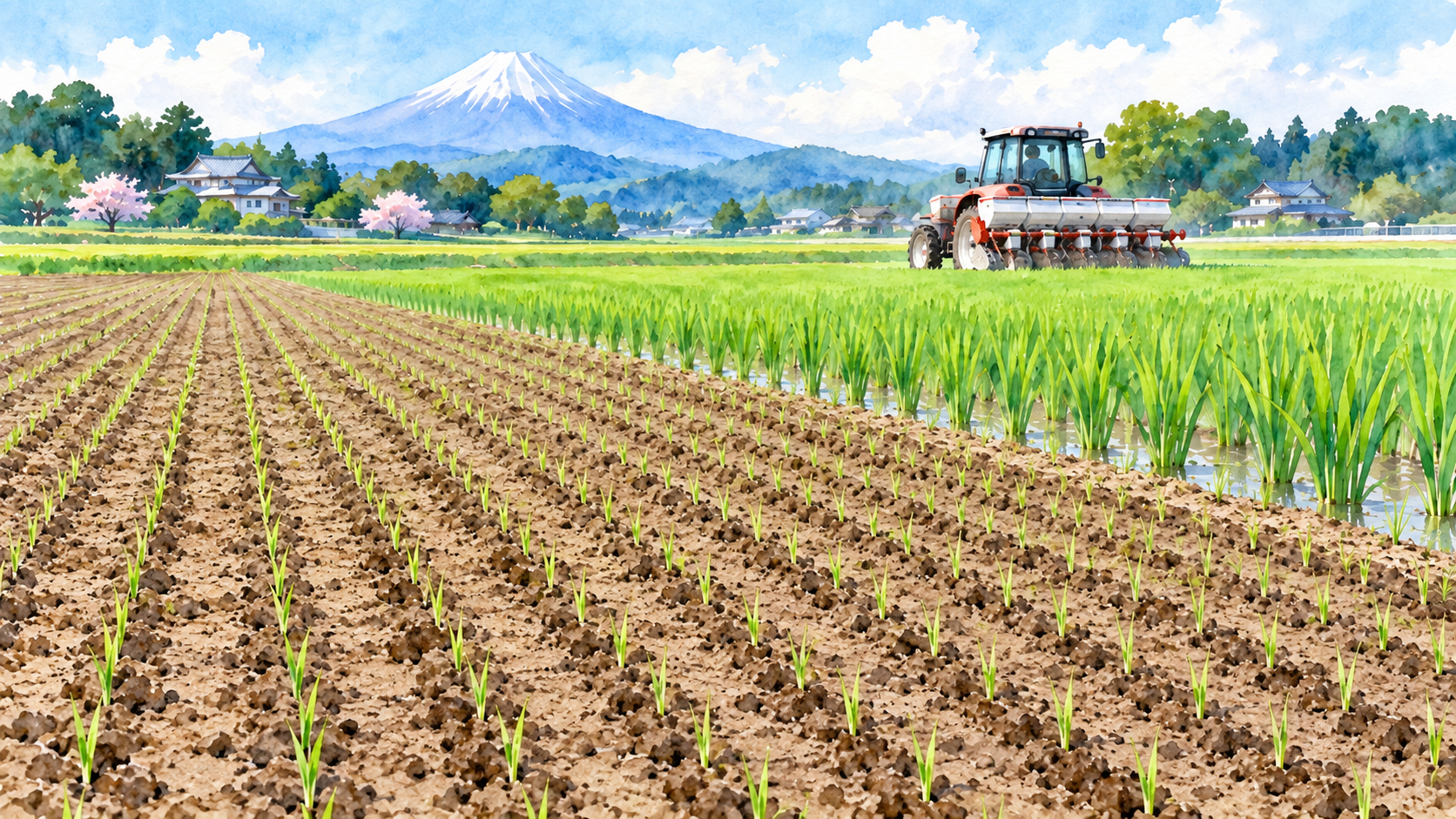
When people picture rice farming in Japan, they often imagine seedlings raised in nursery trays and transplanted into flooded paddies by a rice transplanter.
But a different system is gradually expanding: direct-seeded rice (DSR), in which rice seed is sown directly into the field instead of being transplanted as seedlings.
At first glance, this looks like a straightforward labor-saving technology. Remove nursery production and transplanting, and rice farming becomes simpler. Yet when we follow the statistics, machinery systems, agronomic research, and breeding targets, a broader shift appears.
The fastest-growing form in Japan is dry direct seeding, where seed is sown into a dry field before irrigation. In some systems, farmers use grain drills and other machines originally designed for upland crops, share equipment with wheat and soybean production, integrate crop rotation, and harvest with conventional combines.
In other words, this is not only about “eliminating rice transplanting.” It is increasingly about connecting part of paddy-rice production to machinery and management systems that resemble upland cropping.
And once nursery-grown seedlings are removed, some of the work previously performed by farmers is transferred back to the seed and young plant. Rice must emerge under cool conditions, push through soil, establish roots quickly, compete with weeds, and remain standing well enough for mechanized harvest.
Labor saving does not make the biological problems disappear. It redistributes work from human handling to field design, machinery, and plant traits. That makes direct seeding an interesting subject not only for agricultural engineering, but also for plant physiology and breeding.
- Is direct-seeded rice actually increasing in Japan?
- “Direct seeding” includes very different production systems
- Why remove transplanting now?
- Dry direct seeding is more than swapping a transplanter for a seeder
- What happens at harvest?
- Simplifying machinery gives more work back to the plant
- Wet direct seeding can make low-oxygen germination a major trait
- Weeds are one price of eliminating the nursery advantage
- Lodging resistance becomes part of the machinery system
- ‘Emimaru’ shows what a direct-seeding cultivar can mean
- Dry direct seeding is not expanding because it always yields more
- Field demonstrations show major labor savings—but the numbers need context
- Dry direct seeding is not the same as water-saving dry direct seeding
- Labor saving does not remove work—it moves it
- The future of rice farming is not only a better transplanter
- References and sources
Is direct-seeded rice actually increasing in Japan?
The latest prefecture-level figures currently available from Japan’s Ministry of Agriculture, Forestry and Fisheries (MAFF), corrected in June 2026, cover the 2024 crop year.
In 2024, direct-seeded rice occupied 41,656.7 ha out of 1,514,380 ha of rice area, corresponding to 2.8% of total rice acreage.
That is still a small minority of Japanese rice production. But the breakdown shows a clear directional change.
| Crop year | Dry direct seeding | Wet direct seeding | Total direct seeding | Share of rice area |
|---|---|---|---|---|
| 2020 | 14,630.9 ha | 20,160.8 ha | 34,853.7 ha | 2.2% |
| 2023 | 19,677.7 ha | 18,960.3 ha | 38,638.0 ha | 2.5% |
| 2024 | 23,041.9 ha | 18,556.9 ha | 41,656.7 ha | 2.8% |
From 2020 to 2024, total direct-seeded area increased by about 19.5%. Wet direct seeding declined by roughly 8%, while dry direct seeding increased by about 57.5%.
Even from 2023 to 2024 alone, total direct seeding rose by about 7.8%, while dry direct seeding increased by about 17.1%. By 2024, dry direct seeding accounted for roughly 55% of all direct-seeded rice area.
So the most accurate description is not simply “direct seeding is increasing.” The stronger trend is that dry direct seeding is expanding within Japan’s direct-seeded rice sector.
There is an important caveat. MAFF explicitly notes that these figures are based on voluntary prefectural inquiries and are not designed as a fully controlled statistical survey. Some prefectures did not provide complete breakdowns, and dry- versus wet-seeding subtotals do not always perfectly match the reported total. The numbers are therefore best interpreted as indicators of adoption trends rather than exact census values.
“Direct seeding” includes very different production systems
Japanese direct-seeded rice is broadly divided into wet direct seeding and dry direct seeding.
Wet direct seeding places rice seed into a puddled or otherwise water-managed paddy. Seedlings are not transplanted, but the field environment remains relatively close to conventional paddy-rice management.
Dry direct seeding is different. The field is prepared while dry, rice is sown into soil, seedlings emerge and establish, and irrigation is introduced later.
This distinction matters because Japanese dry direct seeding does not usually mean that rice remains under dryland conditions all the way to harvest. The field is dry during sowing and early establishment, but it is subsequently managed as a paddy in most conventional systems.
Adoption also differs strongly by region.
In 2024, Aichi Prefecture had a direct-seeding rate of 16.7%, and 4,559.5 ha of its 4,622.6 ha direct-seeded area was dry direct seeded. Fukui, by contrast, had a 10.9% direct-seeding rate, but 2,672.9 ha of its 2,737.5 ha was wet direct seeded. Hokkaido had 6,270.2 ha of direct-seeded rice, of which 4,546.5 ha was dry direct seeded.
| Region | Direct-seeding rate | Dominant pattern |
|---|---|---|
| Aichi | 16.7% | Almost entirely dry direct seeding |
| Fukui | 10.9% | Almost entirely wet direct seeding |
| Toyama | 8.5% | Both systems |
| Okayama | 6.8% | Mainly dry direct seeding |
| Hokkaido | 6.1% | Mainly dry direct seeding |
This is therefore not one uniform national technology. Field drainage, climate, cropping systems, regional machinery infrastructure, and accumulated management knowledge all influence which form of direct seeding works.
Why remove transplanting now?
The background is a structural shift in Japanese agriculture.
MAFF estimates that the number of core agricultural workers fell to 987,000 in 2026, dropping below one million, with an average age of 67.7 years. The comparable figure was 1.363 million in 2020.
Rice farming is also consolidating. Preliminary results from the 2025 Census of Agriculture and Forestry show that the number of farm entities producing rice for sale declined by 25.3% between 2020 and 2025, while the number cultivating 15 ha or more increased.
In practical terms, fewer farm businesses are being asked to manage larger areas.
That makes the spring workload critical.
Transplanted rice requires far more than running a transplanter across a field. Seedling facilities must be prepared. Nursery trays must be filled and sown. Seedlings must be raised for several weeks, transported to the field, and continuously loaded into transplanting equipment.
The transplanter itself is already a highly mechanized machine, but the operations around it still generate concentrated labor demand.
NARO has highlighted this issue in its discussion of the Hokkaido direct-seeding cultivar ‘Emimaru’: nursery production, transport of heavy seedling trays, and loading trays into transplanting machines remain difficult to simplify and can limit farm expansion.
For a farm managing increasing acreage, this spring peak becomes a bottleneck.
Direct seeding attacks that bottleneck at its source: do not produce transplant seedlings at all.
The policy environment reflects this change. In fiscal 2026, MAFF introduced a program to support the adoption of direct-seeded rice, including assistance for outsourcing seeding operations so that farmers can test direct seeding without first purchasing dedicated equipment.
Dry direct seeding is more than swapping a transplanter for a seeder
The machinery system reveals how deep the change can be.
A typical plow-and-grain-drill dry-direct-seeding system may use a plow for primary tillage, a laser leveler for land leveling, rollers for compaction when needed, and a grain drill similar to those used for wheat and other upland crops.
NARO has emphasized both the use of multipurpose upland-crop machinery and high-speed seeding at around 10 km/h in such systems.
A 2026 review of plow-and-compaction dry direct seeding in Tohoku goes even further. The system uses plows, chisel plows, grain drills, and other machinery with roots in upland farming, and it is positioned as a core technology for rotations that can include rice, wheat, soybean, and maize.
The authors frame this as a reversal of the historical direction of Japanese paddy mechanization.
For decades, the dominant approach was effectively:
start with the rice machinery system, then adapt wheat or soybean to paddy fields.
Dry direct seeding allows the opposite direction:
connect rice to high-capacity, multipurpose machinery systems developed for upland crops.
That is a much bigger change than replacing a rice transplanter with a seeder.
What happens at harvest?
This raises an obvious question. If the crop was not transplanted in conventional rows, can existing rice harvesters still be used?
In most systems, yes. Direct-seeded rice does not require a special harvesting machine simply because it was direct seeded.
Current mechanization packages for dry direct seeding include both Japanese head-feeding combines and conventional full-feed combines. Yanmar’s 2025 mechanization examples, for instance, pair grain-drill direct seeding with conventional combine harvesting systems.
Real farm systems can go further. In an Iwamizawa, Hokkaido case described by NARO, dry direct-seeded rice is integrated with wheat, soybean, dent corn, rapeseed, and sugar beet, with multiple machines shared across crops. Harvesting is performed using a large combine operated through a contract-harvesting organization.
The issue is therefore not that “rice grown from seed cannot be harvested by a combine.” The challenge is to create a crop stand that remains compatible with mechanized harvesting.
Row seeding can maintain an orderly stand. Lodging must be controlled. Drainage and soil-bearing capacity must allow heavy machinery to enter the field.
Binders can technically cut direct-seeded rice as well, but a binder-based system requires cutting, tying, transport, and separate threshing. That does not fit particularly well with the current direction of large-scale dry direct seeding, which aims to process large areas with fewer workers.
The modern dry-direct-seeding concept is better represented by a whole machinery chain such as:
tractor → plow → leveler → grain drill → roller → crop-protection equipment → combine.
Seen this way, dry direct seeding is less “rice farming without transplanting” than a redesign of the rice-production system itself.
Simplifying machinery gives more work back to the plant
This is where the plant-science side becomes especially interesting.
Transplanted rice receives a great deal of help from people.
The vulnerable germination and early-seedling stage is spent in a nursery. Plants are protected while they establish leaves and roots. Only after seedlings have reached a certain size are they placed into the paddy, already ahead of many competing weeds.
Direct-seeded rice loses that protected start.
The seed must germinate in the field, emerge through soil, establish roots, tolerate environmental fluctuations, and compete for space and light from the beginning.
A 2026 review of early seedling vigor in direct-seeded rice highlights traits including mesocotyl elongation, coleoptile elongation, root-system architecture, early biomass accumulation, and nutrient-use traits.
Seeding depth is particularly important in dry direct seeding.
If seed is placed too deep, the shoot may fail to reach the soil surface. If it is too shallow, the seed can be more vulnerable to drying and bird damage. Genotypes with stronger mesocotyl elongation can be better able to push the shoot toward the surface from deeper placement.
This trait matters far less in transplanted systems.
That illustrates a central point: change the cultivation system, and the phenotype that matters also changes.
This is one of the core breeding challenges created by direct seeding.
Wet direct seeding can make low-oxygen germination a major trait
Wet direct seeding creates a different stress environment.
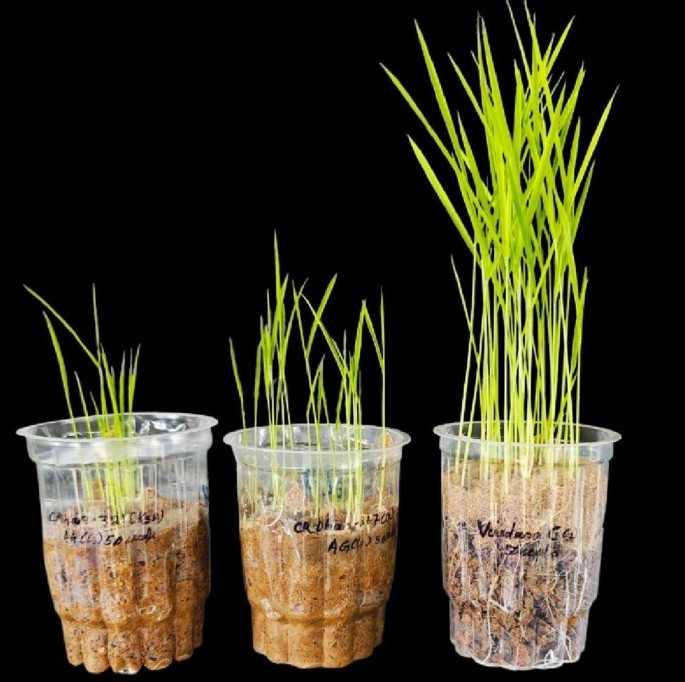
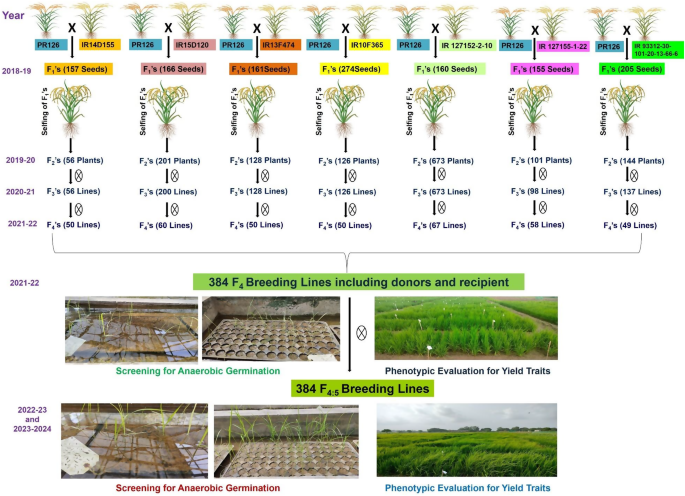
Rice is adapted to flooded ecosystems, but oxygen deficiency during germination can still be severe. One well-studied target is anaerobic germination tolerance.
A classic locus is qAG-9-2, associated with OsTPP7. OsTPP7 affects trehalose-6-phosphate metabolism and is thought to support mobilization of endosperm reserves under oxygen-limited conditions, helping the embryo continue growth.
But this does not mean that every direct-seeded rice variety needs exactly the same trait package.
The stresses experienced by a seedling emerging from dry soil are different from those experienced by a germinating seed under flooded or oxygen-limited conditions.
So “a variety for direct seeding” is not a sufficiently precise breeding target. We need to ask: which direct-seeding system, what seeding depth, and what water-management regime?
Weeds are one price of eliminating the nursery advantage
Weed competition is one of the biggest challenges of direct-seeded rice.
In transplanted systems, the rice enters the paddy as an established seedling. In direct-seeded systems, rice and weeds often begin growing at nearly the same time.
This is particularly important in dry direct seeding, where the pre-irrigation period can allow barnyard grass and other weeds to establish rapidly.
The importance of this problem is reflected in NARO’s technology development. Current tools for dry direct seeding include rice-emergence prediction and image-based systems that estimate barnyard-grass leaf stage to help determine optimal herbicide timing.
Again, agronomy and plant phenotype are linked.
A rice genotype with strong early seedling vigor is not simply a “healthy seedling.” Faster emergence, earlier leaf-area expansion, and rapid root development can help it occupy light and space before weeds do.
This is why seedling establishment and weed competitiveness are difficult to separate in direct-seeding breeding programs.
Lodging resistance becomes part of the machinery system
Lodging is another important trait.
NARO’s current recommendations for direct-seeding rice in Tohoku prominently include cultivars with strong lodging resistance. That is not accidental.
Plant density, seeding depth, and root development differ between direct-seeded and transplanted systems, and some direct-seeding conditions can increase lodging risk.
Lodging reduces yield and quality, but it also interferes with high-speed combine harvesting.
So lodging resistance is not only a biological yield-stability trait. It is also a trait that keeps the entire mechanized production system operational through harvest.
Machinery and breeding are therefore inseparable.
If we want high-speed combine harvesting, we need a crop that stays upright.
If we want stable deeper seeding, we need stronger emergence and mesocotyl elongation.
If we want to simplify weed control, we benefit from faster early growth and stronger competitive ability.
Changing the production system changes the crop’s design requirements.
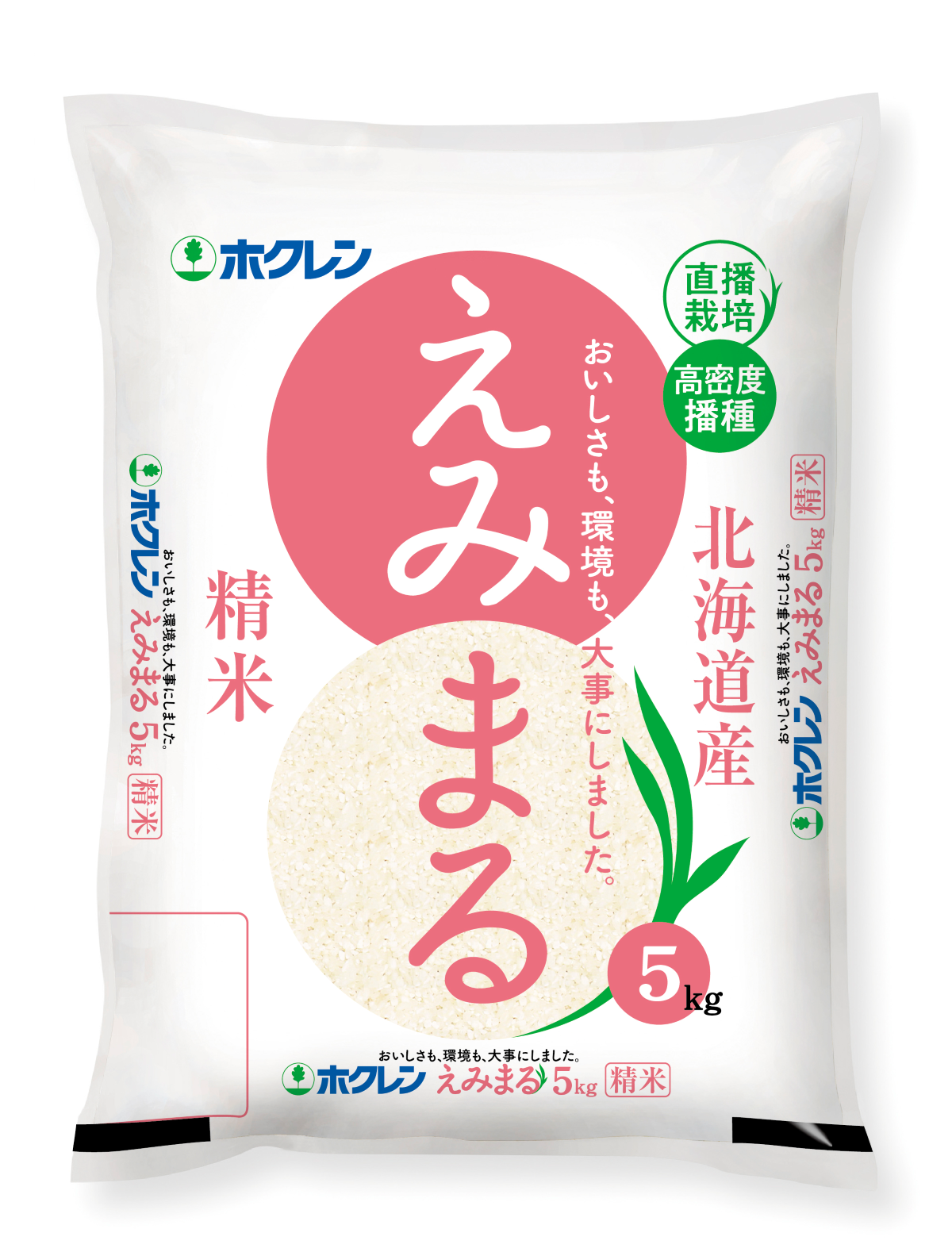
‘Emimaru’ shows what a direct-seeding cultivar can mean
A useful practical example is the Hokkaido rice cultivar ‘Emimaru’.
Cold spring temperatures can severely reduce emergence in direct-seeded rice in Hokkaido. Emimaru was developed with stronger establishment under cool conditions and was intended for direct-seeding use.
Its planted area increased from about 400 ha in 2019 to about 1,900 ha in 2022, with most of that area used for direct-seeded production.
The important point is that a “good direct-seeding cultivar” does not simply mean a high-yielding cultivar.
In Hokkaido, cold establishment matters.
Under deeper seeding, mesocotyl elongation matters.
Under flooded establishment, anaerobic germination matters.
For large-scale machine harvesting, lodging resistance matters.
Under strong weed pressure, early vigor matters.
The best rice phenotype depends on the production system.
Dry direct seeding is not expanding because it always yields more
This is another important point.
A 2025 review of dry direct-seeded rice in northeastern Japan concluded that yields were, on average, about 10% lower than transplanted rice.
Cold conditions, nitrogen-use efficiency, weeds, and spatial heterogeneity within fields remain important constraints. Nitrogen uptake and yield formation are particularly relevant areas for further improvement.
Why, then, does dry direct seeding remain attractive?
Because maximizing yield per hectare is not always the same as maximizing farm performance.
The review highlights another useful metric: yield per working hour.
Japanese rice yields per unit area have not increased dramatically over the past several decades, but production per unit of labor has increased substantially.
As the agricultural workforce shrinks and average farm size expands, the key question increasingly becomes not only:
How many kilograms can one hectare produce?
but also:
How many hectares can one worker successfully establish during a limited spring window, and how many tonnes of rice can that labor ultimately produce?
Under that metric, the value of direct seeding looks very different.
Field demonstrations show major labor savings—but the numbers need context
NARO field demonstrations of plow-and-grain-drill dry direct seeding conducted from 2007 to 2011 reported labor requirements of roughly six hours per 10 a, about one-quarter of the Tohoku average at the time.
Trials using the cultivar ‘Moeminori’ achieved around 600 kg per 10 a, and under certain conditions production costs per 60 kg fell to 57% of the then-current Tohoku average.
Those are striking figures, but they come from specific demonstration systems evaluated against historical regional benchmarks.
They should not be interpreted as a guarantee that every modern dry-direct-seeding farm will reduce costs by the same amount.
The more general lesson is that large savings can emerge when several changes are combined: eliminating nursery and transplanting operations, increasing seeding speed, sharing machinery with other crops, and designing rotations around common equipment.
Dry direct seeding is not the same as water-saving dry direct seeding
Another distinction is becoming increasingly important in Japan: water-saving dry direct seeding.
Conventional dry direct seeding usually means sowing into a dry field and establishing seedlings before later irrigation and paddy management.
Water-saving dry direct seeding goes further by modifying irrigation management to reduce water use itself.
MAFF’s 2026 research and demonstration programs explicitly include development of water management and weed-control systems for these approaches.
So two common interpretations should be avoided:
“Dry direct seeding means rice is grown with almost no water.”
“Dry direct seeding means the field stays dry from sowing to harvest.”
Neither is generally correct for the rapidly expanding conventional dry-direct-seeding systems now used in Japan.
Labor saving does not remove work—it moves it
This may be the most interesting way to interpret the technology.
In transplanted rice, people manufacture a strong, uniform seedling before the plant ever enters the field.
The vulnerable early stage is protected. Seedlings are selected, moved, and placed at controlled spacing and depth.
Dry direct seeding removes much of that process.
But the biological challenge does not disappear.
Instead:
The work of creating a uniform field moves toward leveling, soil preparation, and compaction.
The work of selecting and placing seedlings moves toward seeding precision and seedling-establishment ability.
The competitive advantage of a large transplanted seedling moves toward weed-control systems and early seedling vigor.
The work of placing plants at regular spacing moves toward row-seeding machinery and crop stand architecture.
And if the system is intended for high-capacity combine harvesting, the cultivar must remain upright enough to harvest efficiently.
Labor saving is therefore not simply the removal of work. It is a redistribution of work from manual operations to machinery, field engineering, and plant phenotype.
That is what makes dry direct seeding so interesting from a plant-science perspective.
The future of rice farming is not only a better transplanter
A 2026 review of dry direct seeding and paddy-field crop rotation in Tohoku discusses a future in which dry direct seeding becomes part of large-scale rotational farming.
The question is no longer only how to improve rice production in isolation. It is how to use the same land, machinery, and labor force across rice, wheat, soybean, maize, and other crops throughout the year.
For much of modern Japanese rice agriculture, mechanization focused on one question:
“How can rice transplanting be made more efficient?”
For some large-scale farms, the question may increasingly become:
“Do we need to keep transplanting as a production step at all?”
That does not mean transplanting is about to disappear. Direct seeding still accounted for only 2.8% of Japanese rice area in 2024. Topography, soil, irrigation systems, small field size, cultivar choice, and weed management all limit where the technology can be used.
Direct seeding also retains clear weaknesses in yield stability, seedling establishment, weed control, and nutrient management.
Still, dry direct-seeded area increased by roughly 58% from 2020 to 2024, national support expanded in 2026, and recent agronomic reviews are now explicitly discussing large-scale rotational systems built around the technology.
That suggests this is more than a temporary cultivation trend.
The future may not be a simple choice between transplanting and direct seeding. Farms may combine transplanting, wet direct seeding, and dry direct seeding to spread spring labor across time and match different field conditions.
Breeders, meanwhile, face a new set of design targets. Rice that has long been improved under the assumption that it will be transplanted must increasingly be able to survive the field from the seed stage onward.
A seemingly simple change—removing transplanting—connects seed physiology, root systems, weed competition, lodging, machinery, crop rotation, and farm economics.
Dry direct seeding is not only changing how rice is sown.
It is changing the system by which rice is produced in Japan.
References and sources
- Ministry of Agriculture, Forestry and Fisheries (MAFF), Japan. Direct-seeded rice cultivation and prefectural area data for the 2024 crop year.

- MAFF. Prefecture-level dry- and wet-direct-seeded rice area, 2024 crop year.
https://www.maff.go.jp/j/syouan/keikaku/soukatu/attach/pdf/chokuha-37.pdf
- MAFF. 2026 support materials for adoption of direct-seeded rice.

- NARO. Technologies supporting direct-seeded rice cultivation.

- NARO. Dry direct-seeded rice cultivation in Hokkaido.

- NARO. Plow tillage and grain-drill dry direct seeding of rice.

- NARO. Direct-seeding cultivar ‘Emimaru’.
- Namikawa M, Matsunami M. Dry direct-seeded rice in north-eastern Japan: management and future prospects. Plant Production Science. 2025. DOI: 10.1080/1343943X.2025.2463513.

- Shinoto Y, Otani R, Kanmuri H. Technological development and future prospects of dry direct seeding using plowing and compaction for paddy-field crop rotation systems incorporating maize in the Tohoku region, Japan. Plant Production Science. 2026. DOI: 10.1080/1343943X.2026.2676575.

- Early seedling vigor for direct-seeded rice: traits, mechanisms, and improvement strategies – a review. Plant Growth Regulation. 2026. DOI: 10.1007/s10725-026-01429-4.
- Understanding anaerobic germination in direct-seeded rice: a genomic mapping approach. BMC Plant Biology. 2024. DOI: 10.1186/s12870-024-05901-z.
- Yanmar. Dry direct-seeding mechanization systems. 2025.


Research checked on September 5, 2026. MAFF’s prefecture-level direct-seeding dataset currently extends through the 2024 crop year, so this article does not estimate a national total for 2025.

Comments