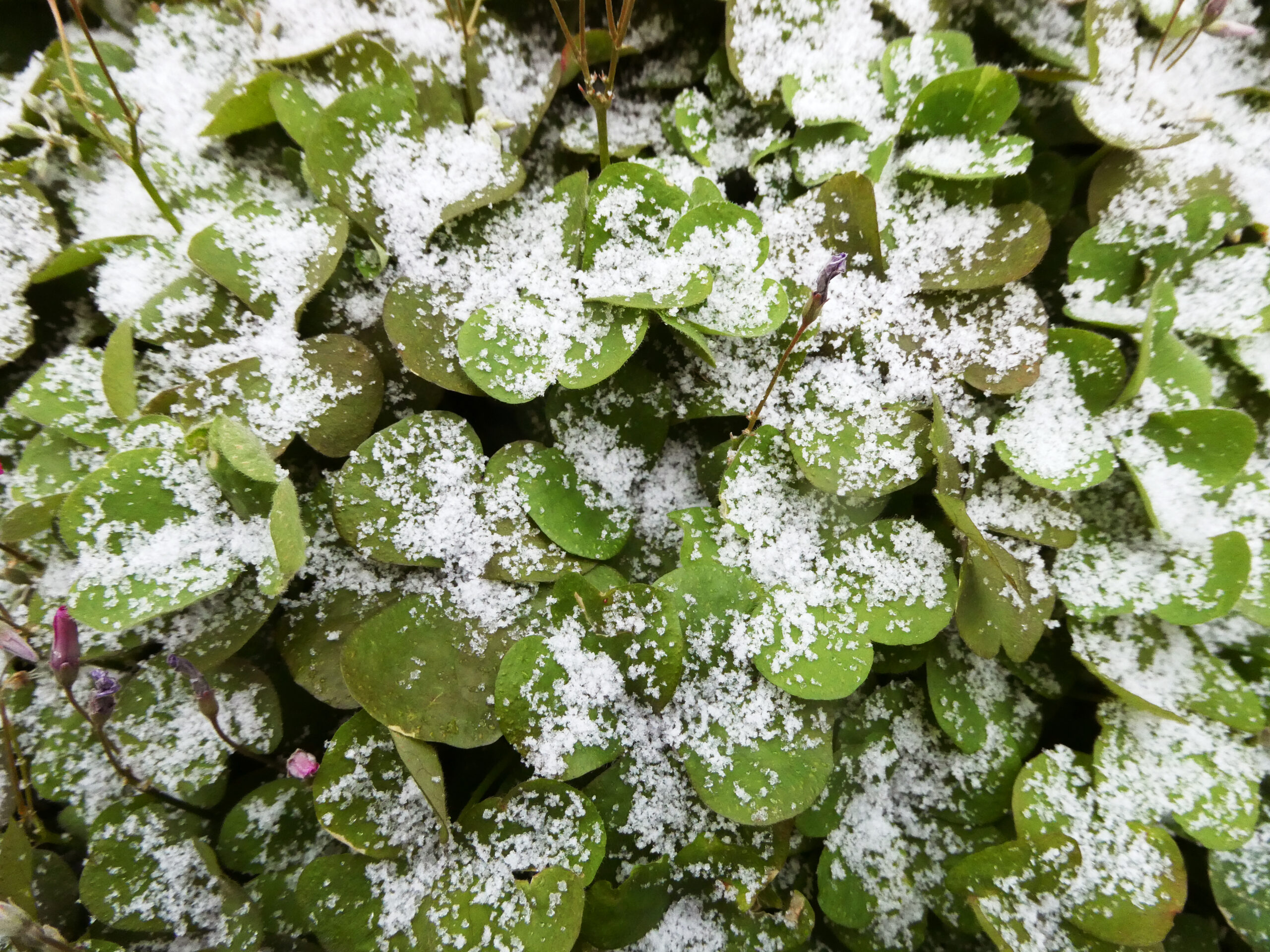
Plants do not survive frost simply because they contain an “anti-freezing substance.” Modern plant-freezing research describes a much more complex system involving supercooling, ice nucleation, ice propagation, extracellular freezing, dehydration tolerance and cold acclimation.
Water does not always freeze at 0°C
Zero degrees Celsius is the melting point of ice, but liquid water still needs an initial ice nucleus before crystallization can proceed. Very pure water can remain liquid below 0°C through supercooling. Homogeneous nucleation can require temperatures near −39°C, whereas natural surfaces, particles and microorganisms promote heterogeneous nucleation at much warmer subzero temperatures.
For a plant, this means freezing risk is determined not only by air temperature but also by where an active ice nucleus is located.
Some plants tolerate freezing rather than preventing it
In many cold-hardy perennial tissues, ice forms outside living cells in the apoplast. Extracellular ice draws water out of cells, increasing intracellular solute concentration and lowering the probability of intracellular freezing. This can protect cells, but prolonged freeze-induced dehydration can itself damage membranes and cellular structures.
Cold acclimation changes membrane composition, osmolytes, sugars and proteins so that cells are better able to survive water loss and rehydration during thawing. Antifreeze and ice-recrystallization-inhibiting proteins are part of this system in some plants, but they are not a universal explanation for cold hardiness.
Ice-nucleating bacteria can increase frost risk
Microorganisms on plant surfaces can alter when ice begins to form. Some strains of Pseudomonas syringae are particularly effective ice nucleators and can trigger freezing at relatively mild subzero temperatures. A 2026 review emphasizes the need to distinguish external microbial or particle nucleators from intrinsic nucleators within plant tissues.
Frost in the meteorological sense is therefore not identical to freezing inside plant tissues. Organ temperature, developmental stage, nucleator identity and the route of ice propagation all matter.
The key question is where ice starts
Plant freezing experiments increasingly focus on the location and timing of the first ice event and how ice then spreads through tissues. Laboratory experiments can also create artificial supercooling that does not represent field behavior.
A better summary is therefore: plants survive subzero conditions through a combination of freezing avoidance and freezing tolerance. The biology is not simply about preventing ice; it is about controlling when, where and how ice forms while keeping cells alive.
For related context, see What Does Plant Resistance Mean? Maize–Mite Interactions Explain Antixenosis, Antibiosis and Tolerance.
For related context, see Barley NAC Genes Through a Pan-Genome Lens: 127–149 Genes Across 20 Genomes.
For related context, see A Pumpkin mRNA Moves into Grafted Cucumber Shoots: CmoKARI1 Raises Isoleucine and JA-Ile to Improve Chilling Tolerance.
Reference
- Lamacque L. et al. Ice Nucleation and Freezing Consequences in Perennial Plants. Physiologia Plantarum. 2026;178:e70961. https://doi.org/10.1111/ppl.70961
Comments