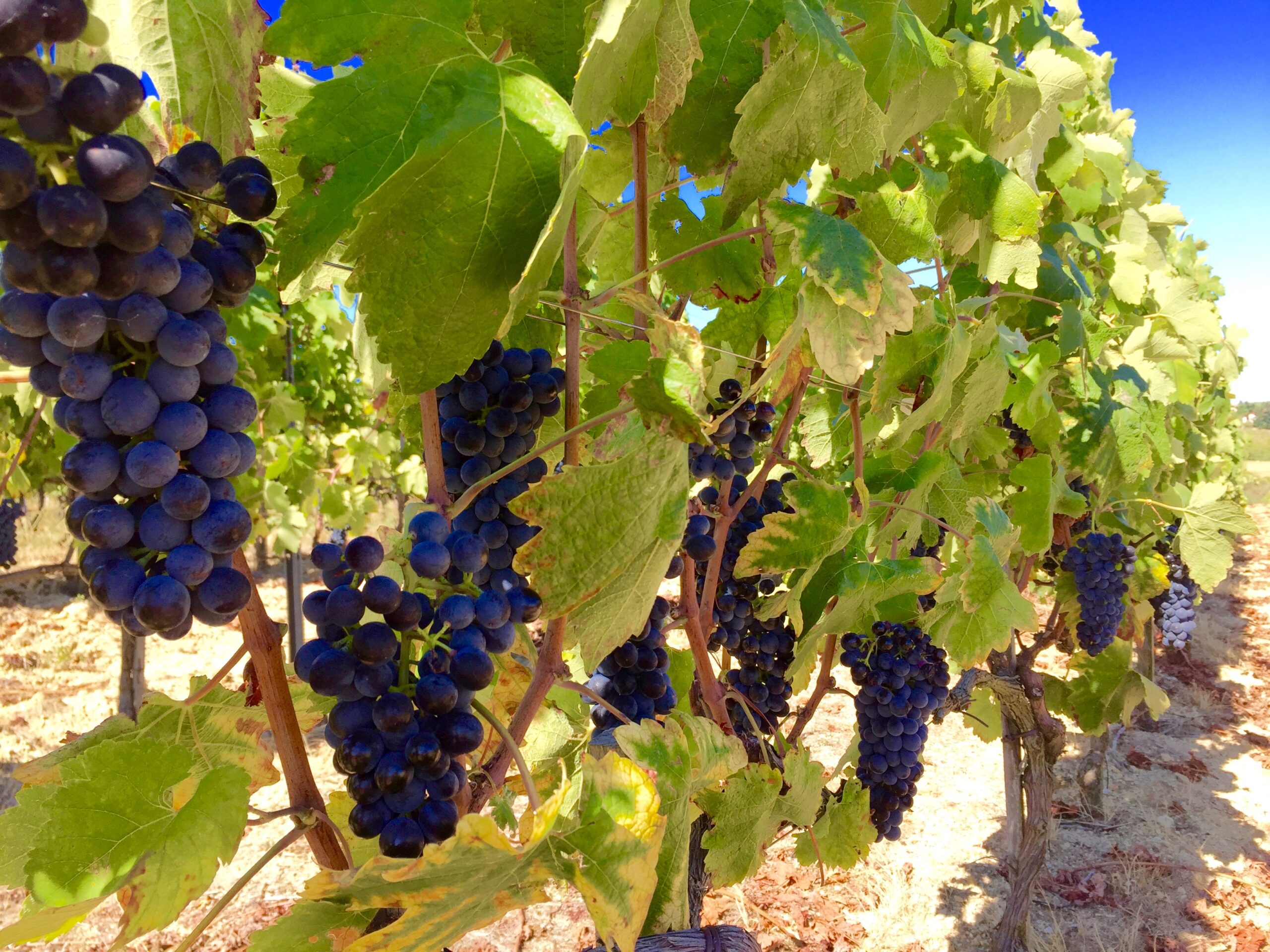
Phytomining uses plants to concentrate metals from soil into harvestable biomass. A 2023 Communications Earth & Environment study showed that ordinary grapevine (Vitis vinifera) can transport rare earth elements (REEs) from soil through xylem sap into leaves.

The important limitation is scale: the authors estimated recovery of roughly 900 mg of REEs per hectare without harvesting the whole plant.
Grapevines reflected soil REE patterns in their leaves

In semi-natural controlled experiments, REEs were transported from soil to foliage through xylem sap, and accumulation became clear from around the fifth month of growth. No obvious crop damage was detected under the tested conditions.
The estimated recovery was about 900 mg/ha
This is interesting as proof of principle but extremely small compared with conventional mineral production. The study does not show that vineyards can economically replace REE mines.
Direct extraction from leaves avoids burning the biomass
The paper proposed leaching REEs directly from harvested leaves instead of burning metal-rich biomass. Organic acids such as citric acid may be useful, but recovery percentage alone does not establish commercial viability. Solvent volume, separation, concentration, waste handling, energy and cost all matter.
A 2026 perspective still identifies major commercial barriers
A 2026 perspective on REE phytomining identified two central barriers: insufficient yields of high-REE biomass and the lack of economically viable processes for recovering REEs from complex biomass.
That places the grapevine work in context: it is a useful demonstration of plant-mediated resource movement, not a mature mining technology.
The more realistic opportunity may be agricultural by-products
Grapevine is not a specialized REE hyperaccumulator, but vineyards already exist and generate leaf/pruning biomass. If this concept becomes useful, it may work as a circular co-recovery process attached to agriculture rather than as a dedicated “vineyard mine.”
For related context, see Eucalyptus Leaves Can Reveal Buried Gold—But This Is Exploration, Not Mining.
For related context, see Water Lettuce Can Clean Wastewater—but Pistia stratiotes Is a Regulated Invasive Species in Japan.
For related context, see Coconut-Mat Layers Reduced Thermal Conductivity of a Geopolymer Panel by Up to 41%.
References
- Barbera M et al. Accumulation of rare earth elements in common vine leaves is achieved through extraction from soil and transport in the xylem sap. Communications Earth & Environment. 2023;4:291. https://doi.org/10.1038/s43247-023-00950-y
- Huang CL et al. Phytomining of rare earth elements from soils using plants. Communications Earth & Environment. 2026;7:402. https://doi.org/10.1038/s43247-026-03549-1

Comments