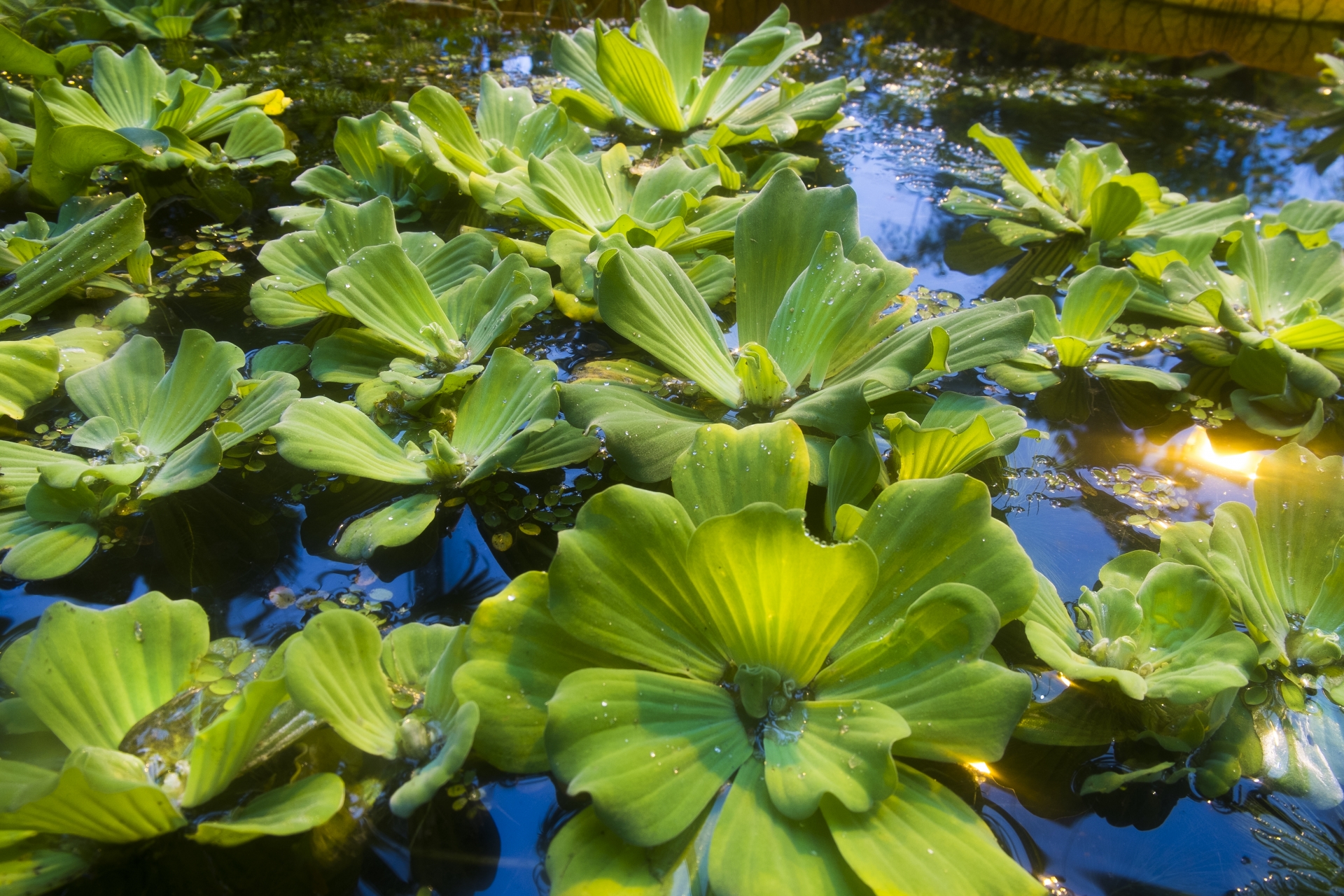
Water lettuce (Pistia stratiotes) has a large suspended root system that can help remove nutrients and pollutants from water. A 2024 Scientific Reports study used the species in a free-surface constructed wetland and reported substantial improvements in domestic wastewater quality.
That does not mean it is a plant people in Japan should obtain and use for wastewater treatment. P. stratiotes is listed by Japan’s Ministry of the Environment as a Specified Invasive Alien Species, and keeping, cultivating, storing, transporting, importing or releasing it is generally regulated under the Invasive Alien Species Act.
- A constructed-wetland experiment in Pakistan
- Thirty-day retention produced the strongest treatment effect
- The treated water was considered suitable for irrigation—not drinking
- Water lettuce is also a highly invasive aquatic plant
- In Japan, the species is legally regulated
- The transferable idea is constructed-wetland design, not necessarily this species
- References
A constructed-wetland experiment in Pakistan

The study was conducted at a facility in Khyber Pakhtunkhwa, Pakistan. Domestic wastewater was routed through free-water-surface constructed wetlands vegetated with P. stratiotes, and hydraulic retention times (HRTs) of 10, 20 and 30 days were compared.
Thirty-day retention produced the strongest treatment effect

At 30 days, the study reported reductions of about 83% for TDS, 82% for TSS, 82% for BOD, 81% for COD, 80% for chloride, 77% for sulfate, 84% for ammonia and 74% for total oil and grease.
These reductions were not caused by plant uptake alone. Sedimentation, filtration, adsorption, microbial reactions, precipitation and the plant/root system all contribute to constructed-wetland treatment.
The treated water was considered suitable for irrigation—not drinking
The final effluent met the environmental-quality criteria used by the authors for recycling to plant watering and crop irrigation. The paper explicitly states that it was not suitable for drinking.
The 30-day retention time is also an important engineering limitation. A nature-based treatment system that holds wastewater for a month has very different area and throughput requirements from a conventional high-rate treatment plant.
Water lettuce is also a highly invasive aquatic plant
Pistia stratiotes can spread rapidly across warm nutrient-rich water bodies. Dense mats can alter light and oxygen conditions, obstruct water use and displace native aquatic communities. A wastewater environment rich in nutrients can also favor exactly the kind of rapid biomass increase that creates management problems.
Any phytoremediation system using an invasive floating plant would therefore need strict containment, biomass removal and disposal controls.
In Japan, the species is legally regulated
Japan’s Ministry of the Environment lists Pistia stratiotes (including stems and roots) as a Specified Invasive Alien Species and notes that it is established in the country. Control programs continue.
So an overseas wastewater-treatment paper should not be translated into a Japanese recommendation to buy or grow water lettuce. Permitted research may fall under formal authorization systems, but that is different from ordinary practical use.
The transferable idea is constructed-wetland design, not necessarily this species

The useful engineering lesson is the integration of a large root surface, microbial communities, settling and hydraulic retention in a low-energy treatment system. In Japan, an application should instead consider legally acceptable non-invasive species and other established constructed-wetland designs.
A plant can remove pollutants and still be environmentally inappropriate to introduce. Treatment performance and invasion risk have to be evaluated together.
For related context, see Eucalyptus Leaves Can Reveal Buried Gold—But This Is Exploration, Not Mining.
For related context, see Can Vine Leaves Be Mined for Rare Earth Elements? What 900 mg/ha Really Means.
For related context, see How Much Lead Can Moso Bamboo Tolerate? Hydroponic Tests Reveal Root-Biased Accumulation and Transport Control.
References
- Ali M et al. Domestic wastewater treatment by Pistia stratiotes in constructed wetland. Scientific Reports. 2024;14:7553. https://doi.org/10.1038/s41598-024-57329-y
- Ministry of the Environment, Japan: Specified Invasive Alien Species list. https://www.env.go.jp/nature/intro/2outline/list.html
Comments