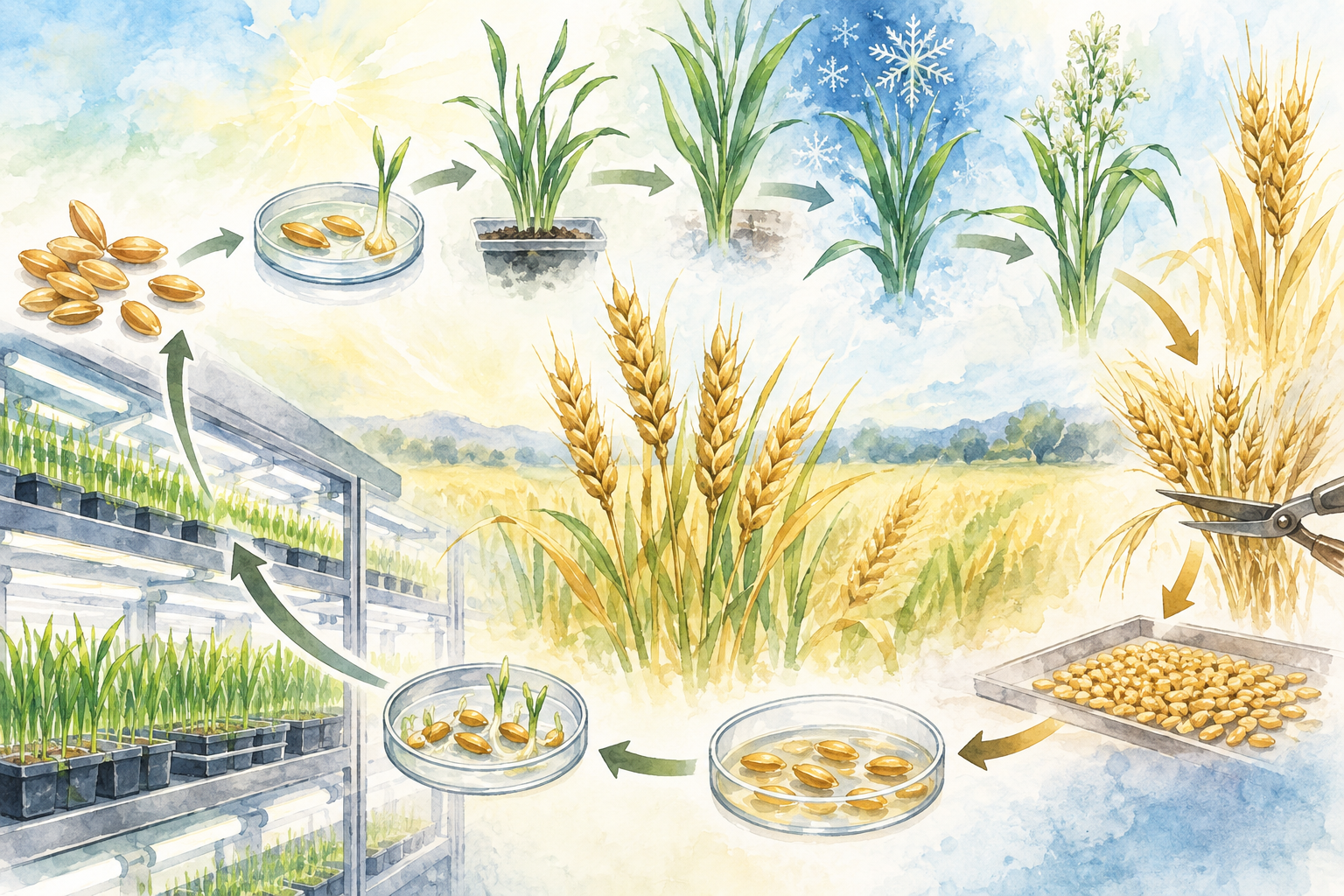
Speed breeding became widely known as a way to accelerate plant development by extending the photoperiod. But the field has moved well beyond the simple idea of “keeping the lights on longer.”
Recent studies have targeted multiple steps of the generation cycle: vernalization, flowering, grain filling, early harvest, post-ripening, dormancy release, and germination of the next generation.
A study published in Frontiers in Plant Science in September 2026 is a useful example of this shift. Rather than focusing on faster flowering alone, the authors optimized how early-harvested winter wheat seeds can be moved reliably into the next generation.
- Where speed breeding started
- Once one bottleneck is shortened, the next one appears
- Shortening the wait for mature seed
- New approaches are targeting immature-seed germination
- The September 2026 study prioritizes reliable generation advance
- Speed breeding as a critical-path problem
- What can this enable?
- Speed breeding is not a finished protocol
- References
Where speed breeding started
One of the landmark studies that brought modern speed breeding to wide attention was published by Watson and colleagues in Nature Plants in 2018.
By combining extended photoperiods with controlled growth conditions, the study showed that up to six generations per year could be achieved in spring wheat, durum wheat, barley, chickpea, and pea, with four generations per year in canola.
Even at that stage, speed breeding was not presented simply as a lighting technique. The authors demonstrated applications to single seed descent (SSD), mutant studies, transformation, and rapid generation cycling, and highlighted its potential integration with genome editing, high-throughput genotyping, and genomic selection.
The real objective was therefore not merely to make plants grow faster. It was to reduce the time required to obtain the next generation.
Once one bottleneck is shortened, the next one appears
It helps to view one plant generation as a sequence of steps:
germination → vegetative growth → vernalization → flowering → seed development → harvest → post-ripening and dormancy release → germination of the next generation
Accelerating only one step does not shorten the entire cycle by the same amount.
Winter wheat is a good example. Even if extended photoperiods accelerate development after vernalization, the crop may still require a substantial cold period before flowering. Vernalization then becomes the limiting step.
In 2022, researchers reported a speed vernalization method using 10°C and a 22-hour photoperiod before transfer to speed-breeding conditions. Combined with speed breeding, the method enabled up to five generations per year in winter wheat or winter barley.
Once flowering is accelerated, however, another delay becomes more visible: waiting for seeds to mature.
This pattern is central to the development of speed breeding. As one part of the generation cycle becomes faster, another part becomes the new bottleneck.
Shortening the wait for mature seed
Seed maturation after flowering has therefore become another target.
In 2023, Schoen and colleagues optimized speed breeding across 48 diverse soft red winter wheat genotypes. In addition to using a 22-hour photoperiod, they tested whether seeds could be harvested before full maturity.
In three genotypes, seeds harvested only 10 days after flowering still showed germination above 75%. With three days of drying at 50°C, viable seed could be replanted about 13 days after flowering, reducing the average sowing-to-sowing cycle to roughly 96 days.
This is extremely fast, but earlier harvest increases the chance that seeds are still physiologically immature. Speed therefore begins to trade off against germination reliability.
That leads to the next question:
How can immature, early-harvested seeds be moved into the next generation more reliably?
New approaches are targeting immature-seed germination
A 2026 study took a biochemical approach to this problem.
Winter wheat seeds harvested 18 days after flowering were treated with a combination of hydrogen peroxide (H₂O₂), gibberellic acid (GA₃), and the ABA-biosynthesis inhibitor sodium tungstate.
The optimized three-reagent treatment increased germination to 80%. Transcriptome analysis indicated a shift toward germination-associated regulation, including enhanced GA biosynthesis and ABA catabolism and reduced expression of several ABA-associated dormancy genes.
This represents another direction for speed breeding: actively manipulating seed physiology so that immature grain can germinate sooner.
The September 2026 study prioritizes reliable generation advance
The new study by Yu and colleagues takes a different approach. It does not attempt to set the earliest possible harvest record. Instead, it asks how early-harvested winter wheat seed can be moved forward with a high and stable success rate.
Using the winter wheat cultivar Yannong 301, the researchers systematically tested harvest timing, drying conditions, cold moist treatment, and germination-promoting treatment.
Their practical optimized workflow was:
- harvest 23 days after flowering
- dry at 40°C for 2 days
- apply a moist treatment at 4°C for 2 days
- soak in 1% H₂O₂ for 1 day
This protocol achieved 97.06% germination.
Importantly, the study went beyond a single cultivar. Across 10 winter wheat cultivars, germination ranged from 80.57% to 95.69%. The protocol was also tested in a 200-line SSD population, where 195 of 200 lines (97.5%) produced seedlings and were carried forward.
For practical breeding, this distinction matters. The goal is rarely to germinate one seed as early as possible. Breeders often need to move hundreds or thousands of lines forward while losing as few as possible.
Seen from that perspective, the study is an important update to speed breeding because it improves the reliability of rapid generation advance at breeding-population scale.
Speed breeding as a critical-path problem
Taken together, these studies reveal a broader pattern.
First, extended photoperiods accelerate growth and flowering.
Then, in winter cereals, vernalization becomes the slow step.
After vernalization is shortened, seed maturation becomes a larger fraction of the remaining generation time.
Harvest the seed earlier, and immature-seed germination becomes the next bottleneck.
Researchers have therefore added drying regimes, cold moist treatments, H₂O₂, GA-related treatments, and ABA-related interventions to move early-harvested seeds more rapidly into the next generation.
In engineering terms, this resembles optimization of a process by repeatedly identifying and shortening its critical path.
The history of speed breeding can be viewed as the progressive removal of waiting time from each stage of a plant generation.
What can this enable?
This broader view makes speed breeding relevant to much more than conventional variety development.
Faster fixation by single seed descent
Advancing F₂, F₃, F₄ and later generations toward genetically fixed lines can take years when only one or two generations are produced annually.
Increasing the number of generations per year can compress the calendar time required to obtain fixed material. The 200-line SSD validation in the new study directly supports this application.
Faster generation advance after genome editing
In genome editing projects, editing itself may be relatively fast, but obtaining T₁ and T₂ progeny, identifying homozygous plants, or segregating away unwanted transgenic components can take much longer.
Combining genome editing with speed breeding can therefore target a major practical delay: the time spent waiting for edited plants to produce the next generation.
Backcrossing, mapping populations, and crossing programs
Rapid generation cycling can also accelerate recurrent backcrossing, the construction of mapping populations, QTL studies, and the development of experimental crossing populations.
Mutants and experimental plant lines
Speed breeding is not only a breeder’s tool. It can shorten the routine “waiting for the next generation” step in plant research, including mutant fixation, transgenic-line development, and genome-edited line establishment.
Speed breeding is not a finished protocol
The main lesson from these studies is that speed breeding should not be viewed as one fixed recipe.
Extended photoperiods shorten development.
Speed vernalization shortens the cold requirement.
Early harvesting reduces the time spent waiting for mature seeds.
Post-ripening, cold treatment, and chemical treatments help those early-harvested seeds germinate sooner.
With each step, another portion of the generation cycle is compressed.
Rather than thinking of speed breeding as specialized lighting equipment, it may be more useful to think of it as:
a strategy for decomposing the breeding or research workflow, identifying the slowest step between one generation and the next, and systematically shortening that step.
The new winter wheat study is one more update in that process.
As these critical paths are optimized for more crops and genotypes, speed breeding could increasingly accelerate not only conventional crossing programs but also genome editing, genetic analysis, and experimental plant-line development.
References
- Watson A, et al. (2018) Speed breeding is a powerful tool to accelerate crop research and breeding. Nature Plants 4:23–29. https://doi.org/10.1038/s41477-017-0083-8
- Cha JK, et al. (2022) Speed vernalization to accelerate generation advance in winter cereal crops. Molecular Plant. https://doi.org/10.1016/j.molp.2022.09.025
- Schoen A, et al. (2023) Reducing the generation time in winter wheat cultivars using speed breeding. Crop Science 63:2079–2090. https://doi.org/10.1002/csc2.20989
- Yan D, et al. (2026) H₂O₂-GA₃-Na₂WO₄ Synergistically Promotes Germination of Immature Winter Wheat Grains for Speed Breeding. Plants 15:1313. https://doi.org/10.3390/plants15091313
- Yu X, et al. (2026) Optimization of post-ripening treatments for efficient germination of early-harvested winter wheat seeds under speed breeding. Frontiers in Plant Science 17:1940423. https://doi.org/10.3389/fpls.2026.1940423


Comments