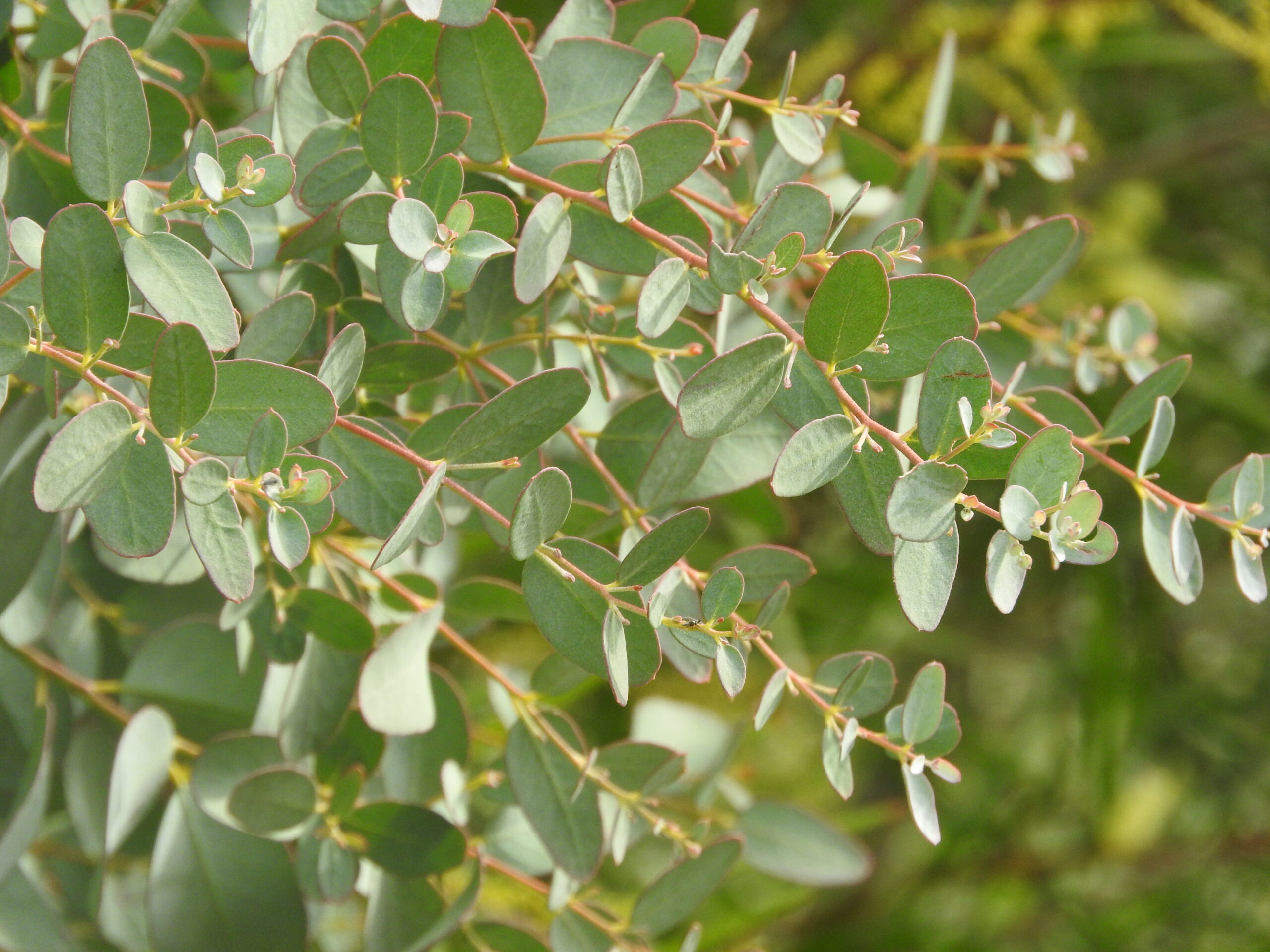
The famous finding of gold in eucalyptus leaves is often retold as if trees could be used to mine gold. The 2013 Nature Communications study actually demonstrated something more specific: biogeochemical exploration for concealed gold deposits.
At the Freddo Gold Prospect in Western Australia, the deposit was buried beneath roughly 30 m of barren sediment. Researchers analysed eucalyptus leaves, twigs, bark, litter and soil to test whether gold was genuinely absorbed into living tissue rather than simply deposited as dust.
A deeply buried deposit and deep eucalyptus roots

Eucalyptus species can develop unusually deep root systems; sinker roots reaching about 40 m have been documented in Eucalyptus marginata. That does not prove that every tree sampled at Freddo had roots physically touching the orebody. The study instead supports a coupled system in which deep roots, groundwater and geochemical transport can move trace gold into vegetation.
Leaf gold was anomalous directly above the deposit

Dried leaves from large Freddo eucalyptus trees contained up to 80 ppb Au and twigs up to 44 ppb, while background plant material was around 0.1 ppb. The anomaly was strongest over the buried deposit.
Individual leaves were highly variable, however. This is not a one-leaf detector that pinpoints an orebody by itself; sampling design and local calibration matter.
Gold particles were observed inside living leaf tissue
Using synchrotron X-ray fluorescence microscopy, the researchers directly imaged naturally occurring gold particles up to about 8 µm within leaf tissue. This helped rule out the idea that all measured gold came from surface dust contamination.
Some particles were associated with calcium oxalate crystals. The authors proposed that moving gold to extremities such as leaves and compartmentalizing it could reduce toxicity, but this should not be treated as a fully proven, gold-specific detoxification pathway.
This is not phytomining
Natural gold concentrations in the foliage were in the ppb range. The work did not demonstrate commercially useful gold recovery from leaves. Its value is as an indirect exploration tool in terrains where mineralization is hidden beneath thick cover.
The 2018 correction did not change the science
A Publisher Correction in 2018 fixed an incorrect HTML article number. It did not alter the experiments or conclusions.
Eucalyptus is therefore better described as a potential biogeochemical sensor of buried mineralization than a literal “gold-producing tree.”
For related context, see Can Vine Leaves Be Mined for Rare Earth Elements? What 900 mg/ha Really Means.
For related context, see Water Lettuce Can Clean Wastewater—but Pistia stratiotes Is a Regulated Invasive Species in Japan.
For related context, see Coconut-Mat Layers Reduced Thermal Conductivity of a Geopolymer Panel by Up to 41%.
For related context, see Tracing Timber Harvest Origin with Stable Isotopes and Trace Elements: 180–230 km Location Estimates.
References
- Lintern M et al. Natural gold particles in Eucalyptus leaves and their relevance to exploration for buried gold deposits. Nature Communications. 2013;4:2614. https://doi.org/10.1038/ncomms3614
- Publisher Correction. Nature Communications. 2018. https://www.nature.com/articles/ncomms16199

Comments