Two 2025 studies report increases in large-tree abundance or tree size in the United States and Amazonia. The observations are important, but the trend should be separated from causal attribution.
United States: big trees increased 2.9%/year in the East and 0.49%/year in the West
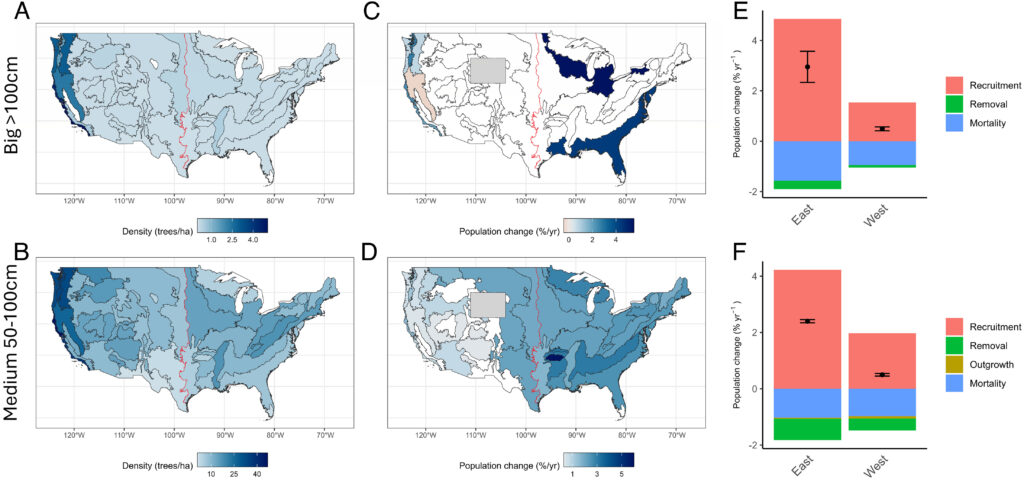
Using US Forest Service Forest Inventory and Analysis data, the PNAS study defined medium trees as 50–100 cm DBH and big trees as >100 cm. Big-tree populations increased by 2.9% per year in the eastern US and 0.49% in the West; medium trees increased by 2.4% and 0.5%, respectively. Sierra Nevada was an important exception, and several individual species declined.
The study does not directly attribute those trends to warmer/wetter growing seasons or CO₂ fertilization. Recovery, management, disturbance and climate can all contribute.
Amazonia: mean tree basal area increased 3.3% per decade across 188 mature plots
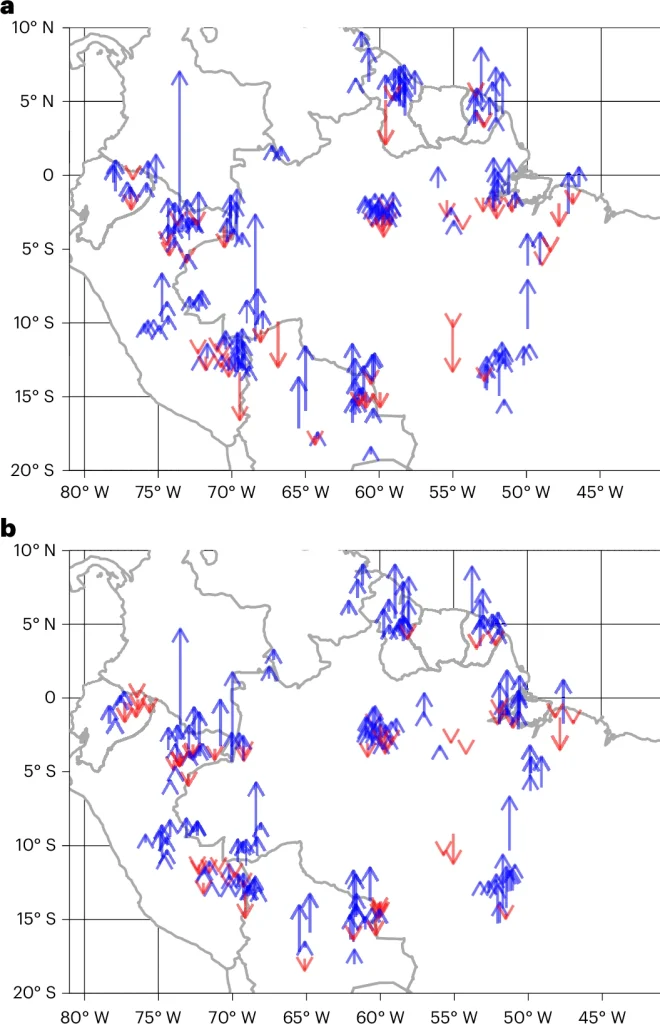
A Nature Plants analysis of about 30 years of records from 188 mature Amazonian forest plots found mean tree basal area increasing 3.3% per decade, median basal area 1.9%, and maximum tree size 5.8% per decade. Large trees increased in number and size while the smallest size classes declined in stem frequency.
The Amazon pattern is consistent with resource effects, not proof of CO₂ alone

The authors interpret the pattern as consistent with a resource-driven boost, potentially involving elevated CO₂ or nitrogen, together with reduced suppression of smaller trees. Observational monitoring does not isolate atmospheric CO₂ as the sole causal driver.
Tree-size increase also does not mean forests are becoming universally safer or more stable. Drought, fire, mortality, recruitment and land-use change remain critical components of future carbon balance.
For related context, see When Does Tree Planting Stop Cooling the Climate? Albedo Accounting Across 172 Carbon-Market Projects.
For related context, see How Much Could Japan's Alpine Autumn Colors Fade? Earlier Green-Up Predicts Lower Brightness.
For related context, see Why Were Canadian Canola, Wheat and Peas Lower-Carbon? Production Conditions Can Outweigh Food Miles.
References
- Chisholm PJ, Gray AN. Populations of large-diameter trees are increasing across the United States. PNAS. 2025;122:e2421780122. https://doi.org/10.1073/pnas.2421780122
- Esquivel-Muelbert A et al. Increasing tree size across Amazonia. Nature Plants. 2025;11:2016–2025. https://doi.org/10.1038/s41477-025-02097-4


Comments