
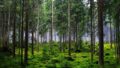
Afforestation and reforestation remove CO2 from the atmosphere, but carbon is not the only climate forcing affected by land-cover change. Converting bright grassland, cropland or snow-exposed surfaces to darker tree cover can reduce albedo and increase absorbed solar energy.
A 2024 Nature Communications study mapped where tree-cover restoration remains climate-positive after albedo is included. A 2025 follow-up then evaluated 172 real Afforestation, Reforestation and Revegetation (ARR) projects in the Voluntary Carbon Market.
The conclusion is not that forests are bad. It is that carbon-only accounting can substantially overstate climate mitigation in some locations.
Albedo measures reflected solar radiation
Forests are often darker than grassland, open land or snow, so a land-cover transition can create positive radiative forcing even while trees remove CO2. The relevant physical comparison is carbon-driven cooling versus albedo-driven radiative forcing—not a simple claim that forests “store heat at night.”
The 2024 study mapped climate-positive restoration

Hasler and colleagues compared carbon sequestration with albedo change for 24 open-land-to-forest transitions over a 100-year framework. Tropical locations often retain strong net climate benefits, whereas snowy or bright dry regions can face larger albedo penalties.
The practical message is to prioritize restoration where net climate benefit, not just tree area or carbon uptake, is highest.
The 2025 study evaluated 172 existing ARR projects
The projects spanned five continents and reported nearly 800 million t-CO2e of projected mitigation over the next century. None of the five registry standards/protocol families used by the sampled projects incorporated albedo change into credit accounting.
Median albedo deduction was 18%

Across the 172 projects, the median estimated albedo deduction was 18%. A quarter of projects had estimated deductions of at least 50%; 12% had deductions large enough to negate all of the claimed CO2 climate benefit; and 9% were estimated to gain additional cooling from albedo.
The older article incorrectly treated 18% as the fraction of projects with overestimated benefits. The correct result is a median 18% deduction.
At a 100% deduction threshold, 21 projects (12%) would be ineligible and represented 30% of projected credits. A 50% threshold would make 43 projects (25%) ineligible, representing 39.1% of projected credits.
This does not mean the carbon was not sequestered. It means the net climate effect can be much smaller when the surface-radiation change is added.
Albedo is not the final biophysical term
Evapotranspiration, cloud formation, aerodynamic roughness, fire risk, water cycling and biodiversity also change with vegetation. The 2024 study explicitly notes that a full net-climate assessment needs broader biophysical accounting.
The policy lesson is therefore iterative: stop treating carbon alone as the complete climate metric, add spatially explicit albedo, then improve accounting for other relevant regional effects.
Tree restoration remains a powerful nature-based solution when projects are well located. The research argues for better site selection and accounting, not a blanket rejection of reforestation.
For related context, see Why Were Canadian Canola, Wheat and Peas Lower-Carbon? Production Conditions Can Outweigh Food Miles.
For related context, see Large Trees Are Increasing in the United States and Amazonia—but That Does Not Prove Warming Made Trees Bigger.
For related context, see Seaweed Feed Is Not One Technology: Separate Antimicrobial Extracts from Asparagopsis Methane Mitigation.
References
- Hasler N et al. Accounting for albedo change to identify climate-positive tree cover restoration. Nature Communications. 2024;15:2275. https://doi.org/10.1038/s41467-024-46577-1
- Reed V et al. Accounting for albedo in carbon market protocols. Nature Communications. 2025. https://doi.org/10.1038/s41467-025-64317-x
Comments