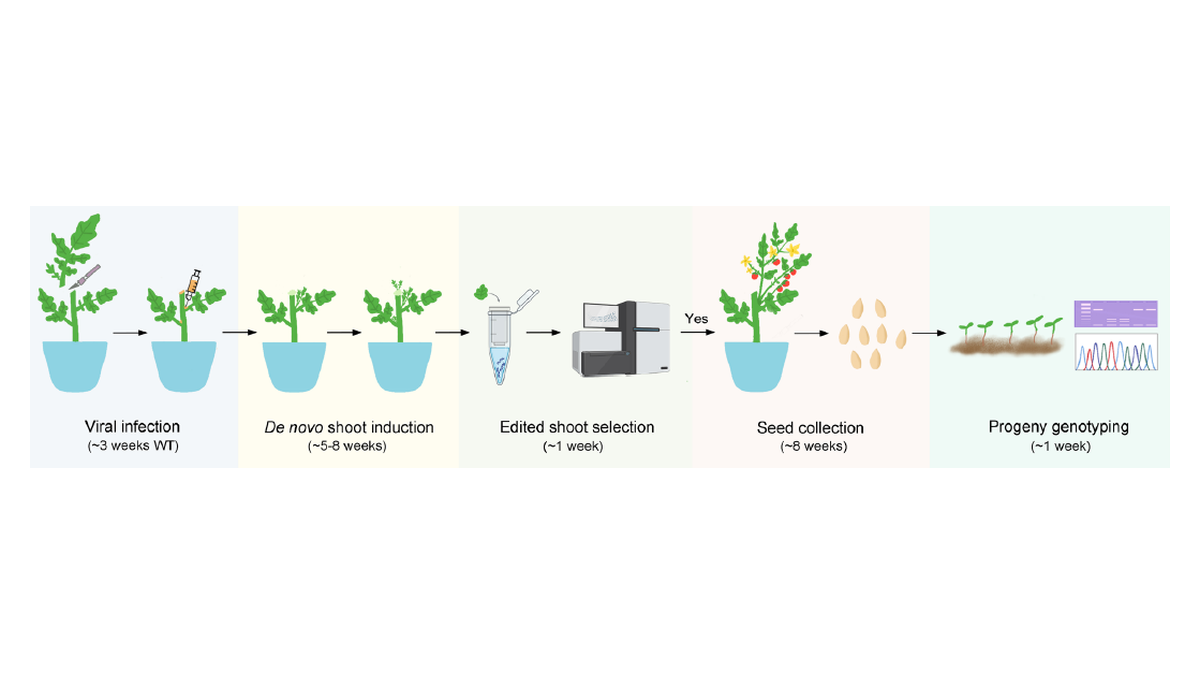
In plant genome editing, the nuclease itself is only part of the problem. A major bottleneck is how to deliver the editing system to the right cells—and how to recover a whole, fertile plant from those cells.
For many crops, genome editing still depends on transformation, selection, callus formation or shoot regeneration, and recovery of regenerated plants. The difficulty and duration of these steps vary greatly among species and even among cultivars.
A 2026 study in PNAS approached this bottleneck from a different direction. The researchers combined Tobacco rattle virus (TRV) with the compact RNA-guided DNA endonuclease TnpB to obtain heritable genome edits in tomato without conventional ex vivo tissue culture.
It is tempting to summarize the study as “a highly infectious virus carried TnpB through the plant and edited the germline.” That is not quite what happened.
The more interesting idea was this:
Instead of forcing the virus into an existing shoot apical meristem, generate a new shoot close to the tissue where viral delivery and genome editing are already occurring.
- Standard TRV inoculation produced somatic edits, but not heritable edits
- The key move: generate a new shoot near the infected tissue
- De novo shoots showed much higher somatic editing
- Edited shoots were not necessarily uniform
- The edits were transmitted through seed
- Why does “not sending the virus to the meristem” help?
- Why TnpB is a good fit for viral vectors
- Genome mining makes TnpB discovery scalable—but not automatically easy
- Beyond PDS: SlDA1 editing increased fruit size
- What “virus-free” and “transgene-free” mean in this study
- Could this work in other plant species?
- The bottleneck in plant genome editing may be shifting
- Paper and references
Standard TRV inoculation produced somatic edits, but not heritable edits
The researchers placed the ISYmu1 TnpB nuclease and a guide RNA targeting tomato SlPDS into a TRV2 vector. The guide RNA was also linked to a modified tomato FT-derived mobility element, mSlFT, designed to enhance cell-to-cell movement.
The construct was introduced into red cherry-type tomato cotyledons via Agrobacterium tumefaciens.
Among 20 inoculated plants, somatic editing was detected in three plants, corresponding to 15% of the treated population. In systemically infected leaves, the measured indel frequencies ranged from 0.8% to 6.93%.
So TRV could deliver the TnpB editing system well enough to generate detectable edits in somatic tissue.
However, seeds collected from the plant showing 6.93% somatic editing did not carry the edit into the next generation.
This distinction is central to the study:
A plant virus can infect a plant and edit somatic cells without necessarily delivering an edit into the lineage that produces the next generation.
Plant viruses can be restricted from shoot apical meristems, and systemic infection in leaves does not automatically imply access to meristematic or reproductive lineages.
The key move: generate a new shoot near the infected tissue
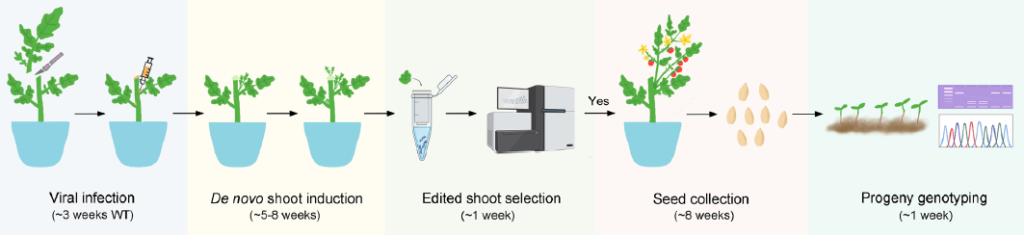
The researchers then changed the experimental design.
In approximately three-week-old tomato plants, they removed the main shoot apex and existing axillary buds. Agrobacterium GV3101 carrying the TRV1 and TRV2 infectious clones was injected into wounds around the main stem and axillary regions.
This is an important technical detail. The method is not simply an injection of purified virus particles. Agrobacterium is used to initiate the TRV system, after which TRV carries the TnpB and guide RNA components.
According to the Methods, newly emerging shoots from the axillary region were also removed during the first month to minimize growth from pre-existing buds and favor de novo shoot formation.
After roughly five weeks, new shoots appeared around the treated axillary regions. Some appeared to arise relatively directly, whereas others emerged after the formation of callus-like tissue. The authors therefore discuss the possibility of both direct and indirect regeneration.
That point matters when interpreting the phrase “tissue culture-free.”
The study does not show that callus-like tissue is completely absent. Rather, it avoids the conventional ex vivo tissue-culture workflow in which transformed cells are selected and regenerated into plants under sterile culture conditions.
De novo shoots showed much higher somatic editing
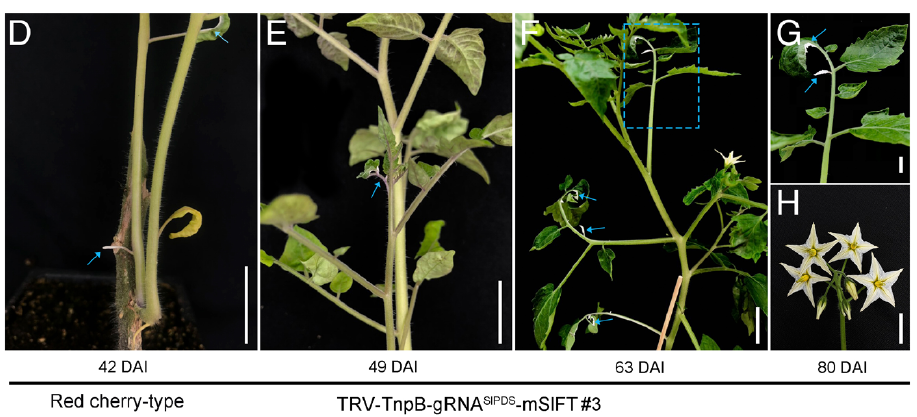
For the SlPDS experiment, 49 treated plants produced a total of 72 de novo shoots.
One shoot, #3, developed photobleached sectors. Amplicon sequencing of green leaf tissue from this shoot detected 56.66% somatic editing, including a 5-bp deletion at 48.51% and a 4-bp deletion at 8.15%.
Additional edited shoots were identified in #7, #17, #43, and #70. Among the edited shoots analyzed, somatic mutation frequencies of approximately 25.21% to 49.69% were reported.
These values were substantially higher than the 0.8–6.93% observed after the initial cotyledon inoculation experiment.
The increase is striking, but the editing percentages alone do not tell the whole story.
Edited shoots were not necessarily uniform
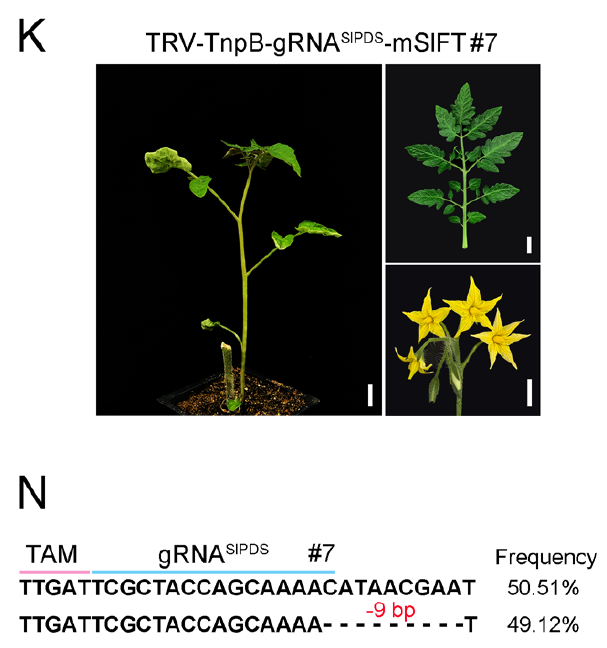
In shoot #3, different tissues showed different mutation spectra and frequencies. The authors interpreted this as evidence that the shoot was chimeric, with genome editing continuing during later stages of de novo shoot development.
By contrast, shoots such as #7 and #17 contained major deletion alleles at frequencies close to 50%, consistent with the possibility that a heterozygous mutation had arisen relatively early during shoot formation.
In other words, de novo shoot formation does not automatically produce a uniformly edited plant. The developmental timing of the editing event matters: an early edit can occupy a large fraction of the regenerated shoot, whereas later editing can produce stronger mosaicism.
The edits were transmitted through seed
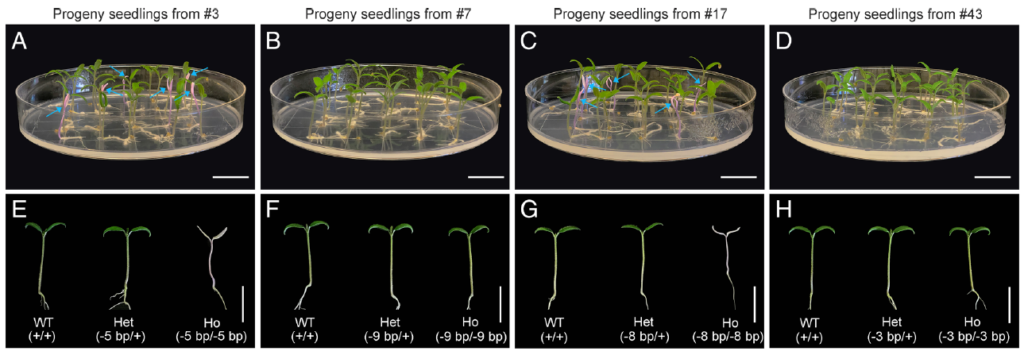
The researchers collected seed from four edited shoots, #3, #7, #17, and #43, and germinated a total of 96 progeny.
For progeny derived from shoot #3:
- 28% were homozygous for the 5-bp deletion,
- 41% were heterozygous,
- 31% were wild type.
For progeny from shoot #7:
- 24% were homozygous for the 9-bp deletion,
- 56% were heterozygous,
- 20% were wild type.
Shoot #17 also produced 27% homozygous and 51% heterozygous edited progeny. Transmission from #43 was lower, with 2% homozygous and 26% heterozygous progeny.
The efficiencies differed among parental shoots, but the central result was clear: alleles generated by the TRV–TnpB system entered reproductive lineages and were transmitted through seed.
In photobleached progeny from #3 and #17, RT-PCR did not detect TRV RNA or TnpB transcripts, and PCR assays did not detect the tested viral T-DNA integration sequences.
Within the scope of the assays used in the study, the edited progeny were therefore described as virus-free and transgene-free.
This should not be interpreted as a whole-genome demonstration that every possible unintended integration or off-target change was absent. Those are different claims, and the paper did not perform a comprehensive genome-wide integration and off-target survey.
Why does “not sending the virus to the meristem” help?
The most interesting part of this study is not simply the activity of the nuclease.
In virus-induced genome editing, one recurring challenge is moving viral vectors or mobile editing components far enough through the plant to reach existing meristems or cell lineages capable of contributing to the next generation.
The authors describe their strategy as reducing dependence on long-distance viral movement by allowing editing to occur immediately before or during the formation of a new shoot meristem.
In practical terms, the design changes the problem from:
“How do we get the virus into the existing meristem?”
to:
“Can we generate a new meristem close to the tissue where the virus and editor are already active?”
That is a subtle but important shift. Viral delivery and plant regeneration are no longer treated as completely separate problems; they are brought together spatially and developmentally.
Why TnpB is a good fit for viral vectors
The other key component is TnpB.
TnpB proteins are transposon-associated RNA-guided DNA endonucleases found in systems including the IS200/IS605 family, and they are considered evolutionarily related to the origins of CRISPR-Cas12 systems.
The ISYmu1 TnpB used here is only 382 amino acids long.
TnpB itself was not suddenly discovered by recent data mining. TnpB proteins had been known as transposon-associated proteins for years, but their molecular function was unclear. In 2021, TnpB was experimentally demonstrated to function as a programmable RNA-guided DNA nuclease, which rapidly increased interest in its potential as a genome editor.
Subsequent studies then used evolutionary and genomic mining to identify particularly useful TnpB variants.
A Nature Biotechnology study screened 64 IS605-family TnpB candidates and identified 25 active proteins in E. coli. The researchers also developed approaches for predicting TAMs and reRNAs from genomic context, mined additional candidates, and identified compact editors including ISAam1 (369 aa) and ISYmu1 (382 aa).
Size is crucial here.
Plant viral vectors have limited cargo capacity. Compared with many Cas9 and Cas12 proteins, which exceed 1,000 amino acids, an approximately 400-aa TnpB makes it much more practical to package the nuclease together with its guide RNA architecture in a viral system.
Genome mining makes TnpB discovery scalable—but not automatically easy
Microbial genomes and metagenomes contain a large diversity of TnpB homologs. This means that candidate discovery can increasingly begin computationally, using sequence context to identify TnpB genes and infer associated RNA and TAM features before experimental screening.
But there is an important distinction:
Finding many TnpB-like sequences is becoming easier. Finding a highly active plant genome editor is still an experimental problem.
Many natural TnpB proteins do not provide sufficient editing activity in a given cellular context.
That is why the field is moving beyond natural discovery toward protein engineering. In 2026, a Nature Biotechnology study used deep mutational scanning to map sequence–function relationships in ISDra2 TnpB and develop engineered variants with markedly improved activity, including in plants.
A separate 2026 Nature Plants study delivered an engineered TnpB with TRV and reported high somatic and heritable editing efficiencies in Nicotiana benthamiana.
And in 2025, another Nature Plants study had already shown transgene-free germline editing in Arabidopsis using TRV delivery of ISYmu1 TnpB.
The emerging workflow is therefore becoming recognizable:
mine natural TnpB diversity → measure activity → engineer the protein/RNA system → exploit the compact editor for viral delivery.
Beyond PDS: SlDA1 editing increased fruit size
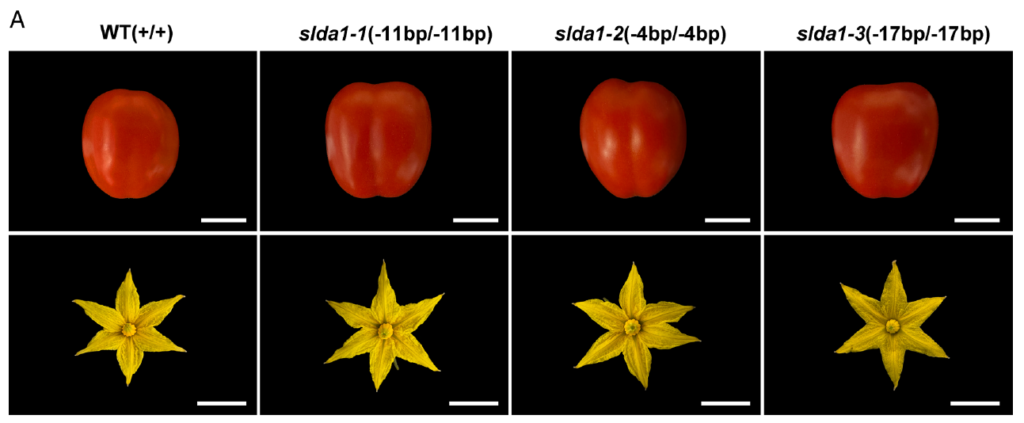
The PNAS study did not stop at the convenient photobleaching marker SlPDS.
The researchers next targeted SlDA1, a tomato gene whose function was expected to relate to organ-size regulation based on the DA1 family in other plants.
SlDA1 editing was detected in de novo shoots from several tomato genetic backgrounds, including M82, Ailsa Craig, and Sweet 100. In some M82 shoots, indel frequencies exceeded 99%.
The SlDA1 mutations were also transmitted to progeny.
The researchers then examined three independent homozygous slda1 lines carrying different frameshift alleles. Compared with wild type, the mutants showed significantly increased fruit height and diameter, and fruit fresh weight increased by 22–30%. The flowers also appeared larger.
This extends the work beyond a PDS proof of concept. The study demonstrates a sequence of:
candidate-gene editing → recovery of heritable mutants → phenotypic analysis.
What “virus-free” and “transgene-free” mean in this study
The terms are important because the system is initiated through Agrobacterium and uses a recombinant RNA virus.
For selected edited progeny, the authors did not detect TRV-derived RNA or TnpB transcripts by RT-PCR. Their PCR assays also did not detect the tested viral T-DNA integration sequences.
Those results support the authors’ description of the recovered progeny as virus-free and transgene-free within the detection framework used in the paper.
They do not establish, by themselves, that every possible unintended genomic event has been excluded. A comprehensive whole-genome analysis would be a different level of evidence.
Could this work in other plant species?
TRV has a broad host range, and the paper notes that it can infect more than 400 plant species. The authors also discuss the possibility of taking advantage of the compact size of ISYmu1 to use other viral vectors with comparable cargo capacities, such as Potato virus X (PVX) and Pea early browning virus (PEBV).
That makes broader application an attractive prospect—but it needs to be framed carefully.
A plant being susceptible to TRV does not mean that this exact heritable-editing workflow will automatically work in that species.
At minimum, several conditions must align:
- the virus must infect, replicate, and move sufficiently in the target plant;
- the TnpB/guide cargo must remain stable enough during infection;
- TnpB must be active in that plant’s cells;
- a suitable target with an appropriate TAM must be available;
- de novo shoots must be inducible near the infected tissue;
- those shoots must flower and set seed normally;
- and the edited lineage must contribute to the germline.
The experiments in this paper establish the approach in multiple tomato genetic backgrounds, not in hundreds of plant species.
Extending the concept to other plants is therefore a promising research direction, not an already demonstrated universal method.
The bottleneck in plant genome editing may be shifting
It would be easy to read this paper simply as “TnpB can edit tomato.” That misses much of its significance.
A conventional plant genome-editing workflow often looks like this:
deliver the editor → select edited/transformed cells → regenerate a plant through tissue culture.
The approach in this study couples a compact viral editor with in planta regeneration close to the infection site.
Delivery and regeneration are brought closer together in both space and time.
The method is not yet universal. De novo shoot recovery efficiency, chimerism, TAM constraints, viral cargo stability, host antiviral responses, regenerative capacity, and off-target activity all remain important variables.
But if suitable virus vectors, compact editors, and in planta regeneration systems can be matched to individual crops, the development problem may begin to shift from:
“How do we transform and regenerate this plant?”
toward:
“Which virus, compact editor, and regeneration strategy work together in this plant?”
That could be particularly important for species and genotypes that are difficult to transform or regenerate using conventional tissue culture.
TnpB is small.
Plant viruses can replicate and move.
Plants can generate new growth centers after wounding.
This study connects those three biological properties in a particularly effective way.
Instead of sending the virus to the meristem, generate a new meristem close to where the virus has already arrived.
The next gains in plant genome-editing speed may therefore come not only from better nucleases, but from combining genome editing with plant development and virus biology in smarter ways.
Paper and references
- Liu Y. et al. Virus-induced transgene- and tissue culture-free heritable genome editing in tomato. Proceedings of the National Academy of Sciences 123, e2530029123 (2026). DOI: 10.1073/pnas.2530029123.
- Weiss T. et al. Viral delivery of an RNA-guided genome editor for transgene-free germline editing in Arabidopsis. Nature Plants 11, 967–976 (2025).
- Xiang G. et al. Evolutionary mining and functional characterization of TnpB nucleases identify efficient miniature genome editors. Nature Biotechnology 42, 745–757 (2024).
- Karvelis T. et al. Transposon-associated TnpB is a programmable RNA-guided DNA endonuclease. Nature 599, 692–696 (2021).
- Thornton B. W. et al. Engineered TnpB genome editors for plants and human cells identified by ribonucleoprotein mutational scanning. Nature Biotechnology (2026).
- Nagalakshmi U. et al. High-efficiency, transgene-free plant genome editing by viral delivery of an engineered TnpB. Nature Plants 12, 503–511 (2026).
Figure reuse
Figures reproduced in this article were cropped from Liu et al. (2026), PNAS, DOI: 10.1073/pnas.2530029123. The article is distributed under the Creative Commons Attribution 4.0 International license (CC BY 4.0). CC BY 4.0


Comments