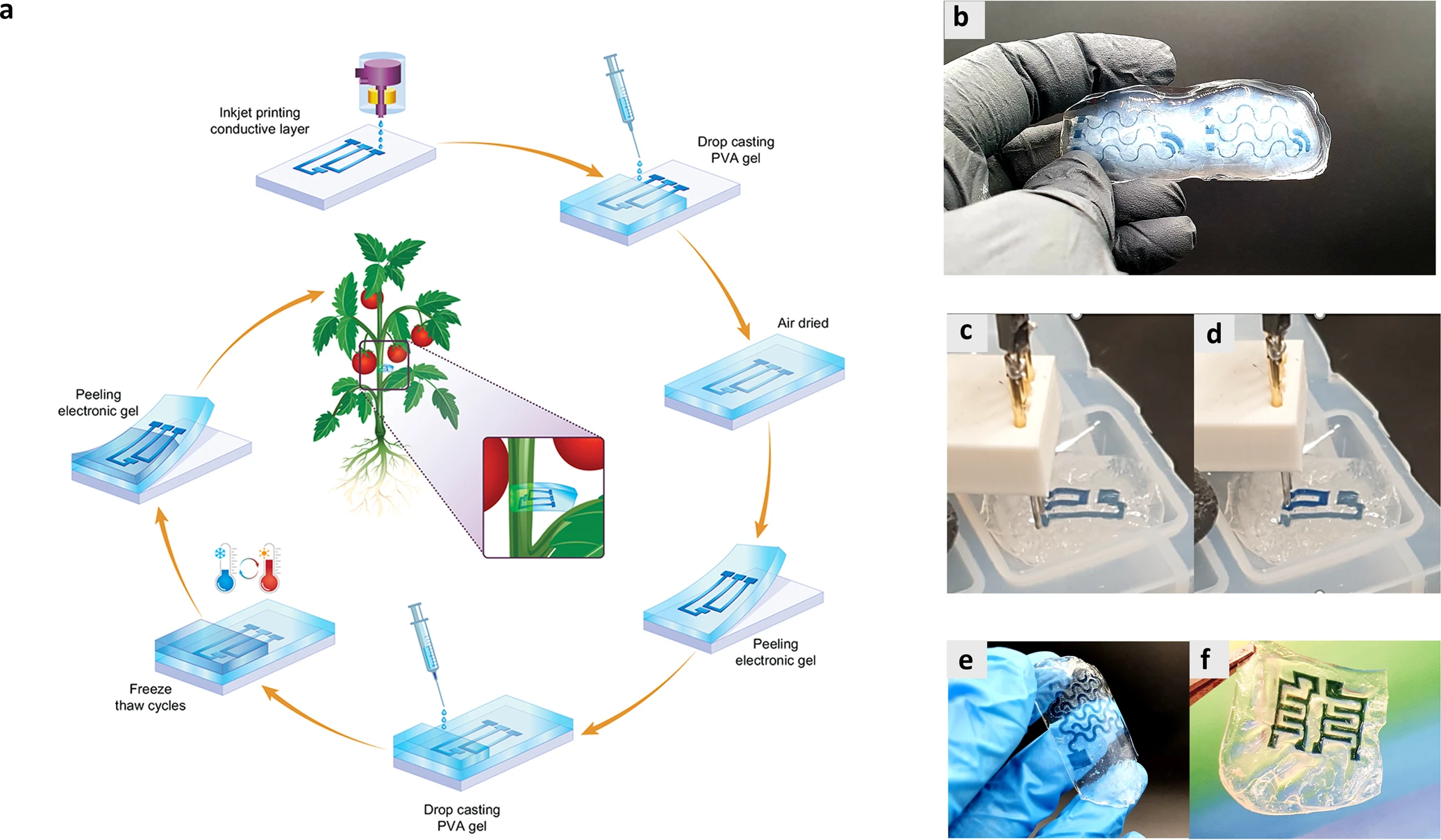
Long-term plant monitoring requires more than a sensitive sensor: the device and living tissue must remain compatible over time. A 2023 npj Flexible Electronics study combined PVA cryogels with printed PEDOT:PSS electronics and maintained an implanted plant–electronics interface in tomato stems for more than two months.
- The self-healing property belongs to the device material
- Printed PEDOT:PSS inside a soft PVA cryogel
- Implanted tomato devices operated for more than two months
- Low tissue response does not mean no tissue response
- What the device actually measures
- Promising platform, not yet a field-ready farm product
- Reference
The self-healing property belongs to the device material
“Self-healable” refers primarily to the PVA cryogel and conductive structure, not to healing the plant. Physically crosslinked PVA can recover part of its mechanical integrity after cut surfaces are brought back together, while damaged conductive traces can recover electrical connection to a degree after realignment.
It is not a circuit that automatically restores any severe damage to its original performance.
Printed PEDOT:PSS inside a soft PVA cryogel

PEDOT:PSS conductive traces were inkjet-printed and incorporated into a PVA hydrogel/cryogel structure. The platform reached conductivities up to 350 S/cm and mechanical strain up to 330%, and supported electrodes, capacitors and organic electrochemical transistors.
Implanted tomato devices operated for more than two months

The researchers implanted cryogel devices into tomato stem vascular tissue and monitored ionic activity using impedance spectroscopy and related electronic measurements. Signals changed with environmental and ionic conditions, including water-stress experiments.
The interface remained functional for over two months.
Low tissue response does not mean no tissue response

Histology showed plant responses such as callus formation and tissue reorganization. The important finding was that the soft interface produced relatively limited lignified scar tissue and allowed long-term measurements. The paper describes minimal scar formation, not a completely injury-free implant.
What the device actually measures
This is not a universal sensor that directly reports nutrient concentration, gene expression or disease diagnosis. It measures electrical/ionic responses in the sap–device interface. Turning those signals into reliable physiological diagnoses requires calibration across crops, growth stages and environments.
Promising platform, not yet a field-ready farm product
Implantation, wiring, cost, durability and crop-specific calibration remain major engineering challenges. The study is best viewed as a materials and interface advance for long-term in-vivo plant bioelectronics.
For related context, see A 4.5-µm Transparent Plant E-Skin Monitors Leaf Growth and Surface Temperature in Real Time.
For related context, see eSoil Increased Barley Seedling Dry Weight by 50% at Day 15—but It Is Not Yet a Proven Crop-Yield Technology.
For related context, see Tomato HY5 Links Light, Electrical Signaling and a Jasmonate Burst During Root-Knot Nematode Defense.
For related context, see A Soil-Moisture Sensor Designed to Return to the Soil: Wireless Power, Thermal Imaging and Fertilizer.
Reference
- Bihar E et al. Self-healable stretchable printed electronic cryogels for in-vivo plant monitoring. npj Flexible Electronics. 2023;7:48. https://doi.org/10.1038/s41528-023-00280-1
Comments