
A late-2024 Scientific Reports study analyzed three maize brace-root traits—penetrometer resistance (PR), root number (RN), and tier number (TN)—using a multi-parent doubled-haploid population.
Brace-root traits were heritable but environment-dependent
Genotype-by-environment effects were significant, while heritabilities remained relatively high: 79.25% for RN, 81.00% for TN and 74.28% for PR.
GWAS identified candidates, not a single root-formation switch
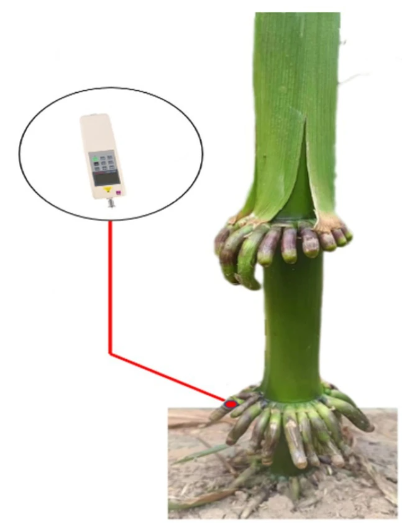
The FarmCPU GWAS detected 22 SNPs and nominated 50 candidate genes. Several genes were highlighted as possible contributors to brace-root growth, but the study did not functionally prove one master switch gene.
Genomic-selection accuracy ranged from 0.36 to 0.51
Five-fold cross-validation with genome-wide SNPs produced prediction accuracies of 0.39 for RN, 0.36 for TN and 0.51 for PR, with improvement possible using selected significant SNP sets.
The study provides breeding markers and genetic architecture for lodging-related root traits, not proof that larger brace roots automatically increase crop yield across environments.
For related context, see Indica OsNLP4 Raised Yield and Nitrogen-Use Efficiency in Japonica Rice Across Multi-Location Field Trials.
For related context, see SW14 Rebalances Soybean Seed Weight, Protein and Oil by Disrupting a LEC1-Containing NF-Y Complex.
For related context, see A Pumpkin mRNA Moves into Grafted Cucumber Shoots: CmoKARI1 Raises Isoleucine and JA-Ile to Improve Chilling Tolerance.
Reference
- Lin S et al. Genome-wide association study and genomic selection of brace root traits related to lodging resistance in maize. Scientific Reports. 2024;14:31898. https://doi.org/10.1038/s41598-024-83230-9
Comments