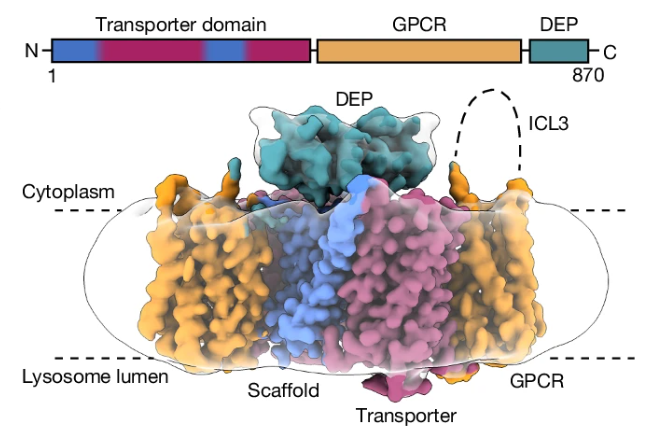
LYCHOS (GPR155) is a human lysosomal membrane protein that senses cholesterol and helps regulate mTORC1. A 2024 Nature cryo-EM study revealed an unusual architecture: LYCHOS combines a GPCR-like domain with a transporter-like domain that is evolutionarily and structurally closest to plant PIN-FORMED (PIN) auxin transporters.
That does not mean humans contain a plant protein. LYCHOS is encoded by the human GPR155 gene. The finding is about evolutionary homology: one domain belongs to an ancient transporter lineage that is represented by PIN proteins in plants and has been repurposed in human lysosomal signaling.
LYCHOS is a lysosomal cholesterol sensor
LYCHOS sits in the lysosomal membrane and links cholesterol availability to mTORC1 activation. The structure shows a homodimer containing an N-terminal transporter-like domain, a central class-B2-like GPCR domain and a C-terminal DEP domain. A cholesterol-binding site lies at the interface between the transporter and GPCR-like regions.
Structural searches point strongly to plant PIN transporters
A FoldSeek search across AlphaFold and PDB structures found the highest similarity between the LYCHOS transporter-like domain and plant PIN auxin transporters. Comparisons with PIN1, PIN3 and PIN8 showed conserved topology and crossover-motif architecture.
Phylogenetic analysis likewise placed the domain closer to plant PIN transporters than to known human transporter families. The authors therefore describe it as a human orthologue of the plant PIN transporter family.
LYCHOS binds IAA but did not show measurable IAA transport
Plant PIN proteins transport the auxin indole-3-acetic acid (IAA). LYCHOS retained weak IAA binding, with an affinity around 1.6 mM, but under conditions where PIN8 drove IAA efflux, LYCHOS did not produce a significant efflux signal.
So it would be incorrect to say that LYCHOS performs the same auxin-transport function as a plant PIN. Its endogenous substrate—and whether it functions as an active transporter at all—remain unresolved.
The evolutionary point is domain reuse, not plant-to-human transfer
Plants and animals share deep eukaryotic ancestry. Protein families can persist while being incorporated into very different biological systems. The striking result here is that a PIN-related fold is retained inside a human protein that participates in lysosomal cholesterol sensing and mTORC1 regulation.
Additional high-resolution LYCHOS structures published in 2025 strengthened the structural picture and explored lipid and metabolite interactions. The PIN-like domain’s physiological transport function remains an open question.
For related context, see Upper and Lower Leaf Stomata Use Different K⁺ Channel Compositions for Light-Induced Opening.
For related context, see Using Amino Acid Transporters as Nanoparticle Entry Receptors: Asp/PDPA-NP Delivers Cargo into Plant Cells Within Minutes.
For related context, see Tomato HY5 Links Light, Electrical Signaling and a Jasmonate Burst During Root-Knot Nematode Defense.
References
- Bayly-Jones C et al. LYCHOS is a human hybrid of a plant-like PIN transporter and a GPCR. Nature. 2024;634:1238–1244. https://doi.org/10.1038/s41586-024-08012-9
- Molecular architecture of human LYCHOS involved in lysosomal cholesterol signaling. Nature Structural & Molecular Biology. 2025. https://doi.org/10.1038/s41594-024-01474-5
Comments