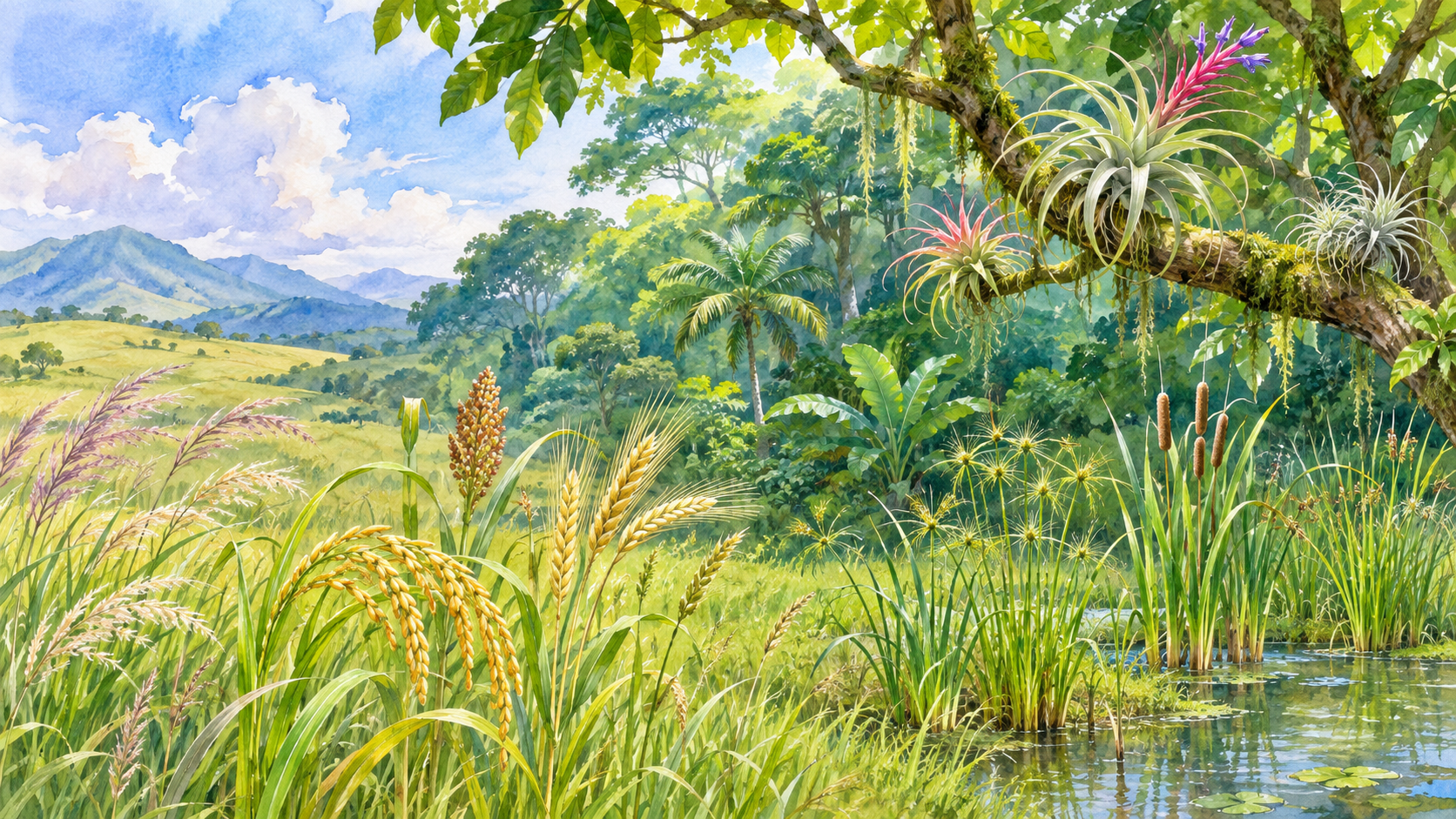
Rice, maize, pineapples, and air plants.
Although they look very different and thrive in very different places, all these plants belong to the same botanical order: Poales.
Plants that cover grasslands around the world, inhabit wetlands, or live on the branches of tropical forest trees are all members of this group.
How did plants sharing a common ancestor evolve to occupy such a variety of environments?
In November 2026, a study in Annals of Botany investigated the relationship between habitats and the evolution of plant traits across nearly 8,800 species of Poales [1].
Its findings reveal that environmental adaptation is more complex than we might imagine.
- Poales: plants that spread across the world
- What was the common ancestor of Poales like?
- What distinguishes grasslands from forests?
- Only two of the six characteristics showed habitat-dependent evolution
- How pollen travels depends partly on where plants live
- Leaving the ground to live in trees
- Surprisingly, photosynthesis tells a more complicated story
- Ecological association and evolutionary dependence are not the same
- Plant traits do not evolve at a single uniform rate
- There is no single path in plant evolution
- References
Poales: plants that spread across the world
Poales comprises 14 families and more than 24,000 described species, making it one of the largest orders of flowering plants.
Besides the grasses (Poaceae), which include rice, wheat, maize, and bamboo, the order encompasses sedges (Cyperaceae), bromeliads (Bromeliaceae), including pineapples and Tillandsia, as well as rushes and cattails.
Its members include many of the crops that sustain humanity and major components of grassland and wetland ecosystems worldwide.
A previous study published in New Phytologist in 2024 examined evolutionary relationships and habitats across 10,100 species of Poales [2].
It revealed a history of repeated expansion into open habitats around the world by different lineages, including grasses and sedges.
The new study goes a step further, asking how shifts between habitats relate to the evolution of various plant traits.
What was the common ancestor of Poales like?
Today, Poales plants occupy environments ranging from grasslands to tropical forests. But what might their common ancestor have been like?
Using the traits of living species and a phylogenetic tree, the researchers reconstructed probable ancestral states.
| Trait | Inferred ancestral state | Model estimate |
|---|---|---|
| Habitat | Open | 87.6% |
| Life history | Perennial | 95.6% |
| Photosynthetic pathway | C3 | 98.5% |
| Pollination | Wind | 64.1% |
| Silica | Absent | 99.9% |
| Wetland habitat | Present | 73.7% |
| Epiphytism | Non-epiphytic | 94.0% |
Source: Valdés-Florido et al. (2026), Table 1.
Taken together, the estimates suggest that the common ancestor of Poales may have been a perennial C3 plant growing in an open wetland.
Many modern grasses accumulate silica (silicon dioxide) in their tissues, yet the common ancestor of Poales was inferred to lack this characteristic.
The reconstruction of a wetland ancestor also differs from earlier research that inferred an ancestor occupying drier habitats [3].
These are not direct observations of ancient plants. They are statistical reconstructions based on living species, and the support for different traits varies. The estimates in the table concern individual ancestral states, not the joint probability that all traits were present together.
Nevertheless, they help us imagine how plants that now look so different may have diverged from a shared ancestor.
What distinguishes grasslands from forests?
The study focuses on habitat openness.
Grasslands, savannas, deserts, and sun-exposed rock walls are examples of open habitats. Forests with continuous or nearly continuous tree canopies are examples of closed habitats.
These environments differ not only in the amount of light plants can access, but also in air movement and surrounding vegetation.
The researchers examined the relationship between habitat openness and the evolution of six traits or ecological characteristics:
- Photosynthetic pathway (C3, C4, or CAM)
- Life history (annual or perennial)
- Pollination mode (wind or animal)
- Epiphytism (epiphytic or non-epiphytic)
- Presence of silica in leaves and culms
- Occurrence in wetlands
Wetland occurrence was used as an indirect indicator of physiological and anatomical adaptations to flooding, such as the development of air-filled aerenchyma tissue.
Combining an existing large phylogenetic tree with trait information gathered from the literature and checked by taxonomic experts, the researchers analyzed 8,740–8,833 species, depending on the trait being compared.
Only two of the six characteristics showed habitat-dependent evolution
When plants expand into a new environment, characteristics that are advantageous under those conditions may be favored.
We might expect photosynthetic mechanisms to evolve in relation to bright environments, or pollen transport to evolve in relation to wind exposure.
However, the analysis did not support dependent evolution with habitat openness for every trait.
| Trait | Evolutionary relationship with habitat openness |
|---|---|
| Pollination mode | Dependent model supported |
| Epiphytism | Dependent model supported |
| Photosynthetic pathway | Independent model supported |
| Annual or perennial life history | Independent model supported |
| Silica presence | Independent model supported |
| Wetland occurrence | Independent model supported |
Source: Valdés-Florido et al. (2026), Table 2.
Habitat-dependent evolution was supported for pollination and epiphytism.
For photosynthetic pathways, life history, and the other characteristics, models assuming independent evolution with respect to habitat openness received the strongest support after accounting for model complexity.
Why might these results differ among traits?
How pollen travels depends partly on where plants live
Pollination was one of the two traits for which habitat-dependent evolution was supported.
For most flowering plants, producing seeds involves transferring pollen to a receptive stigma.
Some plants rely on insects, birds, or other animals, while others use wind.
In maize, for example, pollen released by male flowers at the top of the plant is carried primarily by wind.
In open grasslands, air movement is relatively unobstructed by surrounding vegetation. Inside forests, however, trees and other plants alter airflow.
The effectiveness of pollen transport can therefore depend on habitat structure.
The new study inferred that the common ancestor of Poales may have been wind-pollinated, followed by the evolution of animal pollination in lineages such as bromeliads and pipeworts (Eriocaulaceae).
Even within grasses and sedges, some lineages have shifted toward animal pollination.
In the rate category inferred for much of the Poales phylogeny, shifts between pollination modes were estimated to occur more frequently in closed habitats than in open ones.
This does not mean that every open-habitat plant becomes wind-pollinated, or that every forest plant becomes animal-pollinated.
Rather, the findings support an evolutionary relationship between habitat structure and reproductive strategies.
Leaving the ground to live in trees
The other trait for which dependent evolution was supported was epiphytism.
Tillandsia plants, often sold as air plants, belong to the bromeliad family.
Epiphytes use tree trunks and branches as physical support. Unlike parasitic plants, they generally do not extract water or nutrients directly from their hosts.
Living in trees allows them to occupy light environments different from those on the forest floor. At the same time, it makes obtaining water and mineral nutrients from the soil more difficult.
Some bromeliads absorb water using specialized leaf surface structures, while others collect rainwater in reservoirs formed by the bases of their leaves.
Combinations of such traits may have helped them colonize new habitats above the ground.
The study also yielded a particularly intriguing finding: the common ancestor of living bromeliads may already have been an epiphyte.
Previous studies published in 2004 and 2014 inferred a terrestrial ancestor instead [5,6].
The authors suggest that the inclusion of more epiphytic species in their analysis could explain the difference.
However, epiphytes from families other than Bromeliaceae were not adequately represented in the sample.
Further data will help refine our understanding of the evolutionary history of epiphytism.
Surprisingly, photosynthesis tells a more complicated story
One of the most intriguing findings concerns photosynthetic pathways.
Three major pathways are C3, C4, and CAM photosynthesis.
C3 photosynthesis
This is the pathway used by rice, wheat, and most plant species.
C4 photosynthesis
Found in maize and sorghum, it concentrates carbon dioxide to suppress photorespiration and can be advantageous under conditions such as high temperature and strong light.
CAM photosynthesis
Found in pineapple and other plants, it typically involves taking up carbon dioxide mainly at night, allowing plants to reduce daytime stomatal opening and water loss.
These pathways are closely associated with adaptation to different environmental conditions.
Among the species sampled in the new study, approximately 39% of grasses were C4 plants, while approximately 44% of bromeliads were CAM plants.
Ancestral state reconstruction also suggested that the common ancestor of Poales used C3 photosynthesis, with repeated origins of C4 photosynthesis in grasses and sedges.
Yet the comparison of models across Poales as a whole did not support dependent evolution between photosynthetic pathway and habitat openness.
The researchers themselves considered this result somewhat unexpected.
Ecological association and evolutionary dependence are not the same
Does this mean photosynthetic pathways are unrelated to the environment?
No.
The authors emphasize that strong ecological associations between photosynthesis and habitat remain, despite the independent model being favored overall.
For instance, C3 photosynthesis was relatively stable in both open and closed habitats, and transitions toward C4 photosynthesis were associated with open habitats.
The distinction is important: a trait being advantageous under particular conditions is not the same as its evolution being adequately explained by that environmental distinction alone.
Open habitats are not all alike. A tropical savanna and a cold-climate grassland can differ dramatically in temperature and precipitation.
C4 plants are common in tropical and subtropical grasslands, whereas C3 plants may dominate cooler grasslands.
Photosynthetic evolution is shaped by many factors, including light, temperature, water availability, and atmospheric carbon dioxide concentrations [4].
CAM evolution is also linked to drought tolerance, succulence, and epiphytism, suggesting that different selective pressures can act on C4 and CAM pathways.
Even in similar environments, plants from different lineages have inherited different characteristics from their ancestors.
The study therefore suggests that habitat openness alone is insufficient to capture the complexity of photosynthetic evolution.
Plant traits do not evolve at a single uniform rate
The researchers used a statistical approach known as hidden Markov models (HMMs) [7].
We can observe the characteristics of living plants, but we cannot directly watch the historical changes that produced them.
Instead, phylogenetic trees and information about present-day traits allow researchers to infer ancestral states and estimate how readily traits changed over evolutionary time.
Hidden Markov models can account for the possibility that transition rates differ across lineages or periods due to factors that are not directly observed.
The researchers compared 12 models for each combination of habitat openness and a focal characteristic.
Across all six combinations, models with three rate categories were the best supported among those tested.
Here, evolutionary rate refers to the rate of transitions between trait states—for example, from perennial to annual life history or from C3 to C4 photosynthesis.
Assuming multiple sets of evolutionary rates explained the observed data better than assuming a single uniform set of rates across the tree.
Groups such as Carex, bromeliads, bamboos, and the grass subfamily Pooideae were associated with rate categories distinct from those of much of Poales in some analyses.
However, the support for three rate categories does not mean that exactly three environmental factors or molecular mechanisms were discovered.
It highlights heterogeneity in evolutionary processes that simpler models may fail to capture.
There is no single path in plant evolution
We often explain biological traits by saying that they evolved to help organisms survive in a particular environment.
But there is rarely only one possible way to live under a given set of conditions.
In similar grasslands, some lineages have retained C3 photosynthesis, while others have acquired C4 photosynthesis.
In forests, some plants make use of the limited light reaching the ground, while others occupy new habitats on tree branches.
The authors also note that species-rich lineages have undergone frequent transitions in several traits.
Evolutionary biologists use the term “synnovation” to describe the idea that multiple innovations can combine to contribute to diversification [8].
Plant survival and reproduction depend on photosynthesis, nutrient acquisition, life history, pollination, and many other characteristics.
Rather than any single trait determining a plant’s success, combinations of traits may open ecological opportunities that were previously unavailable.
However, the new study compared individual traits with habitat openness; it did not directly establish that combinations of traits caused species diversification.
Natural selection plays a major role in evolution. Yet similar environments do not guarantee similar evolutionary outcomes, because lineages inherit different traits and have different evolutionary pathways available to them.
Rice and maize, sedges and pineapples, and air plants blooming on tree branches.
The diversity of these descendants of a shared ancestor reflects the intricate interaction between environmental adaptation and evolutionary history.
References
- Valdés-Florido, A. et al. (2026). Habitat–Trait dependent evolution in Poales: Unveiling Dependencies via Hidden State Models. Annals of Botany. doi:10.1093/aob/mcag370
- Elliott, T. L. et al. (2024). Global analysis of Poales diversification – parallel evolution in space and time into open and closed habitats. New Phytologist, 242, 727–743. doi:10.1111/nph.19421
- Bouchenak-Khelladi, Y., Muasya, A. M. & Linder, H. P. (2014). A revised evolutionary history of Poales: origins and diversification. Botanical Journal of the Linnean Society, 175, 4–16. doi:10.1111/boj.12160
- Christin, P. A. & Osborne, C. P. (2014). The evolutionary ecology of C4 plants. New Phytologist, 204, 765–781. doi:10.1111/nph.13033
- Crayn, D. M., Winter, K. & Smith, J. A. C. (2004). Multiple origins of crassulacean acid metabolism and the epiphytic habit in the Neotropical family Bromeliaceae. PNAS, 101, 3703–3708. doi:10.1073/pnas.0400366101
- Givnish, T. J. et al. (2014). Adaptive radiation, correlated and contingent evolution, and net species diversification in Bromeliaceae. Molecular Phylogenetics and Evolution, 71, 55–78. doi:10.1016/j.ympev.2013.10.010
- Boyko, J. D. & Beaulieu, J. M. (2021). Generalized hidden Markov models for phylogenetic comparative datasets. Methods in Ecology and Evolution, 12, 468–478. doi:10.1111/2041-210X.13534
- Donoghue, M. J. & Sanderson, M. J. (2015). Confluence, synnovation, and depauperons in plant diversification. New Phytologist, 207, 260–274. doi:10.1111/nph.13367
This article is based on the accepted full manuscript and supplementary materials of the original study.

Comments