- Can Photosynthesis Produce Hydrogen? The Potential of Algae in a Hydrogen Society
- Photosynthetic electrons can do more than support carbon fixation
- The central obstacle: oxygen from photosynthesis
- Directly connecting photosystem I and hydrogenase
- What changed in 2026?
- Could higher plants make hydrogen?
- An intriguing possibility, not yet an industrial hydrogen source
- References
Can Photosynthesis Produce Hydrogen? The Potential of Algae in a Hydrogen Society
Hydrogen is attracting attention as an energy carrier for a lower-carbon society. A fuel cell using hydrogen releases no CO₂ at the point of use, but hydrogen first has to be produced—often using significant amounts of energy. The International Energy Agency reports that global hydrogen demand exceeded 100 million tonnes in 2025, while low-emissions hydrogen production was close to only 1 million tonnes [1]. How hydrogen is produced therefore matters as much as how it is used.
Water electrolysis powered by renewable electricity is one approach. But plants and algae may also have a role. Plant biomass can serve as a feedstock for gasification or microbial hydrogen production. Another pathway, which draws directly on plant physiology, is to use electrons generated by photosynthesis to make molecular hydrogen (H₂).
Some green algae naturally possess hydrogen-producing enzymes. Researchers have begun engineering the photosynthetic electron transport system and cultivation environments to improve their activity. What has actually been demonstrated, and how close is this approach to a practical technology?
Photosynthetic electrons can do more than support carbon fixation
Photosynthesis is usually explained as a means of turning light energy into sugars using CO₂. But it starts with an electron transport process. Photosystem II (PSII) extracts electrons from water, releasing oxygen. The electrons travel through the photosynthetic electron transport chain to photosystem I (PSI), where light drives further excitation. Electrons carried by ferredoxin normally help supply NADPH for carbon fixation and other pathways.
The model green alga Chlamydomonas reinhardtii has [FeFe]-hydrogenases called HydA1 and HydA2. These enzymes can receive electrons from ferredoxin and catalyze the reduction of protons to molecular hydrogen [2].
Water → PSII → electron transport chain → PSI → ferredoxin → hydrogenase → H₂
This is a simplified view of the electron flow, not a complete metabolic map. Measured hydrogen does not necessarily originate solely from the splitting of water: stored metabolites or externally supplied organic carbon can also contribute electrons in some cultivation conditions.
Even with that qualification, the possibility of directing photosynthetic electrons toward reactions other than CO₂ fixation is scientifically compelling.
The central obstacle: oxygen from photosynthesis
Why not simply cultivate large volumes of hydrogen-producing algae?
One reason is that the [FeFe]-hydrogenases of Chlamydomonas are extremely sensitive to oxygen. Yet PSII produces oxygen while extracting electrons from water. The reaction supplying electrons for hydrogen production also creates the oxygen that inhibits its key enzyme.
In 2000, Melis and colleagues demonstrated light-dependent hydrogen production over several days by transferring Chlamydomonas cultures into sulfur-deprived conditions [3]. Lower PSII oxygen evolution, combined with respiratory oxygen consumption, established conditions in which hydrogenase could function.
However, suppressing PSII also restricts electron supply from water, and nutrient deprivation is unsuitable for continuous healthy growth. Maintaining an electron supply without inactivating hydrogenase remains a central challenge.
Directly connecting photosystem I and hydrogenase
Recent work has gone beyond changing culture conditions to modifying the electron transport apparatus itself.
In 2020, Kanygin and colleagues engineered Chlamydomonas by inserting HydA into PsaC, a subunit of PSI, to create a functional PSI–hydrogenase chimera [4].
Normally, PSI transfers electrons into a network of competing metabolic pathways. The engineered protein placed hydrogenase next to the photosystem so that light-driven electrons could be redirected toward proton reduction.
The resulting cells produced hydrogen in a light-dependent manner for several days. Importantly, the experiment demonstrated more than hydrogenase expression: it showed that the destinations of photosynthetic electrons can be redesigned. It did not, however, eliminate the oxygen sensitivity of hydrogenase.
What changed in 2026?
PSI protein architecture can control hydrogen production
Paul and colleagues reported an experiment in June 2026 using Synechocystis sp. PCC 6803, an oxygenic photosynthetic cyanobacterium [5]. Cyanobacteria are bacteria, not higher plants or eukaryotic algae, despite their historical name of blue-green algae.
The researchers fused the PSI subunit PsaF with the [NiFe]-hydrogenase HoxYH. The fusion alone was insufficient to produce the intended light-driven hydrogen output. They then identified another PSI subunit, PsaE, as a potential structural obstacle to electron transfer.
Removing PsaE enabled light-dependent hydrogen production in the engineered strain. This finding emphasizes that how proteins are positioned within a photosynthetic complex matters, not just which enzymes are present.
The result was demonstrated under anaerobic conditions. It is not evidence of stable production in oxygen-rich environments.
About five liters of hydrogen from a three-liter algal culture
In another 2026 study, Elman and colleagues used a Chlamydomonas mutant lacking PGR5, a protein involved in regulating photosynthetic electron transport and photoprotection [6].
Combining the mutant with a redesigned photobioreactor, the researchers collected an average of approximately 5 L of hydrogen over five days from a 3 L culture. Monitoring gas recovery and illumination in a larger culture system represents a step beyond small laboratory experiments.
But a crucial detail should not be overlooked: the culture was supplied with acetate. This external carbon source supported oxygen consumption and supplied reducing power. Therefore, the measured output cannot be described as five liters of hydrogen made from water and sunlight alone.
Using measured production rates in a modeled retrofit of an existing algal production facility, the authors estimated a production cost of around US$13–19 per kg of H₂. A potential decrease toward about US$2–3 per kg depended on future improvements, such as increased biomass density; that lower cost has not been demonstrated in operation.
Tackling oxygen through reactor engineering
Khosravitabar and Spetea reported a two-compartment membrane bioreactor in 2026 [7]. A hydrophobic membrane separated a Chlamydomonas pgr5 culture from an iron-based oxygen absorbent. This allowed oxygen to be removed without direct contact between the absorbent and the cells.
With appropriate conditions, the reactor maintained low oxygen levels and supported hydrogen generation for 12 days. It illustrates a complementary research direction: improving the physical cultivation environment instead of relying entirely on genetic modification.
Both biological and engineering approaches may be needed to address oxygen inhibition and sustain production.
Could higher plants make hydrogen?
Most successful demonstrations so far involve green microalgae or cyanobacteria. Rice, tobacco and other higher plants have PSII and PSI, but they do not naturally possess the same active hydrogen-production machinery as Chlamydomonas.
Engineering such a system would require more than introducing a hydrogenase gene. The catalytic enzyme must mature correctly, accept electrons from photosynthesis, and be protected against oxygen. Redirecting electrons also risks reducing carbon fixation or growth.
Thus, stable, high-output production of hydrogen by whole higher plants has not been established. Achievements in algae and cyanobacteria are promising, but they should not be described as commercially viable hydrogen-producing crops.
An intriguing possibility, not yet an industrial hydrogen source
Plants and algae may contribute to hydrogen production in two fundamentally different ways: by supplying biomass feedstocks and by using photosynthetic electrons for direct H₂ evolution.
The second route has moved beyond a hypothetical concept. Scientists have demonstrated engineered electron-transfer pathways, sustained multi-day hydrogen generation and pilot-oriented photobioreactor experiments. However, producing a gas in the laboratory is not the same as providing affordable, genuinely low-emissions energy.
Energy and materials needed for illumination, organic substrates, oxygen removal, cultivation, gas collection and purification must all be included in meaningful system-level assessments.
For plant science, the most interesting lesson extends beyond the amount of hydrogen produced. Photosynthesis is an elaborate means of turning sunlight into chemical reactions, and the flow of its electrons can be redirected toward entirely different chemistry.
Photosynthesis is not only a way to make sugars.
There is still a long path to practical hydrogen production, but research on algae offers a new way to think about the potential of the photosynthetic machinery.
References
- International Energy Agency (2026). Global Hydrogen Review 2026. IEA report
- Hippler, M. & Khosravitabar, F. (2024). Light-Driven H₂ Production in Chlamydomonas reinhardtii: Lessons from Engineering of Photosynthesis. Plants, 13, 2114. DOI: 10.3390/plants13152114
- Melis, A. et al. (2000). Sustained Photobiological Hydrogen Gas Production upon Reversible Inactivation of Oxygen Evolution in the Green Alga Chlamydomonas reinhardtii. Plant Physiology, 122, 127–136. DOI: 10.1104/pp.122.1.127
- Kanygin, A. et al. (2020). Rewiring photosynthesis: a photosystem I-hydrogenase chimera that makes H₂ in vivo. Energy & Environmental Science, 13, 2903–2914. DOI: 10.1039/C9EE03859K
- Paul, F. et al. (2026). Removal of Photosystem I Subunit PsaE Leads to Photosynthetic Hydrogen Production in a Cyanobacterial PsaF-HoxYH Fusion Strain. Plant, Cell & Environment, 49, 6850–6858. DOI: 10.1111/pce.70659
- Elman, T. et al. (2026). Photobiological hydrogen production at pilot scale: Integrating bioprocess optimization and techno-economic modeling. International Journal of Hydrogen Energy, 205, 153272. DOI: 10.1016/j.ijhydene.2025.153272
- Khosravitabar, F. & Spetea, C. (2026). Prolonged algal H₂ production in a two-compartment membrane-bioreactor with O₂ absorbent and humidity control. International Journal of Hydrogen Energy. DOI: 10.1016/j.ijhydene.2026.155048
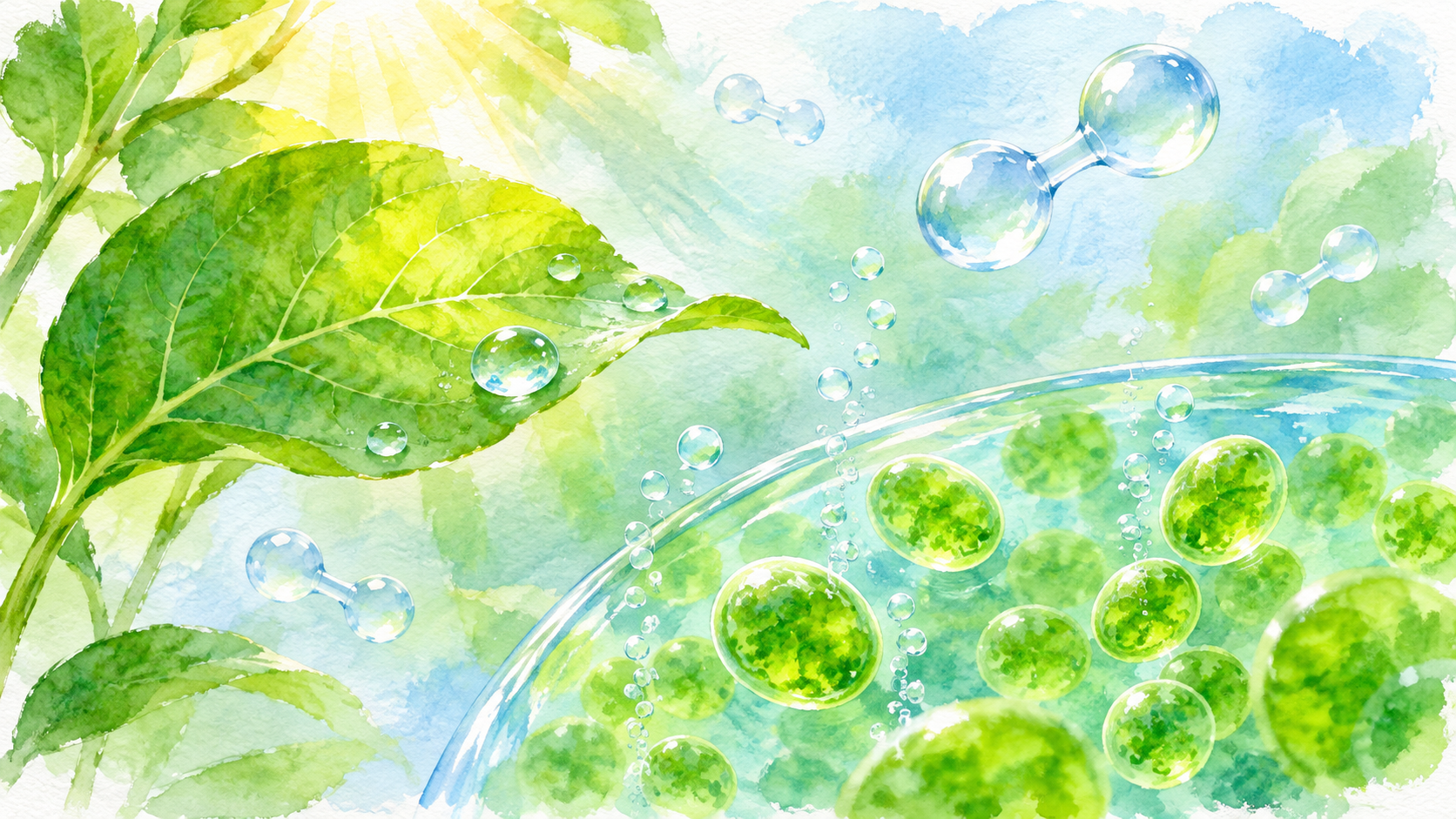
The featured watercolor image is a conceptual illustration, not a photograph of a hydrogen production experiment.
Comments