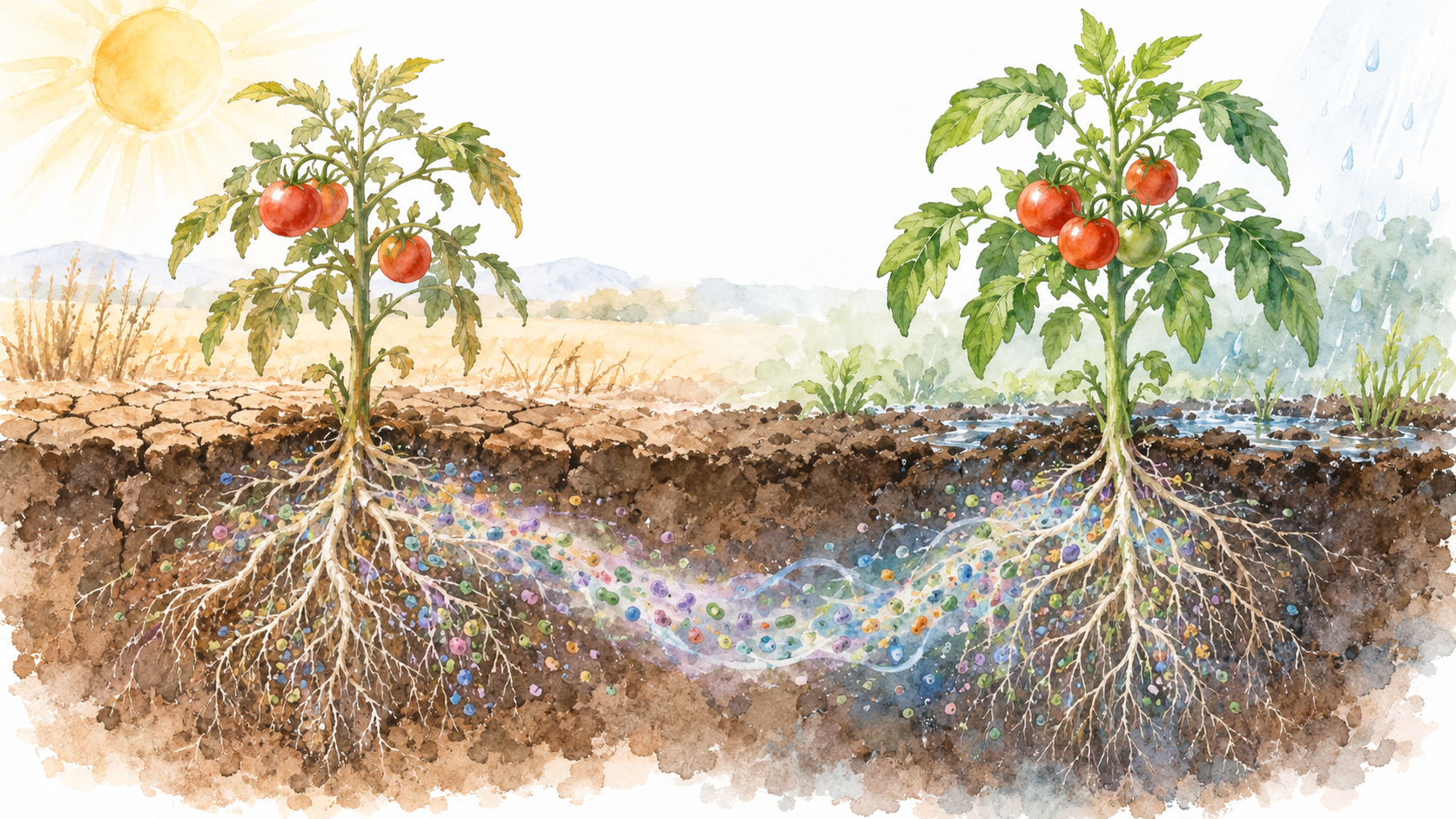
Do drought-tolerant plants withstand water shortage only because of their own genetics? Or does the microbial community around their roots also become part of a drought-adapted state? And if a plant has actually experienced water deficit, can that history remain in its rhizosphere microbiome?
A study published in Environmental Microbiome in September 2026 tested this idea in tomato. The researchers prepared four rhizosphere microbial communities by combining tomatoes that differed in drought tolerance with two previous watering histories, then transplanted those communities into the same drought-susceptible tomato cultivar. All recipient plants were later exposed to the same water-deficit treatment and then rewatered. The clearest differences did not appear while the plants were under drought, but after water was restored.
- Four donor histories: tolerant or susceptible, with or without prior drought
- The clearest differences appeared after rewatering
- What the authors mean by a “dual legacy”
- What changed in the rhizosphere community?
- Predicted microbial functions were not direct measurements of activity
- This is still far from a field-ready microbiome treatment
- What may have been transferred was not “drought tolerance,” but the way plants recover
Four donor histories: tolerant or susceptible, with or without prior drought
The study used the drought-susceptible tomato Solanum lycopersicum cv. Advantage and cv. 449, which had previously been selected as drought tolerant. Rhizosphere material from earlier experiments provided four microbial communities: susceptible cultivar without prior drought (SFI), susceptible cultivar with prior drought (SDI), tolerant cultivar without prior drought (TFI), and tolerant cultivar with prior drought (TDI). More precisely, the “prior drought” condition was a staged water-deficit treatment rather than an undefined history of field drought.
Every recipient plant was the same susceptible cultivar, Advantage. This allowed the researchers to compare two aspects of the donor rhizosphere: which cultivar it came from, and whether that donor plant had previously experienced water deficit. The transplant was not a single isolated bacterium. Five grams of rhizosphere soil were suspended in 5 mL of sterile water. Surface-sterilized seeds were soaked in the suspension for two hours, and the remaining slurry was added to sterilized soil. In other words, a whole rhizosphere community containing bacteria and fungi was transferred. The recipient soil had been autoclaved three times to reduce interference from background soil microbes. Each treatment had three biological replicates.
The timing matters. The microbiome was not applied after the recipient tomatoes had been damaged by drought. It was introduced at sowing, followed by 120 days of well-watered growth. The plants then underwent 12 days of water deficit and 8 days of rewatering. This was therefore not a treatment experiment in which microbes were given to already-wilted plants. It tested whether plants that had received rhizosphere communities with different histories would later recover differently from the same drought.
The clearest differences appeared after rewatering
Plant responses were assessed using net photosynthetic rate (Pn), leaf relative water content (RWC), and stem water potential (Ψstem). Before drought, there was no significant difference in photosynthetic rate among the four groups. After 12 days of water deficit, photosynthesis fell significantly in every group. At least for this trait, the origin of the transplanted rhizosphere did not clearly prevent the immediate physiological effect of drought.
The pattern changed after rewatering. Photosynthetic rate recovered clearly in the two groups that received rhizosphere communities from the tolerant cultivar, regardless of whether the donor plants had previously experienced water deficit. Recovery was weaker in the two groups receiving rhizosphere communities from the susceptible cultivar. The authors likewise interpreted photosynthetic recovery as being associated with the drought-tolerance background of the donor cultivar rather than its previous irrigation regime.
Leaf relative water content showed a different pattern. After rewatering, RWC remained significantly below the pre-drought level in the two groups receiving rhizosphere communities from donors without prior water deficit. By contrast, in both groups receiving communities from drought-experienced donors, the significant difference from the pre-drought state was no longer present. This points more strongly toward an effect associated with the donor plant’s watering history.
Stem water potential produced yet another pattern. The only group that remained incompletely recovered after rewatering was the one receiving the rhizosphere from the susceptible cultivar with no prior drought experience. If the donor rhizosphere came either from the tolerant cultivar or from a plant that had previously experienced water deficit, the difference from the pre-drought state was no longer significant.
Taken together, the three physiological measures placed the tolerant cultivar + prior drought rhizosphere at the best end of the recovery response, and the susceptible cultivar + no prior drought rhizosphere at the worst. The two intermediate cases—tolerant + no prior drought and susceptible + prior drought—fell between them.
This is not the same as saying that any microbiome previously exposed to drought was simply “better.” Photosynthetic recovery tracked the donor cultivar more strongly, whereas leaf water status tracked prior watering history more strongly. When both donor features were combined, however, all three physiological measures showed favorable recovery.
What the authors mean by a “dual legacy”
The authors describe the pattern as a “dual legacy.” One legacy comes from the biological background of the donor plant—its drought-tolerant or drought-susceptible cultivar identity. The other comes from the environment that donor plant previously experienced. The proposal is that both histories shape the rhizosphere microbial community and that their influence can persist after the community is transferred to another plant.
The results are consistent with that interpretation. The tolerant + prior-drought group recovered best, the susceptible + no-prior-drought group recovered worst, and the two groups carrying only one of those histories were intermediate. But it would be too strong to say that the study statistically proved a synergistic interaction between drought-tolerant cultivar background and prior drought exposure.
The experimental layout resembles a 2 × 2 design, but the plant physiological data were mainly analyzed by comparing the four groups using Kruskal–Wallis tests followed by Dunn’s multiple comparisons. A factorial analysis directly testing the main effects of donor cultivar and watering history, together with their interaction term, was not reported. The observed pattern supports the authors’ dual-legacy interpretation, but it should not be confused with a direct statistical demonstration of a two-factor interaction.
There is another limitation. Only one tolerant cultivar, cv. 449, and one susceptible cultivar, cv. Advantage, were used. The experiment therefore cannot fully separate a general effect of “drought tolerance” from properties specific to the 449 genotype. Demonstrating the same pattern across several tolerant and susceptible cultivars would make that part of the conclusion much stronger.
What changed in the rhizosphere community?
16S rRNA and ITS metabarcoding initially detected 6,549 bacterial ASVs and 2,066 fungal ASVs. After filtering, 880 bacterial and 607 fungal ASVs were analyzed. In the tolerant + prior-drought treatment, bacterial Shannon diversity and richness increased significantly between the initial and final samples. Both bacterial and fungal community structures also changed substantially over the course of the experiment, showing that the transplanted microbiome was extensively reassembled during growth in the recipient plant.
When the researchers compared the beginning and end of the tolerant + prior-drought treatment and selected taxa that did not behave as the same biomarkers in the susceptible + no-prior-drought treatment, six bacterial families were enriched at the end: Bacillaceae, Pirellulaceae, Burkholderiaceae, Reyranellaceae, Opitutaceae, and NS11-12. The fungal families Aspergillaceae, Sporormiaceae, and Piskurozymaceae were also identified. Some members of Bacillaceae and Burkholderiaceae are well known in plant growth and stress biology, but these data do not show that any one of these families caused the improved recovery. The experiment transferred an entire community, not defined individual strains.
The meaning of “initial” and “final” is also important. The initial sample was the donor rhizosphere used for transplantation, whereas the final sample was the rhizosphere of the susceptible recipient tomato 140 days later. Those 140 days included 120 days of normal watering, 12 days of drought, and 8 days of recovery. Therefore, taxa enriched at the end cannot simply be described as microbes that increased “during post-drought recovery.” Their abundance could have changed during long-term community assembly in the recipient, as a consequence of switching host plants, during drought, during rewatering, or through a combination of these processes.
The authors themselves note that the microbiome was not sampled at the end of drought, preventing separation of changes that occurred during drought from those that occurred during recovery. More strictly, because the recipient rhizosphere was also not sampled immediately before drought began, changes during the preceding 120 days of well-watered growth cannot be fully separated either.
Predicted microbial functions were not direct measurements of activity
In the tolerant + prior-drought rhizosphere, FAPROTAX-based bacterial functional predictions included increases in categories such as nitrate reduction and anoxygenic photoautotrophy, while FUNGuild indicated increases in fungal groups classified as saprotrophs. The authors discuss the possibility that microbial functions related to nutrient cycling contributed to recovery.
These tools, however, do not directly measure microbial metabolism. They infer likely functions or ecological guilds from taxonomic assignments derived from 16S or ITS data. It would therefore be too strong to state that nitrate-reduction activity itself increased. The safer interpretation is that taxa associated with predicted nitrate-reduction functions became more prominent. The authors similarly point to metabolomics, transcriptomics, and other direct measurements as necessary for testing microbial activity.
Co-occurrence network analysis also differed between the susceptible + no-prior-drought and tolerant + prior-drought communities, with the latter showing a more modular structure and a greater fungal contribution. But each treatment had only three biological replicates. The paper explicitly treats these network results as exploratory, and co-occurrence should not be interpreted as evidence of direct ecological interaction between microbes.
This is still far from a field-ready microbiome treatment
The recipient soil was autoclaved three times. That design makes it easier to detect differences among transplanted communities, but real agricultural soils already contain complex and established microbiomes. Whether an introduced community could colonize, compete with resident microbes, and reproduce the same effect in non-sterile soil or in the field remains unresolved. The authors identify this as an important next step.
The low replication—n = 3 per treatment—is another limitation, especially for microbiome diversity and network analyses. In addition, although the experiment compared four live rhizosphere inocula, it did not include an uninoculated control, a heat-killed inoculum, or a cell-free filtrate. The relative differences among the four transplanted communities can therefore be compared, but the contribution of living microbes cannot be completely separated from non-living material carried over with the rhizosphere slurry, such as metabolites or nutrients.
That does not invalidate the four-group comparison. Only 5 g of donor rhizosphere soil were introduced into a 20 L recipient pot, and the background soil was standardized and sterilized. The point is narrower: additional controls such as heat-killed inoculum would be needed to isolate the microbial contribution more rigorously.
What may have been transferred was not “drought tolerance,” but the way plants recover
The results do not show that transferring a rhizosphere microbiome from a tolerant tomato simply turns a susceptible tomato into a drought-tolerant one. During the 12-day water-deficit period, photosynthesis declined strongly in all four groups. The different microbiomes did not prevent the plants from experiencing drought stress.
The separation emerged after water was restored. Photosynthetic recovery was associated more strongly with whether the donor rhizosphere came from the tolerant cultivar. Leaf water status showed a clearer relationship with whether the donor plant had previously experienced water deficit. And when those two histories were combined in the tolerant cultivar + prior drought rhizosphere, photosynthetic rate, relative water content, and stem water potential all showed favorable recovery.
The study therefore supports the possibility that a plant’s genotype and its environmental history can shape a rhizosphere microbiome in ways that later influence another plant’s stress response. What carries that history—particular microbes, community structure, metabolites, or microbial functions—remains unresolved, as does whether the effect persists in non-sterile soil or over longer periods.
What this experiment transferred was not drought tolerance in the simple sense. It was closer to a change in how another plant recovered after drought, depending on the biological and environmental history embedded in the donor rhizosphere community.
Original paper Dual legacy of plant water-deficit-tolerance and watering history shapes rhizosphere microbial transplant outcomes in tomato post-drought recovery. Environmental Microbiome, 2026. DOI: 10.1186/s40793-026-00953-0

Comments