Dense sensor networks could map soil moisture with much finer spatial resolution, but conventional electronics create another problem: every device eventually has to be recovered and discarded.
A team at Osaka University proposed a different architecture. Their wirelessly powered sensing fertilizer uses a mostly degradable sensor, converts soil-moisture information into heat, and lets a thermal camera read both the sensor location and moisture signal. After use, the substrate can be tilled into soil and release fertilizer components incorporated during fabrication.
The sensor communicates through heat rather than a radio transmitter

The device uses a wood-derived cellulose-nanofiber nanopaper substrate, a tin receiving coil, a carbon heater and a natural-wax coating. Magnetic resonant coupling supplies power from an external transmitter.
Soil moisture changes the resonant behavior and power-transfer efficiency of the receiving coil. That changes the heater temperature. A thermal camera can therefore identify the hotspot position and infer moisture from hotspot temperature, without placing a battery and conventional communication circuit in every sensor.
The paper demonstrated controlled soil-moisture measurements
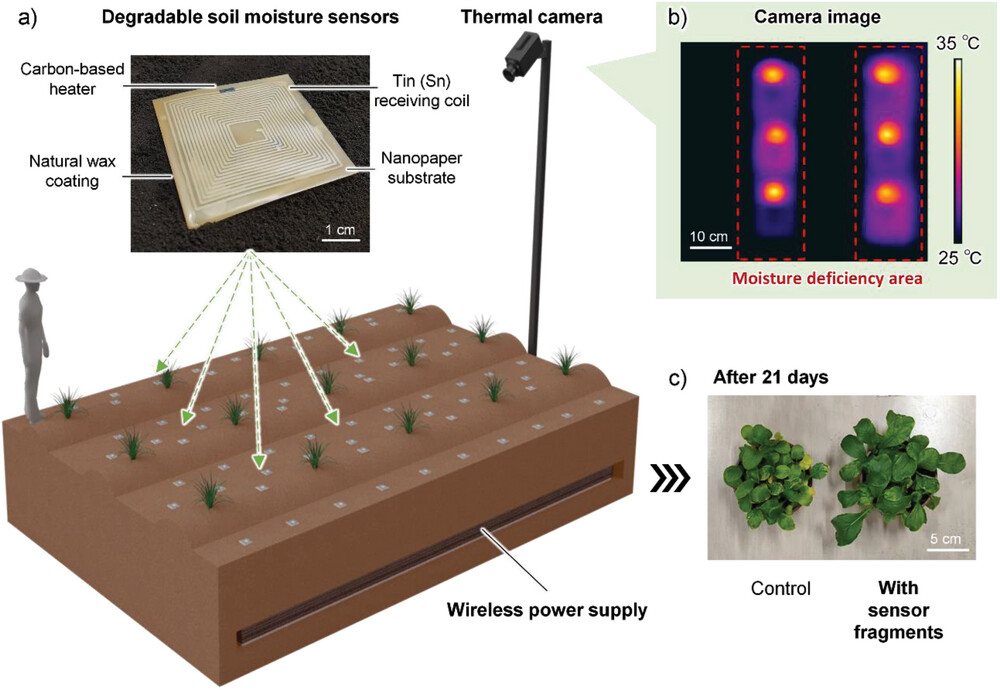
The study evaluated sensors on soil containing roughly 5–30 wt.% water. The transmitter coil was positioned about 10 cm below the sensor and operated near 36.5 MHz. A multi-sensor demonstration showed that thermal imaging could distinguish dry and wet regions.
This was a controlled proof-of-concept, not a season-long field deployment. The authors explicitly note that the devices were positioned at favorable locations and angles for wireless power transfer. Uneven soil surfaces and changing orientation relative to the transmitter remain engineering challenges for real farmland.
“Return to the soil” does not mean every component disappears
Nanopaper and natural wax are biodegradable, while the sensor also contains tin conductors and carbon material. The design intentionally uses residual materials expected to have relatively low environmental impact, but the device is not literally 100% converted into biological material.
The more accurate description is a simplified, mostly degradable sensor architecture intended to reduce recovery and electronic-waste burdens.
Why call it a fertilizer?

The sensor does not magically become fertilizer as its electronics decompose. The nanopaper substrate is manufactured with fertilizer components, including nitrogen and potassium sources. After the device is tilled into soil, those nutrients can be released. Plant-growth experiments in the paper showed the fertilizer-containing substrate could promote growth.
The novelty is therefore the integration of sensing and nutrient-delivery functions in the same disposable device.
A different way to think about precision-agriculture sensors
Instead of making every sensor more sophisticated, this concept shifts complexity toward the external power source and imaging system while keeping field devices simple enough to deploy densely.
As of 2026, the original paper is best viewed as a system-level proof of concept rather than a commercially validated field technology. But it offers an interesting design direction for combining sustainable electronics with precision agriculture.
For related context, see A 4.5-µm Transparent Plant E-Skin Monitors Leaf Growth and Surface Temperature in Real Time.
For related context, see eSoil Increased Barley Seedling Dry Weight by 50% at Day 15—but It Is Not Yet a Proven Crop-Yield Technology.
For related context, see Predicting Individual Chinese Cabbage Weight by Drone: R² > 0.72 Even 53 Days Before Harvest.
Reference
- Kasuga T, Mizui A, Koga H, Nogi M. Wirelessly Powered Sensing Fertilizer for Precision and Sustainable Agriculture. Advanced Sustainable Systems. https://doi.org/10.1002/adsu.202300314

Comments