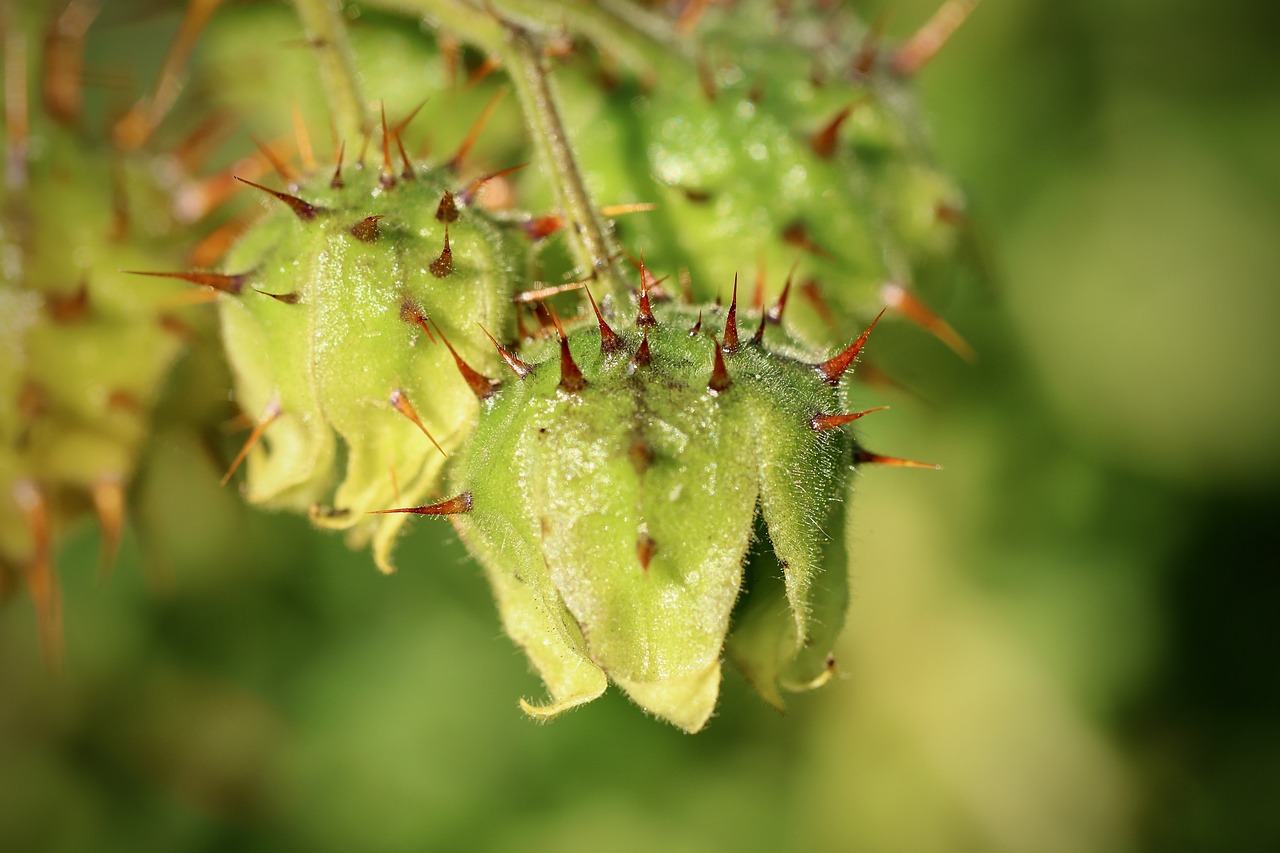
Sharp plant structures are often lumped together as thorns, but thorns, spines and prickles have different developmental origins. A 2024 Science paper focused on prickles—epidermal or superficial projections found in lineages such as roses and spiny Solanum.
LOG mutations repeatedly accompanied prickle loss in Solanum

Across eggplants and wild relatives, mutations in cytokinin-activating LONELY GUY (LOG) genes were associated with at least 16 independent losses of prickles. This is a striking example of convergent evolution repeatedly recruiting the same developmental program.
Related genes operate across deeply diverged flowering plants
LOG homologs were implicated in prickle formation across angiosperm lineages separated by more than 150 million years, including rose and rice. This does not mean every thorn or spine in every plant is controlled by LOG; the study specifically concerns convergently evolved prickles and homologous developmental programs.
Genome editing removed prickles in new Solanum systems
The researchers developed genetic systems for previously difficult species and edited LOG orthologs to eliminate prickles in a wild species and an indigenously foraged berry. That creates a direct crop-improvement proof of concept.
Because LOG genes regulate cytokinin activation, practical breeding still requires checking developmental side effects and selecting the correct tissue-relevant homolog.
For related context, see How miR159 and CKX6 Control Rose Petal Size Through Cytokinin Turnover.
For related context, see What Controls Cucumber Pedicel Length? An EMS Mutant Points to Cytokinin-Dependent Cell Number.
For related context, see SW14 Rebalances Soybean Seed Weight, Protein and Oil by Disrupting a LEC1-Containing NF-Y Complex.
Reference
- Satterlee JW et al. Convergent evolution of plant prickles by repeated gene co-option over deep time. Science. 2024;385:eado1663. https://doi.org/10.1126/science.ado1663


Comments