Higher yield. Better disease resistance. Greater tolerance to heat or drought. A promising F1 hybrid.
In plant biotechnology, reaching that point is often treated as the major breakthrough. But for a crop variety, “we made it” is not the end of the story.
Producing one outstanding plant in a laboratory or trial field is a very different technical problem from producing a million—or ten million—plants with the same quality, at a price farmers can afford, in the places where they are actually needed.
A 2026 review in Frontiers in Plant Science makes this gap unusually visible through Arabica coffee F1 hybrids. The review does not stop at resilience and yield. It follows the hybrids downstream into somatic embryogenesis, mini-cuttings, F1 seed production using male sterility, regional nurseries, production costs, and farmer access.
Seen this way, commercialization has a recurring pattern: solving one bottleneck does not make bottlenecks disappear. It moves them further downstream.
- High-performing F1 hybrids already exist
- You cannot simply save seed from an elite Arabica F1
- Mini-cuttings change where propagation can happen
- The next shift is from moving seedlings to moving seed
- In plant biotechnology, the bottleneck keeps moving
- A good variety and a deployable variety are not the same thing
- This reaches all the way to the coffee we drink
- Who benefits when technology lowers costs?
- From one plant in the lab to the coffee in your cup
- References and further reading
High-performing F1 hybrids already exist
Arabica F1 breeding has been used to combine yield, disease resistance, environmental adaptation, and cup quality from genetically distinct parents.
In a study across 15 sites in Central America, F1 hybrids outperformed American pure-line cultivars on average, with yields 34% higher under full sun and 58% higher under agroforestry conditions. That does not mean every F1 is superior in every environment, but it does show that the question “can breeders create a useful genotype?” has already produced convincing answers.
The next question is harder: how do you get that genotype into farmers’ fields at scale?
At that point, the problem changes.
You cannot simply save seed from an elite Arabica F1
Arabica coffee is predominantly self-pollinating. If seed is collected from a selected F1 plant, the next generation is F2 and will segregate genetically. The exact combination that made the F1 valuable is no longer reproduced uniformly.
That is why somatic embryogenesis (SE) became so important. SE allows selected F1 genotypes to be clonally propagated, producing many plants with the same genetic combination.
But once SE works, commercialization is not finished. It requires specialized facilities, technical expertise, and more investment than conventional seedling production. As programs try to move from thousands of plants to millions, the central questions become production capacity and cost per plant.
The bottleneck has moved from breeding to propagation.
Mini-cuttings change where propagation can happen
Rooted mini-cuttings provide another step in that scale-up process.
Plants produced through SE can be maintained as mother plants and used to generate cuttings. Instead of producing every final plant in a sophisticated micropropagation facility, SE becomes the starting material for further multiplication in nurseries.
That matters for more than multiplication rate.
If regional nurseries can take part in production, plants can be multiplied closer to coffee-growing communities rather than shipped as finished seedlings over long distances from a centralized laboratory. Once that becomes possible, nursery capacity, logistics, seasonal demand, and the price farmers actually pay become more important.
Again, the bottleneck moves downstream.
The next shift is from moving seedlings to moving seed
An even larger change comes from using male sterility for F1 seed production.
A male-sterile maternal line cannot self-pollinate. If it receives pollen from a selected paternal line, it can produce F1 hybrid seed. Starmaya is the best-known example. A 2019 study described a seed-production system using the male-sterile line CIR-SM01 and Marsellesa in seed gardens.
Turning an F1 into a seed-distributed product changes the economics and geography of propagation.
Seed is lighter than seedlings, easier to transport, and can be raised in local nurseries. Male sterility therefore is not merely a breeding trick for lowering propagation costs. It can change the architecture of the planting-material supply system itself.
Should elite hybrids be clonally produced in centralized facilities and shipped as plants? Should SE-derived stock be multiplied through mini-cuttings in regional nurseries? Or should hybrid seed be produced in seed gardens and distributed through a more decentralized nursery network?
What makes the 2026 review particularly useful is that it treats these not as isolated techniques, but as parts of a system for getting improved varieties into farmers’ hands.
In plant biotechnology, the bottleneck keeps moving
Following the coffee F1 story changes how commercialization looks.
At first, the challenge is to create a better hybrid. Once that is possible, the problem becomes how to reproduce the same genotype in large numbers. Somatic embryogenesis solves part of that problem, but then cost and production capacity become limiting. Mini-cuttings extend multiplication into nurseries, and logistics and nursery capacity become more important. Hybrid seed production reduces the need to transport finished plants, but now seed gardens, seed production, quality control, and regional availability matter.
Commercialization is therefore not the removal of a single bottleneck.
It is a process of pushing the critical path from the laboratory into production, from production into distribution, and finally toward the people who will use the technology.
Coffee makes the pattern easy to see, but it is not unique to coffee. A genome-edited plant can be obtained as a single regenerated individual. A transformed line can show an excellent phenotype. A promising fruit-tree or forest-tree genotype can be selected. In all of these cases, the next practical question may be whether the material can be multiplied reliably and cheaply enough to matter outside the research system.
A good variety and a deployable variety are not the same thing
World Coffee Research distinguishes between the availability of improved varieties and their accessibility to farmers.
A variety may exist, yet still be functionally unavailable if farmers cannot obtain reliable seed or seedlings at the right time, in the right place, and at an affordable price.
That distinction matters far beyond coffee.
Imagine a genotype that yields 30% more in trials. If only a handful of plants exist and farmers cannot obtain planting material, that genetic gain does not become an agricultural gain. Breeding creates the potential value, but seed production, clonal propagation, quality assurance, nurseries, and logistics determine whether that value reaches a field.
Coffee adds another reason this matters: it is a perennial crop. Trees remain in production for many years. A decision about which variety and which planting material enters a farm can therefore shape productivity for a long time.
This reaches all the way to the coffee we drink
Propagation may sound like a problem for breeders and nurseries, but it connects directly to the coffee supply that eventually reaches consumers.
If improved F1 hybrids can be propagated more efficiently, the cost and difficulty of renovating a farm with new varieties can fall. If higher-yielding, disease-resistant, or climate-resilient varieties become easier to access, they can support farm productivity and reduce some of the instability caused by disease and environmental stress.
That does not mean a cheaper seedling translates directly into a cheaper cup of coffee.
Between a nursery and a café are cultivation, harvesting, processing, export, transport, roasting, distribution, labor, and many other costs. Planting-material efficiency is only one part of that chain. But it is an upstream part that helps determine how readily coffee farms can renew themselves and adopt improved genetics.
And once we look at the whole chain, another question appears: who captures the value created by technological improvement?
Who benefits when technology lowers costs?
For plant-biotechnology scale-up, lowering the cost per plant is an obvious objective. But lower production costs alone do not guarantee a sustainable system.
If propagation becomes cheaper, yields rise, or crop losses fall, where does that additional value go? To consumers? Traders? Roasters? Nurseries? Or does some of it remain with the farmers who pay for the new planting material and take the production risk?
This is where a fair-trade perspective becomes relevant. Fairtrade systems emphasize the need for producer prices and economic conditions that allow farmers to cover production costs and maintain viable farms. A technically excellent variety will not spread sustainably if farmers cannot afford to plant it or do not gain enough from adopting it to justify future renovation.
Plant-biotechnology deployment therefore involves two kinds of scale-up.
One is biological scale-up: moving from one plant to a million plants.
The other is economic and social scale-up: building a system in which those plants can be produced, distributed, purchased, grown, and renewed over time.
A technology has truly reached society only when both are working.
From one plant in the lab to the coffee in your cup
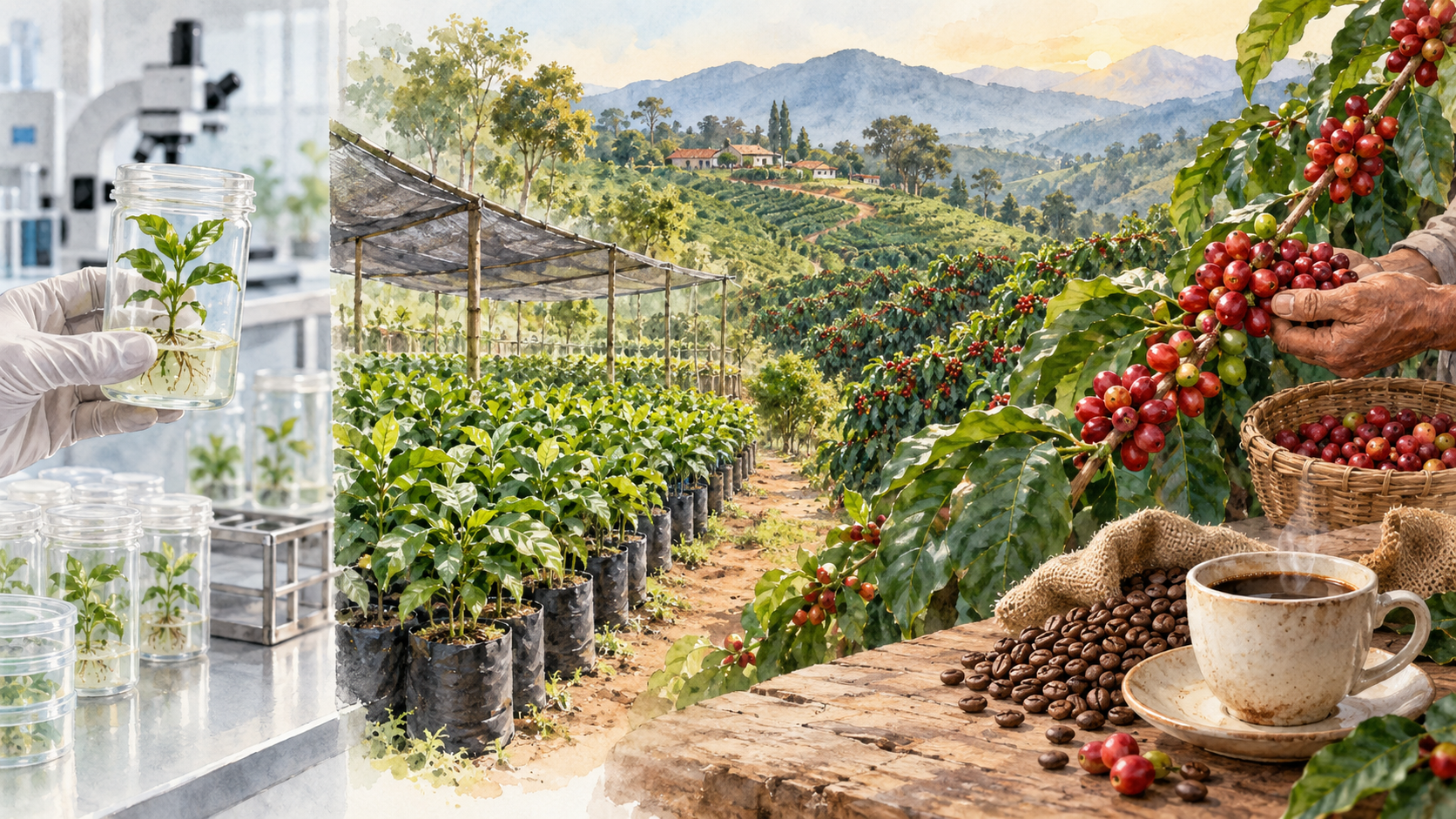
A genotype selected in a breeding program may be propagated through tissue culture, multiplied as cuttings, or produced as F1 seed. It moves through a nursery and into a coffee farm. Years later, cherries are harvested, processed, exported, roasted, and finally brewed into a cup.
Looking at that entire path makes one point especially clear.
Making one successful plant in the laboratory and supplying a million plants commercially are fundamentally different technical challenges.
In plant biotechnology, the final bottleneck is not always the gene or the phenotype. Sometimes it becomes a much more practical question: can we multiply it and deliver it?
Discovering genes and creating useful traits remain essential. But if the goal is real-world adoption, propagation, cost, quality, logistics, and farmer economics become part of the technology too.
Arabica F1 coffee hybrids make that entire chain visible—from one plant in a breeding program to the cup we drink every day.
References and further reading
- Georget F, et al. Improving resilience of Arabica coffee plantations by cultivating F1 hybrid varieties: challenges to future seed production and enhancing farmers’ access to modern varieties. Frontiers in Plant Science. 2026. DOI: 10.3389/fpls.2026.1905477. https://www.frontiersin.org/journals/plant-science/articles/10.3389/fpls.2026.1905477/full
- Bertrand B, et al. Performance of Coffea arabica F1 hybrids in agroforestry and full-sun cropping systems in comparison with American pure line cultivars. Euphytica. 2011;181:147–158. DOI: 10.1007/s10681-011-0372-7. https://link.springer.com/article/10.1007/s10681-011-0372-7
- Georget F, et al. Starmaya: The First Arabica F1 Coffee Hybrid Produced Using Genetic Male Sterility. Frontiers in Plant Science. 2019;10:1344. DOI: 10.3389/fpls.2019.01344. https://www.frontiersin.org/journals/plant-science/articles/10.3389/fpls.2019.01344/full
- Etienne H, et al. Coffee Somatic Embryogenesis: How Did Research, Experience Gained and Innovations Promote the Commercial Propagation of Elite Clones From the Two Cultivated Species? Frontiers in Plant Science. 2018;9:1630. https://www.frontiersin.org/journals/plant-science/articles/10.3389/fpls.2018.01630/full
- World Coffee Research. Why do seed systems matter? https://worldcoffeeresearch.org/programs/why-do-seed-systems-matter
- Fairtrade International. Coffee price review. https://www.fairtrade.net/en/why-fairtrade/how-we-do-it/standards/standards-work-in-progress/price-review-coffee.html


Comments