
Crop leaves absorb about 90% of visible photons from 400–700 nm but transmit or reflect much of the 700–800 nm far-red (FR) spectrum. A 2025 Nature Communications study used a 3D soybean-canopy model to ask what would happen if crops gained FR-absorbing chlorophyll d/f capacity like some cyanobacteria.
This was a simulation, not a Chl d/f transgenic soybean trial
The model reconstructed field-grown soybean canopy architecture and combined spectral ray tracing with leaf energy balance and gas-exchange models. It calculated photon absorption and CO₂ assimilation through the day; no engineered soybean carrying Chl d/f was grown in the field.
Chl d strategies increased daily canopy assimilation by about 13.5–13.7%
Uniform Chl d absorption produced a 13.5% increase in daily canopy assimilation. A strategy that increased FR absorption with the canopy FR/red ratio produced a 13.7% increase while concentrating the extra absorption in light-limited lower leaves.
A longer-wavelength Chl f strategy reached up to 26% in pod filling
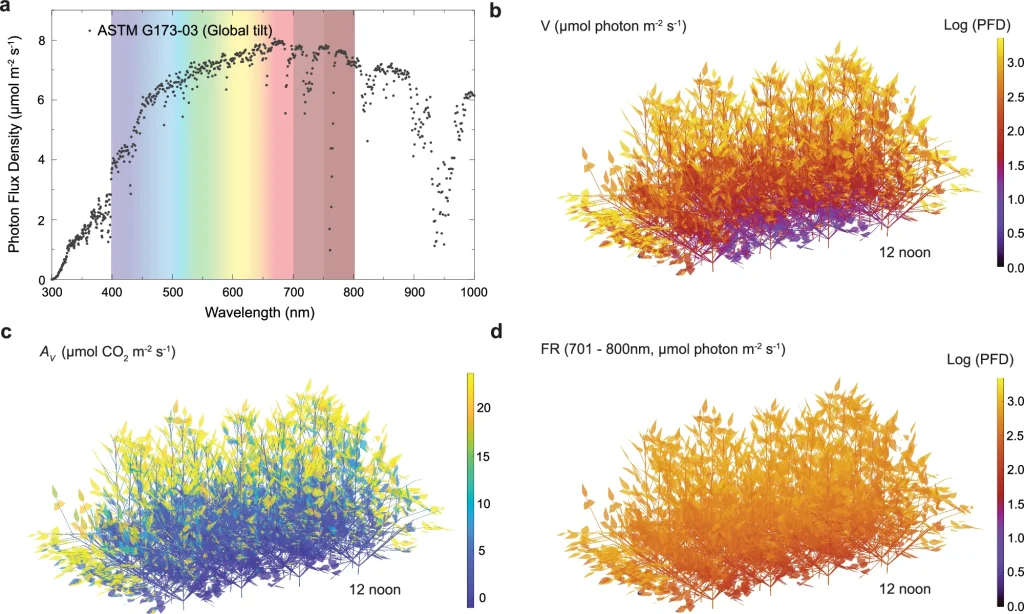
When FR absorption was regulated according to phytochrome-sensed FR/red ratio, the modeled canopy CO₂ assimilation increased by as much as 26% during the critical pod-filling stage, without increasing simulated photodamage risk.
26% more assimilation does not equal 26% more yield
The authors explicitly note that increased photosynthesis does not necessarily translate one-for-one into yield. Source–sink balance, respiration, phenology, nutrients, water and stress all intervene.
The main purpose of the model is to quantify whether the difficult task of engineering FR chlorophylls into crop photosystems could be worth pursuing. Producing the pigments, inserting them correctly into photosystems and controlling their expression remain major biological challenges.
For related context, see Moss Photosynthesis Increased at 6–10G: IBSH1/AP2-ERF Links Hypergravity to CO₂ Diffusion.
For related context, see How Much “Breeding” Happened in This AI Breeding Study? Reading a Synthetic-Data bioRxiv Proof of Concept.
For related context, see How Much Did Rising CO2 Increase Global Land Photosynthesis? A 13.5 ± 3.5% Constraint for 1981–2020.
Reference
- Wang Y, Oliver TJ, Croce R, Long SP. Addition of longer wavelength absorbing chlorophylls into crops could increase their photosynthetic productivity by 26%. Nature Communications. 2025;16:7933. https://doi.org/10.1038/s41467-025-62885-6

Comments