Studying gene function in woody plants takes time. In species such as macadamia, where tissue culture and regeneration are difficult, the major bottleneck is often not merely introducing DNA. It is rebuilding a whole plant from transformed cells.
A paper published in Plants in August 2026, “Efficient In Planta Induction of Transgenic Hairy Roots in Macadamia Seedlings and Mature Trees Using Visual Reporters,” approaches that problem from a very different direction.
Instead of returning macadamia material to a tissue-culture system, the authors used Agrobacterium rhizogenes—also classified as Rhizobium rhizogenes in current taxonomy—to induce transgenic hairy roots directly on intact plants. Most notably, they made the system work not only in seedlings but also on branches of five-year-old macadamia trees.
Original paper: Mo Y. et al. Efficient In Planta Induction of Transgenic Hairy Roots in Macadamia Seedlings and Mature Trees Using Visual Reporters. Plants. 2026;15(16):2418. https://doi.org/10.3390/plants15162418
- Making transgenic roots without returning the tree to a culture dish
- This is not a genetically transformed mature tree
- RUBY is convenient, but visibility comes at a metabolic cost
- The hairy-root system itself may be the larger biological complication
- Direct field use in Japan would face additional barriers
- Still, this is a compelling proof of concept
- Paper information
Making transgenic roots without returning the tree to a culture dish
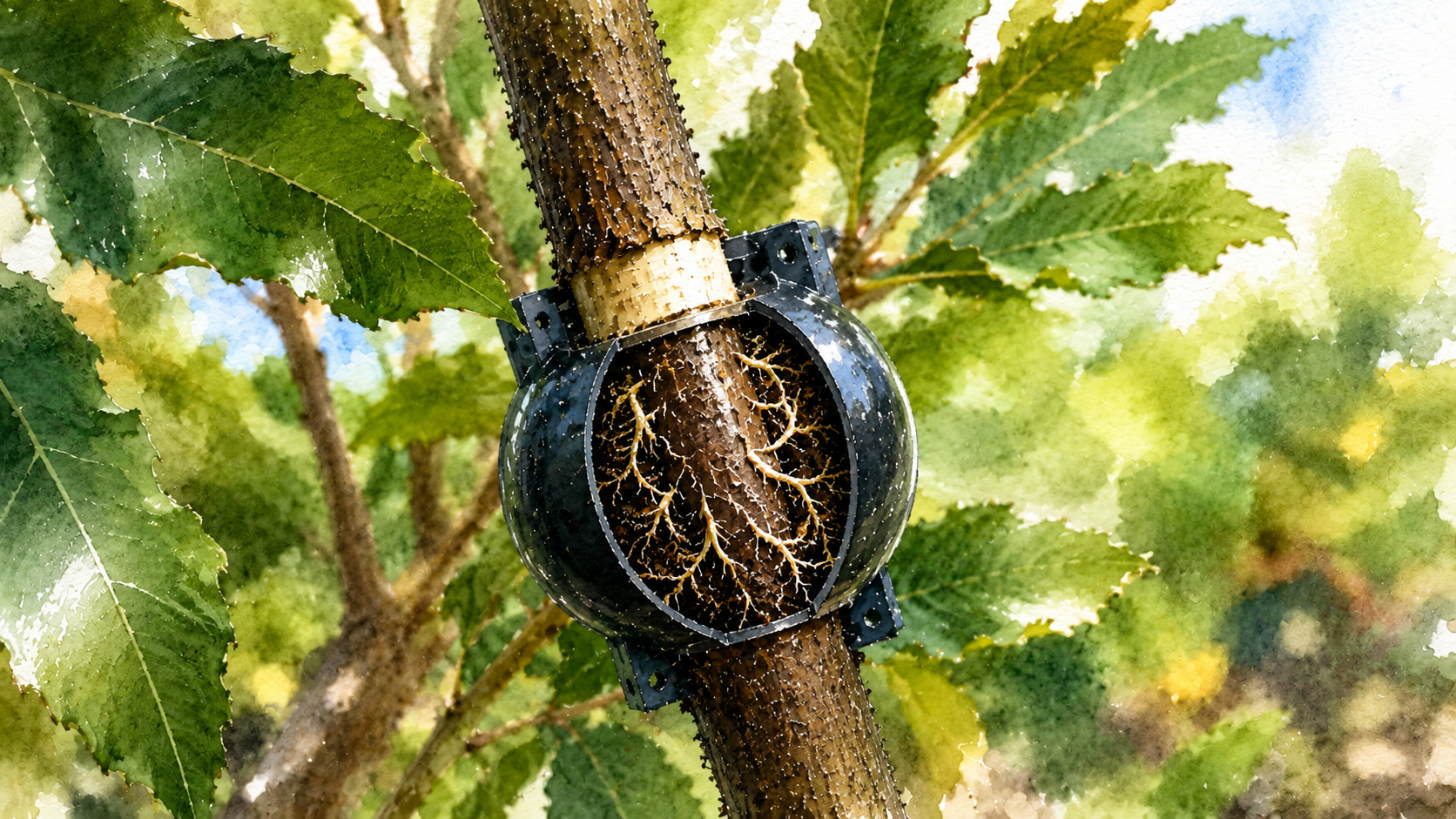
The mature-tree method resembles air layering used in horticulture. A ring of bark is removed from a branch, the wound is inoculated with the bacterium, and the treated area is enclosed in a humid rooting container. Callus and roots then develop around the wound, and some of those roots carry the introduced construct.
In seedlings, syringe injection performed better than dipping the cut surface into the bacterial suspension, producing positive hairy roots at 39.25–47.38%. In mature trees, optimization produced efficiencies of up to 28.2%. The paper reports that positive roots appeared, on average, about 30 days after inoculation.
For a perennial woody crop such as macadamia, that is an interesting result.
The conventional route can require transformation, selection, regeneration and then years of plant growth. This approach instead offers the possibility of generating experimentally useful transformed roots while they remain connected to a tree that is already several years old.
That could be useful for studying root development, nutrient uptake, rhizosphere interactions and pathogen responses.
But this is also where the important limitations begin.
This is not a genetically transformed mature tree
Only the newly induced hairy roots are transformed. The branch, leaves, buds and flowers remain non-transgenic.
The result is therefore a composite plant: a non-transgenic shoot connected to transformed roots.
The paper itself identifies this as a limitation. Because reproductive tissues are not transformed, the method does not directly produce a heritable transgenic macadamia line. The authors describe root-to-shoot organogenesis from positive hairy roots as a future step.
At present, it is therefore better viewed not as a technology for immediately creating new macadamia cultivars, but as an experimental platform for testing gene function in the roots of mature trees.
RUBY is convenient, but visibility comes at a metabolic cost
The study also tested several visual markers for identifying transformed roots.
Alongside fluorescent proteins such as eGFP and DsRed2, the authors used RUBY and AtPAP2. RUBY is particularly convenient because transformed roots become visibly red, allowing positive roots to be identified without fluorescence microscopy.
For experiments involving large plants outside a standard culture room, that is a substantial practical advantage.
However, RUBY is not simply a red protein tag. It introduces an artificial metabolic pathway that converts endogenous tyrosine into betalain pigments through several enzymatic steps. In other words, a RUBY-positive root has already had its metabolism altered by the reporter itself.
That becomes important if the experiment concerns tyrosine metabolism, secondary metabolism, redox responses, stress physiology or metabolite composition. In those cases, changes caused by the gene of interest must be separated from changes caused by RUBY.
This does not invalidate the hairy-root system, because the paper also demonstrates eGFP and DsRed2. But the convenience of visual selection with RUBY should be considered together with the fact that the reporter itself modifies metabolism.
The hairy-root system itself may be the larger biological complication
From an experimental-interpretation perspective, the use of R. rhizogenes may be even more important than RUBY.
This bacterium is a plant pathogen that causes hairy-root disease. The rol genes transferred from the Ri plasmid alter plant-cell behavior and drive the formation of abundant hairy roots.
Those genes do more than simply make roots appear.
rolA, rolB and rolC can affect auxin and cytokinin metabolism or sensitivity, hormone signaling, root development and secondary metabolism. rolB in particular is central to hairy-root formation and can alter auxin responses and specialized metabolism.
That creates an important complication for some of the most obvious applications of this platform.
Suppose a transformed root shows altered root architecture, improved stress tolerance or increased secondary metabolite production. The phenotype may not be attributable solely to the gene being tested, because the rol genes required to generate the hairy root can influence those same processes.
Appropriate K599-only controls can reduce this problem, but the system still should not be treated as physiologically identical to an ordinary macadamia root.
The feature that makes hairy roots so useful—their strong capacity to form and grow—is also an inherent experimental constraint.
Direct field use in Japan would face additional barriers
Regulation also matters when considering practical use in Japan.
R. rhizogenes is a plant-pathogenic bacterium. It would be inaccurate to say that the species is uniformly prohibited in Japan; requirements depend on the strain, its origin and the conditions of use. For example, NITE notes that the overseas-derived R. rhizogenes strain NBRC 13257 requires permission from the Plant Protection Station.
Using a strain under containment in a research facility is very different from inoculating branches of mature fruit trees and maintaining them outdoors.
There is also the issue of genetically modified organisms. In Japan, use of a genetically modified organism in the environment without containment measures falls under Type 1 Use under the Cartagena Act and requires prior assessment and approval. Work conducted with containment is managed as Type 2 Use.
So the method described in this paper cannot simply be transferred directly into an ordinary orchard setting in Japan.
Both management of the plant-pathogenic bacterium and regulation of genetically modified organisms have to be considered.
Still, this is a compelling proof of concept
Listing these limitations can make the technology sound less interesting than it actually is. My impression is the opposite.
This is not yet a plug-and-play practical technology. RUBY can alter metabolism. Hairy roots are physiologically influenced by rol genes. The shoot remains non-transgenic. Outdoor use in Japan would face regulatory hurdles.
There is still a long distance between “it works” and “it is freely usable.”
Even so, the study demonstrates something conceptually valuable: a five-year-old tree does not necessarily have to be returned to cultured cells and regenerated from scratch in order to perform a genetic experiment on part of its root system. A transformed experimental root can instead be added to a tree that already exists.
Generation time is one of the fundamental constraints in woody-plant research. This approach tries to bypass part of that constraint by asking whether the entire plant really needs to be transformed for every experiment.
Future systems may reduce the physiological impact of rol genes. Non-destructive markers may improve beyond RUBY. If transformed hairy roots can eventually be regenerated efficiently into shoots, this platform could also become a bridge toward stable transformation. The paper itself points to root-to-shoot regeneration as a future direction beyond the current composite-plant system.
There is still a long way to go.
That is precisely why it will be interesting to see how this technology develops.
Paper information
Mo Y. et al. (2026) Efficient In Planta Induction of Transgenic Hairy Roots in Macadamia Seedlings and Mature Trees Using Visual Reporters. Plants 15(16):2418. DOI: 10.3390/plants15162418


Comments