In plant tissue culture, we often say that a tissue “forms callus and then regenerates shoots.” For practical culture work, that description is sometimes enough. At the molecular level, however, it is increasingly clear that it is far too coarse.
What exactly is callus? How do callus cells become capable of making a new shoot? And does every plant reach shoot regeneration through the same developmental route?
When the classic Arabidopsis studies are placed next to a new 2026 study in petunia, the history of the field looks like a gradual increase in resolution. That is the central theme here: sharpening the resolution of regeneration.
- Callus was not simply an undifferentiated mass of cells
- Becoming “root-like” turned out to have a function
- In 2026, even the competent state acquired a time dimension
- Is the root-meristem program actually required?
- The shoot program starts without a clear canonical root-meristem intermediate
- This still does not prove that the root program is completely unnecessary
- It is also too early to conclude that Arabidopsis and petunia are fundamentally different species
- Breaking the word “regeneration” into smaller steps
- This higher-resolution view may matter in biotechnology as well
- Sharpening the resolution of regeneration
- References
Callus was not simply an undifferentiated mass of cells
A major conceptual shift came from the 2010 study by Sugimoto, Jiao, Meyerowitz and colleagues in Developmental Cell.
Callus had often been pictured as a mass produced when differentiated plant cells reverted to a broadly undifferentiated state. Detailed work in Arabidopsis showed that this view was too simple. Calli induced from roots, cotyledons and even petals displayed gene-expression and structural features resembling the root meristem, particularly the lateral-root developmental program. Mutants unable to initiate lateral-root formation were also impaired in callus formation from multiple tissues.
Rather than
differentiated tissue → completely undifferentiated state → callus,
the process was better described as
differentiated tissue → a lateral-root-like developmental program → callus.
That changed the meaning of “callus.” A similar-looking callus does not necessarily consist of cells with no developmental identity at all.
Becoming “root-like” turned out to have a function
In 2015, Kareem and colleagues pushed this model further.
In the standard Arabidopsis regeneration system, explants are first cultured on an auxin-rich callus-inducing medium (CIM), then transferred to a cytokinin-rich shoot-inducing medium (SIM). When the PLETHORA transcription factors PLT3, PLT5 and PLT7 were removed, callus could still form, but the callus largely lost its ability to regenerate shoots.
PLT3/5/7 promote PLT1 and PLT2, which are associated with root stem-cell identity. Restoring PLT1 or PLT2 recovered the ability to generate shoot progenitor cells, but this alone was not sufficient to make complete shoots; downstream shoot-development regulators such as CUC2 were also required.
This separated two steps that had previously been blended together: acquiring a root-like stem-cell program and using that regenerative competence to execute a shoot program.
In the canonical Arabidopsis two-step system, the root-like state therefore appeared to be more than a detour. It was closely linked to acquisition of regeneration competence, or pluripotency.
Importantly, “becoming a root” here does not mean that the tissue first produces a complete root organ and then turns into a shoot. It means that cells transiently use a molecular and developmental state resembling a root meristem or lateral-root primordium.
In 2026, even the competent state acquired a time dimension
The Arabidopsis model gained another layer of resolution in 2026.
Bae and colleagues reported in Nature Communications that callus on CIM does not maintain a constant capacity for shoot regeneration. In leaf-derived callus, regenerative capacity was high after roughly 4–7 days on CIM, but prolonged culture did not improve regeneration simply by producing more callus. Instead, competence declined. Similar trends were found in calli from other tissues and across multiple Arabidopsis accessions.
Single-cell RNA-seq suggested that this was not just nonspecific “callus aging.” During the high-competence window, WOX5-associated root stem-cell activity was maintained. With prolonged culture, the WOX5–TAA1 axis weakened and cell populations shifted toward a lateral-root-cap-like differentiated state. ROS, hypoxia-related responses and salicylic-acid-associated processes also changed as regenerative competence was lost.
So the observation “callus formed” is still not enough. Two pieces of callus that look similar can differ profoundly: one may not yet have acquired competence, another may sit near peak competence, and another may already be losing it.
That makes simple callus-formation rate a much coarser readout than it first appears.
Is the root-meristem program actually required?
This is where the 28 August 2026 Frontiers in Plant Science paper on petunia becomes particularly interesting.
Zhang and colleagues cultured leaf discs from Petunia hybrida ‘Mitchell Diploid’ on MS medium supplemented with 2.5 μM 6-BA. No exogenous auxin was added.
Callus developed around the wound edge, and visible shoot primordia appeared at about day 14. Importantly, this was not the conventional CIM-to-SIM two-step protocol. Regeneration proceeded on the same cytokinin-containing medium from the start: a one-step regeneration system.
There is an important terminology point. The petunia explants clearly pass through a callus stage, so this is indirect organogenesis, not direct organogenesis. “One-step” and “direct” are not synonyms.
The authors followed the process by RNA-seq at 0 h, 2 h, 4 h, 1 day, 4 days and 7 days. The resulting trajectory did not look like the canonical Arabidopsis CIM-induced callus program.
The shoot program starts without a clear canonical root-meristem intermediate
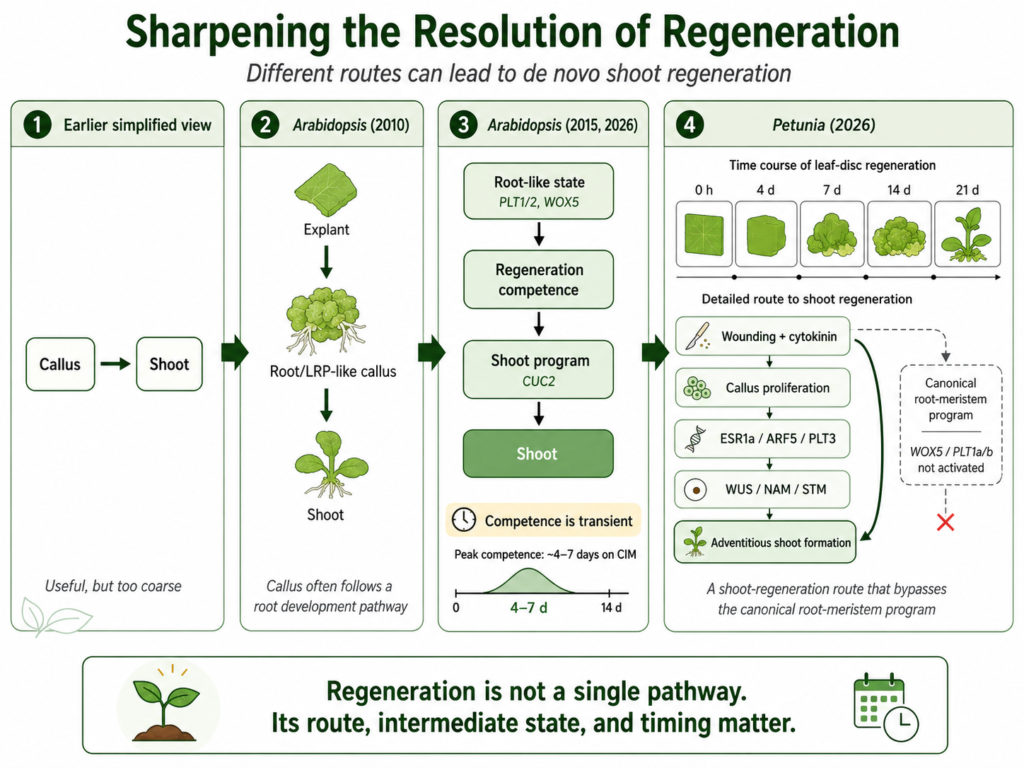
Petunia PhPLT3-family genes were induced during regeneration. But the canonical downstream root-meristem markers behaved very differently: PhWOX5 and PhPLT1b were essentially not induced, while PhPLT1a remained very low. SHR, several LBD genes and WOX11/12 also failed to produce a coherent canonical lateral-root-primordium signature.
Could this simply mean that petunia cannot activate those genes? The authors tested that possibility by culturing the same type of leaf discs on NAA. Under the auxin treatment, PhWOX5 became detectable by day 2 and PhPLT1a/b by day 4. Petunia therefore retains the ability to activate the root-meristem program; it simply does not appear to use that program strongly under the cytokinin-driven shoot-regeneration condition.
Meanwhile, the shoot side of the network clearly activated. PhESR1a and PhWUS rose strongly by day 4, and by day 7 PhSTM and NAM/CUC-related shoot-apical-meristem genes were also induced.
Conceptually, the canonical Arabidopsis CIM→SIM route can be summarized as
tissue → auxin → root/LRP-like program → regeneration competence → cytokinin → shoot meristem → shoot.
The petunia system examined here instead looks more like
leaf disc + wounding + cytokinin → cell proliferation/callus → shoot-meristem program → shoot.
At minimum, the molecular-marker trajectory is different.
This still does not prove that the root program is completely unnecessary
The strongest interpretation should remain cautious.
The RNA-seq was bulk RNA-seq from pooled leaf-disc tissue. If a very small subset of regeneration-initiating cells transiently expressed WOX5 or PLT1/2, that signal could have been diluted below detection in the whole-tissue sample.
The study also did not use lineage tracing to demonstrate directly that an individual shoot-forming cell never entered a root-meristem-like state.
For that reason, the safest conclusion is not “the root program is absent,” but rather that shoot regeneration proceeded without a clearly detectable canonical root-meristem signature.
Single-cell RNA-seq, spatial transcriptomics, WOX5/PLT1/2 reporters and lineage tracing would make the bypass model substantially stronger.
The authors also acknowledge another limitation: the time-series RNA-seq did not include a time-matched hormone-free control. Cytokinin-specific effects therefore cannot be completely separated from generic responses to wounding and culture time.
It is also too early to conclude that Arabidopsis and petunia are fundamentally different species
There is another confounding factor in the comparison.
Much of the Arabidopsis model was established using an auxin-rich CIM → cytokinin-rich SIM two-step protocol. The petunia study instead used a cytokinin-supplemented one-step system. Plant species and culture protocol therefore change at the same time.
So the present data do not justify a simple species-level rule such as “Arabidopsis uses a root route, petunia does not.”
Indeed, Arabidopsis itself can regenerate shoots in systems that bypass a conventional CIM pretreatment, and torenia has been shown to generate shoot apical meristems directly from mature stem epidermal cells under cytokinin treatment without first forming a large callus mass.
The more accurate reading of the petunia paper is therefore not that petunia “breaks a universal Arabidopsis rule,” but that a powerful Arabidopsis model should not automatically be treated as a universal rule for all plant regeneration systems.
Breaking the word “regeneration” into smaller steps
Placed in sequence, these studies show how the resolution of regeneration research has increased.
At first the picture was simply callus → shoot.
Then it became clear that callus can carry a root-like developmental program rather than representing a completely blank state.
Next, the root stem-cell program was linked to acquisition of regenerative competence.
Then competence itself turned out to be transient and time-dependent, rather than a permanent property of callus.
And now petunia provides evidence that a shoot can be reached without a clearly detectable canonical root-meristem intermediate.
Regeneration is therefore not well described as a binary outcome—regenerates or does not regenerate. We need to ask which cells initiate the process, what triggers reprogramming, which intermediate state is used, when competence is gained, how long it is retained, and which route ultimately establishes the shoot meristem.
This higher-resolution view may matter in biotechnology as well
This is not only a question of basic developmental biology.
In plant transformation and genome editing, we frequently encounter species or genotypes described simply as “difficult to regenerate.” But that label does not tell us where the process fails.
Does callus fail to form? Do cells proliferate but fail to acquire regenerative competence? Is competence acquired and then lost during prolonged culture? Do shoot progenitors form but fail to establish a functional shoot apical meristem?
A further question now becomes plausible: is forcing a plant through an Arabidopsis-like root-associated route even the best route for that material?
The petunia result suggests that improving regeneration may not always reduce to finding one universal “regeneration gene.” Different species, explants and hormone regimes may make use of different developmental routes.
Instead of measuring only the final regeneration percentage, it may be more informative to resolve the intermediate states one by one. That should make the questions “why does this material fail to regenerate?” and “how can regeneration be improved?” much more precise.
Sharpening the resolution of regeneration
The earlier Arabidopsis work was not wrong. Quite the opposite.
The 2010 study replaced the vague idea of an undifferentiated callus with a specific root-development-associated state. Subsequent work resolved that state further into PLT/WOX networks, stem-cell activity and a time-dependent window of pluripotency.
Studies in other plants and alternative culture systems are now revealing the next layer: even that route may not be the only route.
Scientific progress has not erased the earlier model. It has clarified where the model applies and made it possible to classify regeneration more finely.
That is what makes the new petunia paper particularly interesting. The question is no longer simply whether “a shoot comes out of callus.” The field is increasingly asking which developmental path a cell followed on the way there.
References
- Sugimoto K, Jiao Y, Meyerowitz EM. Arabidopsis regeneration from multiple tissues occurs via a root development pathway. Developmental Cell 18, 463–471 (2010). DOI: https://doi.org/10.1016/j.devcel.2010.02.004
- Kareem A, et al. PLETHORA Genes Control Regeneration by a Two-Step Mechanism. Current Biology 25, 1017–1030 (2015). DOI: https://doi.org/10.1016/j.cub.2015.02.022
- Bae SH, et al. Stem cell activity is linked to a transient acquisition of pluripotency during callus proliferation. Nature Communications 17, 6585 (2026). DOI: https://doi.org/10.1038/s41467-026-73124-x
- Zhang X, Yue Y, Cai L, Guo Y. Cytokinin-supplemented medium drives de novo shoot regeneration in petunia (Petunia hybrida) by bypassing the root-meristem program. Frontiers in Plant Science 17:1918195 (2026). DOI: https://doi.org/10.3389/fpls.2026.1918195


Comments